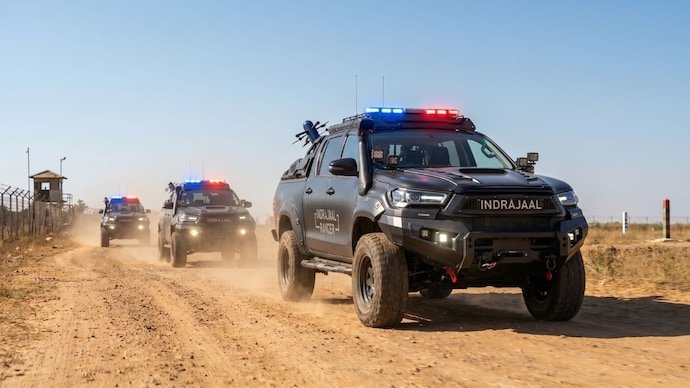
India is set to strengthen its response to growing drone threats with the deployment of mobile anti-drone systems designed to protect borders as well as urban areas.
Government agencies have placed orders worth around Rs 155 crore for the Indrajaal Ranger, according to reports. The procurement includes an estimated Rs 145 crore order for border-security deployment and another Rs 10 crore order for urban police use.
The move represents a shift from conventional Counter-Unmanned Aircraft Systems (Counter-UAS), which are generally designed to protect fixed military and strategic installations. The Ranger has instead been designed to detect, track, identify and counter unauthorised drones while moving.
The Technology is aimed at addressing the increasing use of unmanned aircraft for surveillance, reconnaissance and the cross-border movement of weapons and narcotics.
Mobile anti-drone system designed for moving threats
Traditional counter-drone systems are often positioned around specific locations that need permanent protection. The Indrajaal Ranger takes a different approach by putting the counter-drone capability on a mobile platform.
This could allow security agencies to reposition the system depending on where a potential drone threat emerges.
Along India’s borders, the system could be used to monitor areas where drones may cross into the country and potentially deliver weapons or narcotics.
In cities, the platform can be deployed around VVIP routes, airports, major public gatherings and critical Infrastructure.
The ability to move the system could allow security agencies to adjust protected airspace based on operational requirements rather than relying solely on permanent installations.
Indrajaal Ranger combines detection and countermeasures
Indrajaal Autonomous Defense Systems describes the Ranger as an ARDTC-approved anti-drone patrol vehicle.
According to the company, the system is designed to retain its counter-drone capabilities even while travelling at high speeds. The company has also said the platform underwent government evaluations and was selected by the Ministry of Home Affairs.
The Ranger is powered by the company’s SkyOS platform, which combines sensors, Artificial Intelligence, sensor fusion and command-and-control capabilities.
These technologies are integrated with multiple methods for dealing with unauthorised or hostile drones.
Rather than depending on a single countermeasure, the platform uses a layered approach intended to respond to different types of drone threats.
How the three-layer anti-drone system works
The Indrajaal Ranger uses three named layers for countering drone threats: Retractor, Lakshman Rekha and Net Interceptor.
1. Retractor
The first layer, known as Retractor, is designed to electronically take control of a rogue drone.
If successful, security personnel can recover the drone rather than simply destroying it. This can potentially allow authorities to preserve the aircraft for further examination and forensic analysis.
The ability to recover a drone could be particularly relevant when security agencies want to determine where it came from, how it was operated or what equipment it was carrying.
2. Lakshman Rekha
The second layer, called Lakshman Rekha, creates a virtual boundary around protected airspace.
The system is intended to prevent unauthorised drones from entering the designated area.
This layer provides a form of electronic protection around locations where drone access is restricted, allowing security agencies to establish protected zones based on operational requirements.
3. Net Interceptor
The third layer is the Net Interceptor.
It is designed to physically intercept and capture a hostile drone when electronic countermeasures are not sufficient.
This provides the system with a physical interception option when a drone cannot be neutralised or controlled through electronic means.
Together, the three layers are intended to provide different responses depending on the nature of the drone threat.
Why mobile counter-drone technology matters
The growing availability of relatively inexpensive drones has changed the security challenge facing governments.
Unmanned systems can potentially be used for surveillance, reconnaissance and the delivery of prohibited materials. Unlike conventional aircraft, small drones can also operate at low altitudes and may be difficult to detect using systems designed primarily for larger aerial threats.
For border forces, this creates a challenge because potential drone incursions can occur across large stretches of territory.
A mobile counter-drone platform could allow security agencies to move protection to areas where the risk is considered higher.
In cities, the same capability could be deployed temporarily during major events or moved to different sensitive locations.
Counter-drone security expands beyond military bases
Kiran Raju Penumacha, founder and CEO of Indrajaal Autonomous Defense Systems, said the experience of Drone Warfare in Ukraine had demonstrated the importance of unmanned systems on the battlefield.
However, he argued that the security challenge now extends beyond conventional military operations.
According to Penumacha, borders, airports, cities, public events, critical infrastructure and VVIP movements all require protection from low-altitude aerial threats.
He said counter-UAS technology therefore needs to become part of everyday National Security infrastructure rather than being restricted to traditional military installations.
Penumacha also said the Ranger was designed to allow security forces to deploy autonomous counter-drone capabilities wherever a threat emerges.
India focuses on indigenous counter-drone technology
The procurement also highlights the growing role of India’s domestic Defence Manufacturing sector in developing counter-drone technologies.
The Ranger combines artificial intelligence, sensor fusion and multiple countermeasures in a mobile platform, according to the company.
Sunil Kalidindi, CEO of Sigma Advanced Systems, said the programme demonstrated the ability of India’s defence industry to develop and deliver indigenous technology at operational scale.
He said Sigma’s partnership with Indrajaal would contribute to strengthening border and urban security through next-generation counter-drone capabilities.
The comments reflect a broader push to develop domestic solutions for emerging security requirements rather than relying entirely on imported systems.
Rs 155 crore orders signal expanding demand
The reported Rs 155 crore procurement provides an indication of the increasing demand for mobile counter-drone systems in India.
The larger Rs 145 crore order is intended for border-security deployment, while a separate Rs 10 crore order is for urban police applications.
The difference in procurement size reflects the potentially larger requirements associated with securing India’s extensive border areas, where drones could be used for surveillance or smuggling.
Urban deployments, meanwhile, could focus on specific sensitive locations and events where temporary or mobile protection is required.
From border surveillance to VVIP protection
One of the notable aspects of the Ranger is the range of environments in which it can potentially be deployed.
At the border, the system can provide a mobile response to suspected drone incursions.
In cities, it can be positioned around airports, public gatherings and critical infrastructure. It can also support security arrangements around VVIP movements.
This flexibility is particularly relevant because the nature of the threat can change quickly. A system that can move with security teams can potentially provide protection across multiple locations rather than being permanently tied to one installation.
Growing global concern over drone threats
The deployment comes amid increasing international concern about the security risks created by unmanned systems.
Drones are increasingly being used not only in military conflicts but also for surveillance and other security-sensitive activities. Their relatively low cost and mobility can make them attractive to both legitimate users and hostile actors.
For governments, this means protecting airspace is no longer limited to monitoring conventional aircraft.
Borders, airports, cities, public events and critical infrastructure can all potentially become targets for unauthorised drone activity.
India’s decision to expand mobile counter-drone capabilities therefore reflects a broader evolution in how authorities approach low-altitude airspace security.
What the Ranger deployment means for India’s security
The reported orders for the Indrajaal Ranger indicate that India’s counter-drone strategy is moving beyond the protection of fixed military and strategic sites.
By combining mobility with detection, tracking, identification and multiple countermeasures, the platform is designed to provide security agencies with a more flexible way of responding to drone threats.
The Rs 155 crore procurement, spanning both Border Security and urban policing, also suggests that counter-UAS technology is becoming relevant across a wider range of security operations.
As drones become more common and their applications expand, the ability to detect and counter unauthorised systems quickly could become an increasingly important part of India’s border and urban security infrastructure.
For breaking news and live news updates, like us on Facebook or follow us on Twitter and Instagram. Read more on Latest India on thefoxdaily.com.






COMMENTS 0