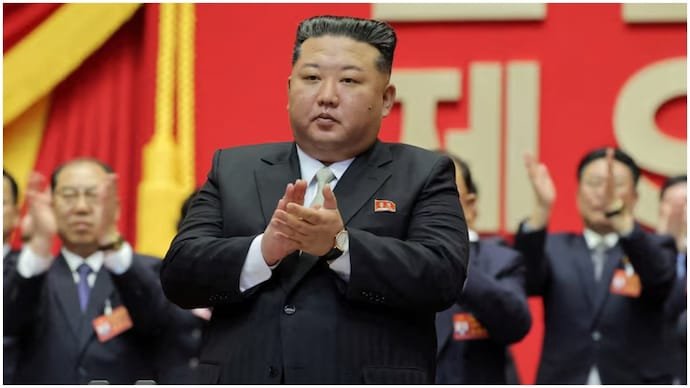
Tensions on the Korean Peninsula have entered another volatile phase after North Korean leader Kim Jong Un personally oversaw a series of advanced weapons tests and called for a stronger offensive military posture, prompting South Korea to announce one of the biggest expansions of its Drone Warfare programme in recent years.
The developments underscore how both Koreas are increasingly preparing for future conflicts through technological innovation rather than diplomatic engagement. While Pyongyang continues to expand its missile and nuclear capabilities, Seoul is investing heavily in unmanned systems, Artificial Intelligence and low-cost precision strike platforms that have transformed modern battlefields from Ukraine to the Middle East.
KIM SUPERVISES NEW GENERATION OF WEAPONS TESTS
According to North Korea‘s state-run Korean Central News Agency (KCNA), Kim Jong Un supervised multiple weapons tests on Thursday aimed at evaluating the combat effectiveness of several upgraded systems.
The tests reportedly included a tactical ballistic missile equipped with what Pyongyang described as a “special mission” warhead, an improved multiple-launch rocket system, and an extended-range self-propelled artillery platform capable of delivering precision strikes over greater distances.
North Korean officials portrayed the exercise as another step in modernising the country’s conventional military capabilities alongside its expanding nuclear arsenal.
KCNA claimed the tests demonstrated technological advances designed to strengthen North Korea’s firepower along the southern border, suggesting the weapons are intended to target military installations across South Korea, including facilities hosting US forces.
KIM CALLS FOR STRONGER OFFENSIVE DETERRENCE
Following the demonstrations, Kim urged the military to reinforce what he described as a “deadly and destructive offensive posture” capable of discouraging any adversary from considering military action against North Korea.
State media quoted Kim as saying that creating continuous uncertainty and fear among potential enemies remains a crucial component of effective deterrence.
North Korean officials also claimed the newly tested warhead was specifically designed to inflict significant damage on strategic infrastructure, including military airfields, naval ports, logistics hubs and power generation facilities.
While such statements are consistent with Pyongyang’s long-standing military messaging, analysts note that they also serve an important domestic purpose by reinforcing the leadership’s narrative of military strength and technological progress.
SOUTH KOREA RESPONDS WITH MAJOR DRONE STRATEGY
Only hours after details of North Korea’s latest weapons tests emerged, South Korea announced an ambitious expansion of its drone warfare capabilities, signalling that Seoul increasingly views unmanned technology as central to future national defence.
The Defence Ministry unveiled plans to acquire more than 20,000 reconnaissance and attack drones while accelerating development of long-range loitering munitions capable of striking high-value targets with precision.
Unlike conventional missiles, loitering munitions can remain airborne for extended periods before identifying and engaging targets, making them highly effective against mobile military assets.
South Korea also intends to integrate drone operations across every branch of its armed forces, including the Army, Navy, Air Force and Marine Corps.
500,000 “DRONE WARRIORS” TO BE TRAINED
Perhaps the most striking element of Seoul’s strategy is its plan to train virtually its entire active-duty military force—around 500,000 personnel—to operate drones as part of everyday combat operations.
Defence Minister Ahn Gyu-back said future soldiers must be able to use drones with the same level of familiarity as conventional firearms.
The initiative reflects how recent conflicts have transformed military thinking worldwide. Low-cost drones have proven capable of destroying expensive tanks, artillery systems, radar installations and command posts, dramatically changing battlefield economics.
Military planners increasingly believe that future wars will depend not only on advanced fighter aircraft and missiles but also on thousands of networked unmanned systems operating simultaneously.
RUSSIA-UKRAINE WAR RESHAPES MILITARY THINKING
South Korean officials acknowledged that lessons from the war in Ukraine have significantly influenced their latest defence strategy.
Cheap reconnaissance drones, first-person-view (FPV) attack drones and loitering munitions have become some of the conflict’s most influential weapons, demonstrating how relatively inexpensive platforms can neutralise far more costly military equipment.
Seoul also expressed concern that North Korea may be acquiring valuable Military Technology through its growing cooperation with Russia.
Western intelligence assessments have repeatedly suggested that military cooperation between Moscow and Pyongyang has expanded since the outbreak of the Ukraine conflict, raising concerns that North Korea could benefit from Russian expertise in missile guidance, satellite technology and drone systems.
THE DIPLOMATIC STALEMATE CONTINUES
The renewed military activity comes as diplomatic engagement between North Korea, South Korea and the United States remains effectively frozen.
Negotiations that began during former US President Donald Trump‘s first administration collapsed in 2019 after both sides failed to bridge differences over Sanctions relief and nuclear disarmament.
Since then, Kim Jong Un has accelerated development of both nuclear and conventional weapons while rejecting proposals that require denuclearisation as a precondition for renewed negotiations.
Pyongyang has also hardened its position towards Seoul, officially describing South Korea as its “principal enemy” and expanding military infrastructure along the heavily fortified Demilitarised Zone (DMZ).
NORTH KOREA CONTINUES MODERNISING ITS MILITARY
The latest missile demonstrations form part of a much broader military modernisation programme.
Earlier this week, North Korea commissioned the 5,000-ton destroyer Choe Hyon, which Kim described as evidence of the country’s expanding naval capabilities.
Over the past several years, Pyongyang has also unveiled new intercontinental ballistic missiles, submarine-launched ballistic missiles, reconnaissance satellites, underwater nuclear weapons and increasingly sophisticated cruise missile systems.
Military analysts believe North Korea is pursuing a strategy that combines nuclear deterrence with improved conventional precision-strike capabilities, making its armed forces more flexible across different conflict scenarios.
ARMS RACE ENTERS A NEW PHASE
The latest announcements from both Koreas illustrate how the regional security competition is increasingly shifting beyond traditional missile development toward emerging technologies such as drones, artificial intelligence, electronic warfare and autonomous weapons.
Rather than relying solely on conventional military hardware, both countries are investing in capabilities designed to dominate future battlefields through speed, precision and real-time battlefield intelligence.
With Diplomacy showing little sign of revival and military cooperation among regional powers continuing to evolve, defence analysts expect both Pyongyang and Seoul to further accelerate investments in advanced weapon systems over the coming years.
For now, Kim Jong Un’s latest weapons demonstrations and South Korea’s sweeping drone expansion serve as fresh reminders that the Korean Peninsula remains one of the world’s most heavily militarised flashpoints, where technological competition is becoming just as significant as traditional military strength.
For breaking news and live news updates, like us on Facebook or follow us on Twitter and Instagram. Read more on Latest World on thefoxdaily.com.





COMMENTS 0