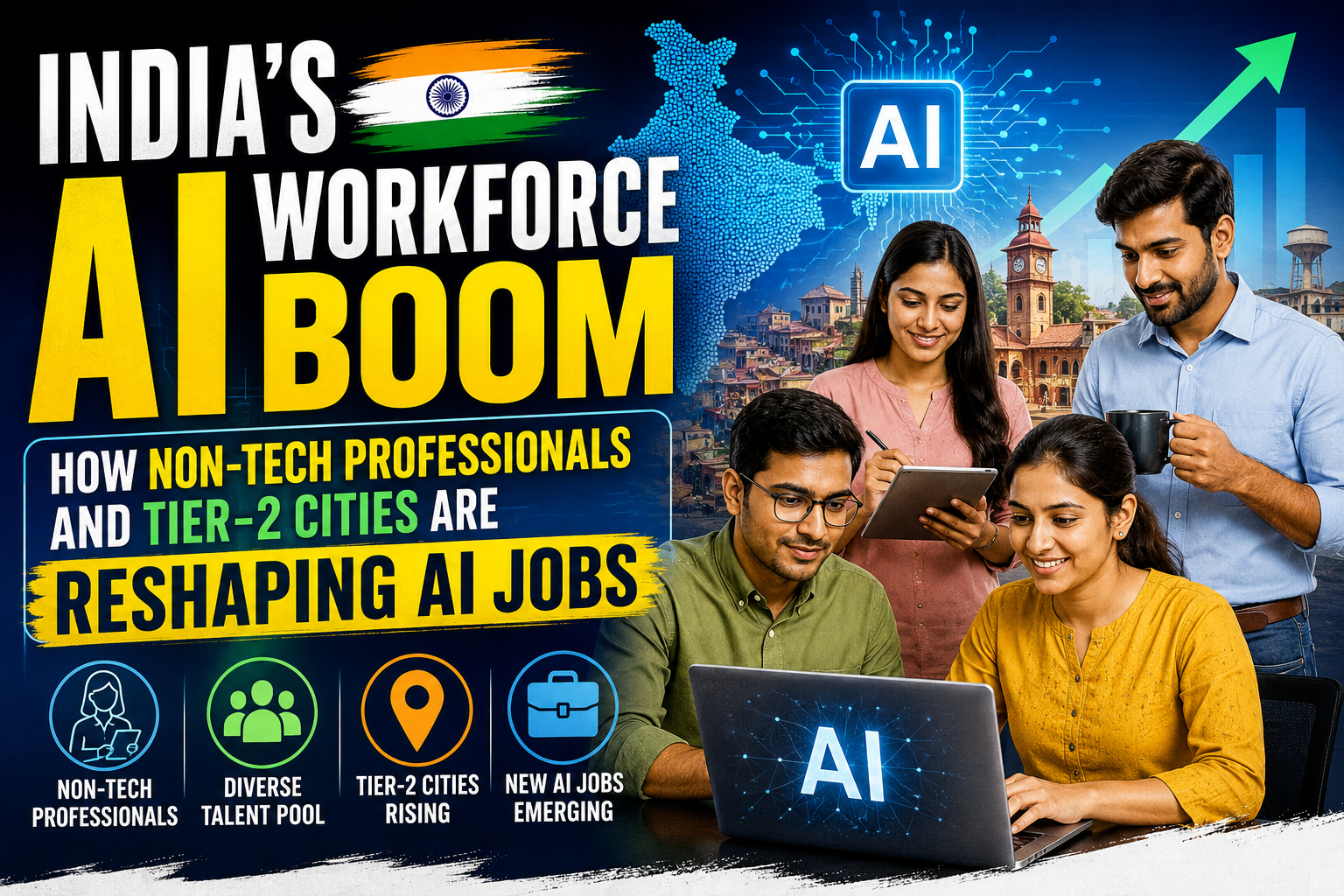
Artificial Intelligence is no longer the exclusive domain of software engineers and data scientists. Across India, professionals from marketing, finance, human resources, consulting, operations, and academia are rapidly adopting AI skills to stay relevant in an evolving job market.
The latest India AI Workforce Report 2026 by Scaler highlights a fundamental transformation in India’s employment landscape. Based on insights from 11,444 professionals, the report reveals that AI has evolved from a specialised technical capability into a core workplace skill influencing salaries, career progression, and hiring trends across industries.
The findings underscore a broader reality: India’s AI revolution is becoming more inclusive, geographically diverse, and accessible to professionals regardless of their educational background.
India’s AI Ecosystem Is Expanding Beyond Engineering
For years, artificial intelligence was associated primarily with software developers, machine learning engineers, and data scientists. That perception is changing rapidly.
According to the report, nearly 25% of AI learners now come from non-technical backgrounds, signalling a significant expansion of AI adoption across business functions.
More than half of AI-enabled career outcomes are now emerging outside traditional software development roles.
Professionals are increasingly using AI tools to improve decision-making, automate repetitive tasks, enhance productivity, and generate data-driven insights.
Key sectors witnessing strong AI adoption include:
- Marketing and customer experience
- Human resources and talent acquisition
- Finance and risk management
- Operations and supply chain management
- Consulting and business strategy
- Education and academic research
This shift reflects a growing understanding among employers that AI literacy is becoming as essential as digital literacy was a decade ago.
Why Non-Technical Professionals Are Learning AI
The growing interest in AI among non-engineers is driven by one simple factor: career advancement.
Generative AI tools and automation platforms are transforming workplace expectations. Employees who understand how to leverage AI can streamline workflows, reduce manual tasks, and deliver better business outcomes.
Unlike earlier technological shifts that required extensive coding knowledge, modern AI tools are increasingly user-friendly.
Professionals can now use AI for tasks such as:
- Data analysis and reporting
- Content creation and communication
- Customer support automation
- Workflow optimisation
- Predictive analytics
- Research and market intelligence
As organisations integrate AI into everyday operations, employees who lack AI skills risk falling behind in a highly competitive job market.
Tier-2 Cities Are Emerging as India’s New AI Talent Hubs
One of the most significant insights from the report is the rapid rise of AI learners from Tier-2 cities.
Nearly one in five AI learners now comes from smaller urban centres, including Lucknow, Jaipur, Patna, Indore, Coimbatore, and Nagpur.
This trend signals a major decentralisation of India’s technology workforce.
Historically, AI opportunities were concentrated in metropolitan hubs such as Bengaluru, Hyderabad, Mumbai, and Pune. However, improved internet access, remote work opportunities, and online learning platforms have created new pathways for professionals outside major cities.
The democratisation of AI education is helping bridge the gap between urban and emerging markets.
For employers, this expanded talent pool offers access to skilled professionals beyond traditional hiring locations.
Bengaluru Maintains Its Position as India’s AI Capital
Despite the growth of Tier-2 cities, Bengaluru remains India’s undisputed AI hub.
According to the report, the city accounts for 19% of all AI learners in the country.
Several factors continue to strengthen Bengaluru’s leadership position:
- A mature startup ecosystem
- Strong presence of global technology companies
- Access to venture capital
- Leading educational institutions
- A highly skilled technology workforce
Pune, Hyderabad, Mumbai, and Chennai follow closely as major centres for AI learning and career opportunities.
However, the growing participation from smaller cities suggests that India’s future AI workforce will be more geographically distributed than ever before.
Women Are Increasingly Driving AI Adoption
The report also highlights encouraging progress in gender diversity within AI-enabled careers.
Women are increasingly transitioning into AI-focused roles across industries such as marketing, human resources, education, and operations.
Among female professionals who moved into AI-related careers, the average salary increase reached 145%.
Women working in quality assurance roles recorded the highest gains, with salary growth reaching an impressive 574% after transitioning into AI-enabled positions.
These findings indicate that AI could play an important role in narrowing gender gaps across technology and business sectors.
AI Upskilling Is Delivering Significant Salary Growth
The financial benefits of AI education are becoming increasingly clear.
Professionals who pursued AI upskilling reported an average salary increase of 147%, while early-career professionals experienced salary growth of 155%.
The impact was visible across career stages.
| Professional Segment | Average Salary Growth After AI Upskilling |
|---|---|
| Early-career professionals | 155% |
| All professionals | 147% |
| Women professionals | 145% |
| Women in quality assurance roles | 574% |
Senior professionals, including vice presidents, engineering leaders, and chief executives, reported average post-upskilling salaries of approximately Rs 33 lakh per annum.
The data suggests that AI expertise is becoming a critical factor in salary negotiations and career advancement.
New Career Paths Are Emerging in the AI Economy
Software engineering remains the most common AI-related career outcome, accounting for 34.77% of transitions.
However, new opportunities are rapidly emerging beyond coding roles.
Consulting positions linked to AI nearly doubled, rising from 3.1% of entry-level outcomes to 5.65% of overall professional outcomes.
Engineering leadership roles accounted for 17.51% of AI-enabled career transitions.
Increasingly, organisations are seeking professionals who can combine domain expertise with AI capabilities.
The future workforce will likely reward individuals who understand both business challenges and AI-driven solutions.
Why AI Literacy Will Matter More Than Ever
The report reinforces a broader trend shaping the global economy: AI is becoming a foundational workplace skill rather than a niche technical expertise.
Just as spreadsheet software, cloud computing, and digital collaboration tools became essential over the past two decades, AI proficiency is quickly moving into the mainstream.
Companies are not necessarily replacing employees with AI. Instead, they are prioritising professionals who can effectively work alongside AI systems.
The competitive advantage increasingly belongs to workers who can ask better questions, interpret AI-generated insights, and apply them strategically.
Conclusion
India’s AI transformation is entering a new phase—one defined by accessibility, inclusion, and widespread adoption.
The rise of non-technical learners, the rapid growth of Tier-2 cities, and increasing participation among women indicate that AI opportunities are no longer limited to traditional technology hubs or engineering backgrounds.
As organisations continue integrating AI into everyday workflows, upskilling is shifting from an optional career move to a strategic necessity.
The message from the India AI Workforce Report 2026 is clear: the future of work in India will belong to professionals who can combine human expertise with artificial intelligence.
Whether they come from Bengaluru or Patna, software engineering or marketing, the next generation of AI talent is already reshaping India’s workforce.
For breaking news and live news updates, like us on Facebook or follow us on Twitter and Instagram. Read more on Latest Careers on thefoxdaily.com.






COMMENTS 0