- What Does “75% AI-Generated Code” Actually Mean?
- The Rise of AI Agents in Software Development
- Real-World Impact: Faster Development, Smaller Teams?
- What Engineers Do Now: The New Job Description
- The Infrastructure Behind the AI Boom
- The Debate: Productivity Revolution or Job Disruption?
- Comparison: Traditional Coding vs AI-Assisted Development
- The Hidden Risk: Over-Reliance on AI
- The Bigger Picture: A Shift Across the Tech Industry
- The Missing Insight: Coding Is Becoming a Language of Intent
- Future Outlook: What Comes Next?
- Conclusion: Not the End of Engineers, But the Beginning of a New Era
Introduction: The New Reality of Coding in the AI Era
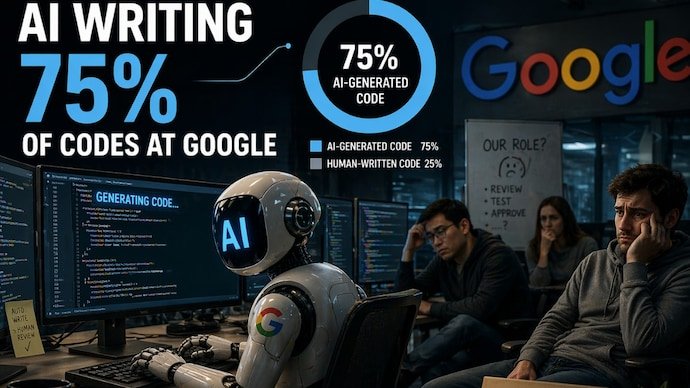
The world of Software Development is undergoing one of its most dramatic transformations yet. At Google, a company long known for engineering excellence, a striking shift is now official: around 75% of new code is generated by Artificial Intelligence, with human engineers guiding and approving the output.
This isn’t just a productivity upgrade it’s a fundamental redefinition of what it means to be a software engineer.
What used to involve hours of manual coding, debugging, and iteration is now increasingly handled by AI systems working behind the scenes. Engineers are still central to the process, but their responsibilities are rapidly evolving.
So what does this shift really mean? Is AI replacing developers or elevating them into entirely new roles?
What Does “75% AI-Generated Code” Actually Mean?
At first glance, the number sounds startling. But it doesn’t mean humans are no longer needed. Instead, it reflects a new workflow:
- AI systems generate large portions of code based on prompts or tasks
- Engineers review, refine, and approve that code
- Humans remain responsible for correctness, security, and design decisions
In essence, coding is shifting from writing every line to orchestrating intelligent systems.
This is similar to how calculators didn’t eliminate mathematicians but changed how they work.
The Rise of AI Agents in Software Development
One of the biggest changes inside Google is the use of AI agents autonomous systems capable of executing complex development tasks.
Instead of assigning tasks to human team members, engineers now:
- Delegate specific objectives to AI agents
- Run multiple agents in parallel
- Monitor progress and intervene when necessary
This multi-agent workflow allows projects to move at unprecedented speed.
Think of it as managing a team of tireless junior developers except they work 24/7 and scale instantly.
Real-World Impact: Faster Development, Smaller Teams?
The benefits are already visible:
- Massive speed gains: Complex projects are being completed up to six times faster
- Rapid prototyping: Applications can go from idea to working model in days
- Parallel execution: Multiple parts of a system can be built simultaneously
For example, internal tools enabled the creation of a macOS application prototype in just a few days something that would traditionally take weeks.
But this efficiency raises an uncomfortable question:
If AI can do most of the coding, how many engineers are actually needed?
What Engineers Do Now: The New Job Description
The role of a software engineer is not disappearing but it is being redefined.
From Coders to Orchestrators
Instead of focusing on syntax and implementation, engineers now spend more time on:
- Designing system architecture
- Defining problem statements for AI
- Evaluating outputs for accuracy and reliability
From Builders to Reviewers
Code review is becoming even more critical:
- Ensuring AI-generated code meets standards
- Identifying subtle bugs or inefficiencies
- Maintaining security and compliance
From Execution to Strategy
Engineers are increasingly involved in higher-level thinking:
- Deciding what should be built
- Prioritizing features
- Balancing speed with quality
In short, the job is shifting from doing the work to directing the work.
The Infrastructure Behind the AI Boom
This transformation is powered by Google’s massive technological ecosystem.
Key enablers include:
- Advanced AI models: Systems capable of understanding and generating complex code
- High-performance infrastructure: Tools like Bigtable and custom chips (TPUs)
- Integrated development environments: AI tools embedded directly into workflows
These components allow AI to operate at scale handling millions of lines of code efficiently.
The Debate: Productivity Revolution or Job Disruption?
Not everyone sees this shift as purely positive.
There is growing concern about the long-term impact on Jobs.
Optimistic View
- Engineers become more productive and creative
- Barrier to entry for coding decreases
- Innovation accelerates across industries
Pessimistic View
- Fewer engineers may be needed
- Entry-level roles could decline
- Skills gap may widen between junior and senior developers
Some experts warn that AI could eventually handle not just coding, but also decision-making tasks further reducing the need for large teams.
Comparison: Traditional Coding vs AI-Assisted Development
| Aspect | Traditional Development | AI-Assisted Development |
|---|---|---|
| Code Creation | Manual | Mostly AI-generated |
| Speed | Moderate | Very high |
| Team Size | Larger | Potentially smaller |
| Engineer Role | Builder | Supervisor/Architect |
| Error Handling | Human debugging | Human + AI review |
The Hidden Risk: Over-Reliance on AI
While AI brings speed, it also introduces new risks.
Some key concerns include:
- Black-box behavior: AI-generated code may not always be fully understood
- Hidden bugs: Errors can scale quickly if not caught early
- Security vulnerabilities: Automated code may introduce exploitable flaws
This makes human oversight more important not less.
Ironically, the more powerful AI becomes, the more critical human judgment is.
The Bigger Picture: A Shift Across the Tech Industry
Google is not alone in this transformation.
Across the tech industry:
- Companies are integrating AI into development pipelines
- Startups are building products with minimal engineering teams
- Automation is expanding beyond coding into design, testing, and operations
This signals a broader shift toward AI-first development models.
The Missing Insight: Coding Is Becoming a Language of Intent
One crucial insight often overlooked is this:
Coding is no longer about writing instructions it’s about expressing intent.
Instead of telling machines how to do something step by step, engineers now tell them what they want and AI figures out the rest.
This changes the core skill set required:
- Clear thinking becomes more important than syntax knowledge
- Problem framing becomes a key competitive advantage
- Communication skills gain new importance in technical roles
In a way, software engineering is becoming closer to product design and systems thinking.
Future Outlook: What Comes Next?
The trajectory is clear AI will continue to play a larger role in software development.
Possible future scenarios include:
- AI generating nearly all routine code
- Engineers focusing almost entirely on high-level design
- New roles emerging (AI supervisors, prompt engineers, system auditors)
However, one thing is unlikely to change:
Human accountability.
No matter how advanced AI becomes, responsibility for software especially critical systems will remain with humans.
Conclusion: Not the End of Engineers, But the Beginning of a New Era
The fact that AI now generates 75% of code at Google is not the end of software engineering it’s the beginning of its next chapter.
This shift is redefining roles, accelerating innovation, and challenging long-held assumptions about work in the tech industry.
For engineers, the message is clear:
The future belongs not to those who write the most code but to those who understand it, guide it, and think beyond it.
In this new era, the most valuable skill may not be coding itself but knowing what should be coded in the first place.
For breaking news and live news updates, like us on Facebook or follow us on Twitter and Instagram. Read more on Latest Technology on thefoxdaily.com.






COMMENTS 0