ChatGPT users in India are beginning to receive notifications from OpenAI about a change that could significantly alter the way they use the AI chatbot: advertisements.
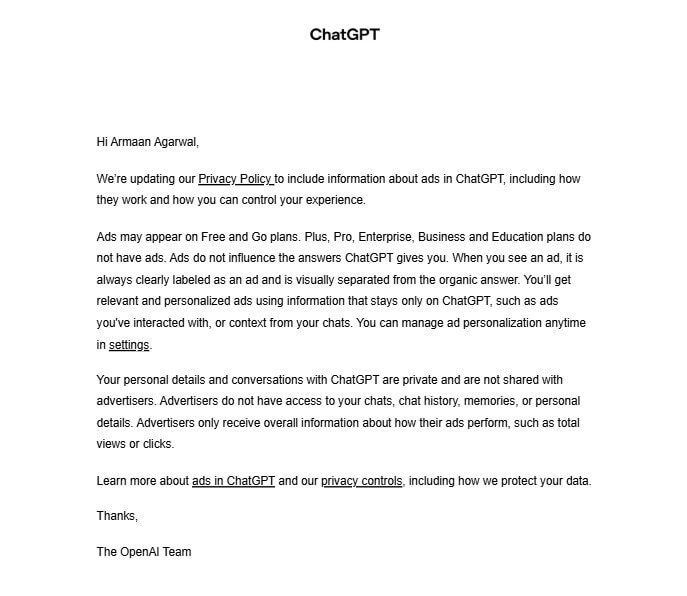
OpenAI has been testing advertising inside ChatGPT and expanding the program to additional markets. Now, some users in India have received an email explaining that the company’s privacy policy is being updated to include information about ads, how they work and how users can control their experience.
The email does not necessarily mean that every Indian user will immediately see advertisements. OpenAI has been rolling out the feature gradually, and availability depends on factors including the user’s plan and market.
Still, the communication is notable because India has become an important market for ChatGPT, particularly after OpenAI introduced its lower-cost ChatGPT Go subscription in the country. The potential arrival of advertising could give OpenAI another way to monetize users who rely on the free or more affordable versions of the service.
What OpenAI told ChatGPT users in India
The email sent to some users explains that OpenAI is updating its privacy policy to cover advertising inside ChatGPT.
The company says users may see advertisements on eligible ChatGPT plans as the advertising program expands. According to the information provided to users, ads can appear on the Free and Go plans, while Plus, Pro, Enterprise, Business and Education plans do not have ads.
This makes the change particularly relevant to people using ChatGPT without a premium subscription.
For many users, the Free version is their main way of accessing ChatGPT. ChatGPT Go sits between the Free and higher-priced subscription options, giving users additional access without requiring the cost of the Plus plan.
The introduction of ads therefore creates a new trade-off: users may be able to continue accessing ChatGPT at a lower or no subscription cost, while OpenAI earns revenue through advertising.
Will every ChatGPT user in India see ads?
Not necessarily.
The advertising program is being introduced gradually, and OpenAI has not indicated that advertisements will appear for every account at the same time.
The company has already tested advertising in the United States and expanded its program to other international markets. The rollout has included countries such as the United Kingdom, Mexico, Brazil, Japan and South Korea, while advertising has also been tested in markets including Australia, Canada and New Zealand.
The fact that Indian users are receiving privacy-related advertising notifications is therefore an important indication of a possible expansion, but it should not be treated as confirmation that advertisements are already active for every Indian ChatGPT account.
Users will ultimately be able to tell whether the feature has reached their account by checking their ChatGPT interface for clearly labelled sponsored placements.
Which ChatGPT plans are affected?
The biggest difference is between free and paid plans.
| ChatGPT plan | Advertising status |
|---|---|
| Free | Ads may appear |
| Go | Ads may appear |
| Plus | No ads |
| Pro | No ads |
| Business | No ads |
| Enterprise | No ads |
| Education | No ads |
For Indian users, the Free and Go tiers are therefore the most important parts of the advertising discussion.
OpenAI has increasingly positioned ChatGPT as a service with several levels of access. The free tier provides broad access with limits, Go offers more usage at a lower price than premium subscriptions, and higher plans provide additional capabilities and usage.
Advertising adds another layer to that structure by allowing OpenAI to generate revenue from users who do not pay for a premium subscription.
Why OpenAI is turning to advertising
Running a large AI chatbot is fundamentally different from operating a conventional website.
Every time a user asks ChatGPT a question, OpenAI’s computing infrastructure has to process the request and generate a response. Millions of users making repeated requests require substantial computing capacity.
As AI models become more capable, the cost of providing access to those models remains a major consideration for companies operating them.
Subscriptions are one way to recover those costs. Advertising offers another.
For OpenAI, the attraction is straightforward. A free service can reach a much larger audience than a subscription-only product, while advertisements can potentially generate revenue from users who never upgrade to a paid plan.
India is especially important in this model because a large population of internet users can potentially use AI services without necessarily becoming premium subscribers.
OpenAI has been testing ads before the India rollout
The move is not completely unexpected.
OpenAI has already been experimenting with advertisements inside ChatGPT in other markets. The company has described the advertising program as a way to support broader access to the chatbot while continuing to invest in the Technology and infrastructure behind it.
The initial advertising experiments have focused on eligible adult users and specific ChatGPT plans rather than placing advertisements throughout every version of the product.
This gradual approach allows OpenAI to observe how users respond to advertisements and refine the system before expanding it further.
India now appears to be part of that wider conversation, although the precise scale and timing of the rollout remain important details to watch.
OpenAI says ads will not influence ChatGPT answers
One of the most important questions surrounding ChatGPT advertising is whether advertisers could influence the answers users receive.
OpenAI says they cannot.
The company’s advertising model separates sponsored content from ChatGPT’s generated response. Advertisements are intended to be clearly identified as sponsored content and visually separated from the organic answer.
This distinction is particularly important for an AI chatbot because users often ask it to compare products, explain services or recommend options.
If a paid advertisement could influence the answer itself, users could have difficulty knowing whether a recommendation was based on the AI’s response system or commercial interests.
OpenAI’s stated approach is designed to prevent that conflict by keeping advertisements separate from the model’s answers.
Can advertisers see your ChatGPT conversations?
This is another major concern for users.
OpenAI says advertisers do not receive access to users’ chats, chat history, memories or personal details.
Instead, advertisers are provided with broader performance information about their campaigns, such as the number of views or clicks.
That means the appearance of an advertisement does not mean an advertiser is being given access to the conversation that preceded it.
However, advertising inside a conversational AI system still creates a more complicated privacy environment than traditional advertising because ChatGPT can have access to contextual information from a user’s interactions.
ChatGPT ads could still be personalized
OpenAI says advertisements may be personalized using information that remains within ChatGPT.
This can include interactions with advertisements and, depending on the user’s settings and the way the system operates, context from conversations.
This creates an important distinction for users.
Advertisers not receiving your chats does not necessarily mean that advertising is completely unrelated to your ChatGPT activity.
The system can potentially use information within ChatGPT to make advertising more relevant while keeping that information away from advertisers themselves.
For users who are uncomfortable with personalized advertising, the available advertising and privacy controls will therefore become increasingly important.
Why privacy matters more with AI advertising
Advertising on an AI chatbot raises different questions from advertising on a normal website.
People may use ChatGPT to discuss their Careers, finances, relationships, education, Health concerns, business ideas or personal projects. Those conversations can contain much more context than a typical search query or webpage visit.
That makes transparency particularly important.
Users need to know what information can be used for advertising, what advertisers can access and whether advertisements can influence the AI’s response.
OpenAI’s current approach attempts to separate those functions. Advertisers are not supposed to receive private conversations, while the advertisements themselves are supposed to remain separate from ChatGPT’s answers.
Whether users consider those protections sufficient will ultimately depend on how the advertising system works in practice and how clearly OpenAI communicates its controls.
Why India is an important market for OpenAI
The potential advertising expansion comes after OpenAI made several moves to strengthen its presence in India.
One of the most important was the introduction of ChatGPT Go, a lower-cost subscription option designed to provide more access than the free version.
That plan gives OpenAI an additional monetization layer between completely free users and customers paying for higher-tier subscriptions.
Advertising could complement that strategy.
A user who does not want to pay for Plus or Pro may continue using Free or Go while seeing sponsored content. At the same time, users who want an ad-free experience can remain on one of the higher subscription tiers.
From a business perspective, this creates multiple ways for OpenAI to earn revenue from the same large user base.
What the advertising change means for free users
For free users, the most visible change could simply be another element appearing around ChatGPT’s responses.
The advertisements are expected to be clearly separated from the chatbot’s answers rather than blended into the generated response.
That means the basic way users ask questions should not necessarily change.
The bigger change is economic. Free access to a powerful AI system becomes increasingly connected to an advertising-supported business model.
This is similar in principle to the way many major internet services provide free access while generating revenue from advertisements. The difference is that ChatGPT is an interactive AI assistant rather than a traditional search engine, social network or publishing platform.
Could ads change how people use ChatGPT?
There are several possible effects.
Some users may simply ignore sponsored placements. Others may become more interested in paid subscriptions if they prefer an ad-free experience.
Businesses may also see ChatGPT as a new advertising environment because users increasingly turn to AI systems when researching products and services.
That could make advertising inside conversational AI commercially valuable.
But OpenAI faces a more delicate challenge than conventional advertising platforms: maintaining user trust.
People expect an AI assistant to provide useful and reliable answers. If users begin to believe that commercial interests are influencing recommendations, confidence in the product could suffer even if the underlying AI model has not changed.
What Indian ChatGPT users should know
The immediate takeaway is that OpenAI is preparing users for advertising as the company expands its ad-supported ChatGPT model.
- Free and Go users are the groups most likely to encounter advertisements under OpenAI’s current model.
- Plus, Pro, Business, Enterprise and Education plans are not part of the ad-supported tiers.
- OpenAI says advertisements will be labelled as sponsored content.
- OpenAI says advertisers cannot access users’ chats, chat history, memories or personal details.
- OpenAI says ads do not influence the answers generated by ChatGPT.
- Advertising personalization can involve information that remains within ChatGPT, subject to the available settings and controls.
What happens next for ChatGPT ads in India?
The next important question is whether the emails being received by Indian users are followed by a full advertising rollout.
OpenAI’s international approach suggests that the company is likely to continue expanding the program gradually rather than switching advertising on for every account simultaneously.
The company will also have to balance two competing objectives: generating enough advertising revenue to support affordable access while ensuring that advertisements do not undermine the usefulness and credibility of ChatGPT.
For Indian users, the arrival of advertising could ultimately mean more choice rather than simply more commercials. Free and lower-cost access may remain widely available, while users who strongly prefer an ad-free experience can choose a higher subscription tier where available.
The bigger significance is that ChatGPT is moving beyond a simple free-versus-paid model. Advertising is becoming another part of OpenAI’s strategy for financing AI access.
For now, users who receive the new email should treat it primarily as notice of OpenAI’s changing advertising and privacy policies, rather than proof that every ChatGPT account in India has already entered the advertising program.
But the direction is clear: ads are becoming an increasingly important part of the ChatGPT business model, and India appears to be moving closer to that advertising-supported future.
For breaking news and live news updates, like us on Facebook or follow us on Twitter and Instagram. Read more on Latest Technology on thefoxdaily.com.






COMMENTS 0