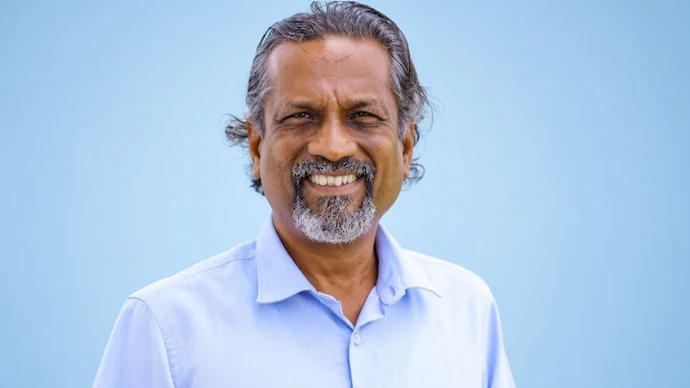
As Artificial Intelligence becomes increasingly capable of handling complex intellectual tasks, Zoho founder Sridhar Vembu believes society may need to rethink what gives human work its meaning. He has warned that mathematicians and programmers are beginning to experience the kind of disruption that earlier waves of mechanisation brought to farmers, weavers, carpenters and other traditional workers. In an AI-driven future, he suggests, people may find greater purpose in activities connected to nature, nurturing, culture and scripture.
Vembu shared his views on November 22, 2026, while responding to AI researcher Subbarao Kambhampati on X. The discussion focused on how technological progress affects Employment, professional identity and the sense of purpose people derive from their work. While much of the debate around AI centres on productivity and job losses, their exchange highlighted a less frequently discussed question: what happens when machines begin performing tasks that people have traditionally considered uniquely intellectual?
Vembu agreed with Kambhampati’s argument that intellectual workers are now confronting a form of disruption experienced by other sections of society during earlier technological transformations. He also offered examples from his own experience, describing how AI helped him optimise a complicated piece of software and enabled a non-technical colleague to produce a mechanical computer-aided design.
AI Is Bringing the Disruption of Mechanisation to Programmers and Mathematicians
Kambhampati, who has worked extensively on evaluating artificial intelligence capabilities, argued that the current anxiety surrounding AI is partly connected to the fact that intellectual professions are now facing technological displacement. Earlier industrial revolutions transformed the livelihoods of farmers, craftspeople and manual workers, but the intellectual class largely remained insulated from the same experience.
In his post, Kambhampati wrote that intellectual workers had never quite experienced the loss of purpose that many other groups faced when technology changed their occupations. He suggested that this difference helps explain the heightened concern expressed by professionals whose identities are closely connected to knowledge-based work.
Vembu agreed with the observation and compared the emerging impact of AI on programmers and mathematicians with the consequences of mechanisation for traditional occupations.
He argued that the changes experienced by farmers, weavers, carpenters and ironsmiths during previous waves of automation are now beginning to reach people working in mathematics and software development. The comparison reflects a broader shift: technology is no longer affecting only physical labour or repetitive administrative tasks. It is increasingly being used to perform activities that require reasoning, technical knowledge and problem-solving.
For decades, expertise in mathematics and programming provided a degree of protection against automation. Machines could perform calculations and execute instructions, but designing software, understanding complicated requirements and solving unfamiliar problems generally required substantial human involvement. More capable AI systems are now challenging some of those assumptions.
Vembu illustrated the change with an example from his own work. He said he had asked an AI system to optimise a complicated piece of code while he was travelling. According to him, a task that might have taken a highly capable programmer at least a month was completed in approximately an hour.
He described the work as technically demanding, explaining that the AI understood his high-level requirements, developed a detailed plan, implemented the changes and tested the resulting code against extensive test cases that it had generated itself. Vembu said the exercise cost approximately $4 in AI tokens.
The example is significant because it goes beyond asking an AI chatbot to generate a short function or explain a programming concept. Vembu was describing a workflow in which an AI system helped understand a requirement, plan a technical solution, modify software and carry out testing. Such capabilities could change how development teams divide work between engineers and automated tools.
However, his account represents an individual experience rather than proof that every complex programming assignment can now be completed in an hour. Software projects differ widely in their requirements, security risks, maintenance needs and consequences of failure. Human engineers remain important for defining objectives, reviewing results and ensuring that software works reliably in real-world environments.
AI Could Make Technical Work Accessible to People Without Specialist Training
Alongside the risks of automation, Vembu pointed to another possibility: AI could allow people to explore technical fields that previously required years of formal education or specialist experience.
He described how one of his non-technical colleagues used a personal AI account to create a detailed computer-aided design for a motor housing. The colleague had no engineering background but used AI alongside an inexpensive CAD application installed on his computer.
Vembu said he was particularly interested in the fact that the AI appeared to work with a recently released, low-cost CAD tool that he doubted had been part of its training data. He presented the example as evidence of how a curious person could use AI to enter an unfamiliar technical field and attempt work that might previously have seemed inaccessible.
The distinction is important. AI can potentially reduce the amount of specialist knowledge needed to begin a task, even when it does not eliminate the need for expertise. A person without formal engineering training may be able to describe a design requirement, receive guidance from an AI system and use software to develop an initial model. But the resulting design may still require an experienced engineer to check its dimensions, material properties, structural performance, manufacturing requirements and safety.
Nevertheless, the broader implication is that access to technical capabilities may become less dependent on traditional professional boundaries. Small businesses, independent creators and individuals could use AI tools to experiment with software development, product design, data analysis and other specialised activities without immediately hiring a large technical team.
This could also create opportunities for people whose interests and abilities have not traditionally translated into formal technical careers. AI may help them turn ideas into prototypes, test concepts and learn through practical experimentation.
Vembu’s argument therefore contains two sides. The same technology that can reduce the demand for certain forms of specialist labour may also give more people the ability to perform work that was previously beyond their reach.
Why Vembu Believes Humans Should Return to Nature and Scripture
The discussion took a broader philosophical turn when Vembu was asked what people might do if AI eventually becomes better than humans at mathematics, programming and other forms of intellectual work.
His response was that society should reconsider the categories of activities that provide meaning and engagement. Vembu suggested four areas that could remain central to human life in an AI-driven economy: nature, nurture, culture and scripture.
He described these as potential categories of work for people in the age of AI, adding that he remained optimistic about humanity’s ability to find meaningful ways to stay occupied and engaged.
The suggestion moves the debate beyond the question of which jobs AI might replace. It raises the possibility that human activity could become less centred on competing with machines in areas where automation is increasingly effective and more focused on relationships, community, creativity, cultural continuity and engagement with the natural world.
Nature could include activities connected to environmental protection, agriculture, conservation and a deeper relationship with the physical world. Nurture could involve caring for children, supporting families, looking after older people and strengthening communities. Culture could encompass art, music, literature, traditions and the preservation of shared identities. Scripture, in Vembu’s formulation, points towards religious texts, spiritual inquiry and the search for meaning.
These categories do not necessarily represent a conventional list of occupations. Instead, they describe areas of human experience that Vembu believes could remain important even as machines become more capable of performing technical and intellectual tasks.
His position also reflects his earlier comments about the relationship between religion and artificial intelligence. Last month, Vembu argued that AI could challenge what he called humanity’s intellectual pretence by demonstrating that machines can perform increasingly sophisticated forms of reasoning.
He questioned what would remain distinctly human if machines could outperform people in many intellectual activities. His answer again centred on nature, nurture, culture and scripture, which he connected to the broader philosophy of Sanatana Dharma.
For Vembu, the argument is not simply that people should abandon technology or return to traditional occupations. It is that human identity and purpose may need to be understood through something broader than professional intelligence, technical expertise or economic productivity.
Vembu Warns That One AI User Could Perform the Work of Ten People
Vembu has previously warned that AI could significantly alter employment across computer-based professions. He has argued that a single worker using advanced AI tools might eventually perform work that would otherwise require a team of around 10 people.
Such a change could put pressure on organisations that have traditionally relied on large teams for software development, digital marketing, research, analysis and other computer-based operations. If AI allows a smaller workforce to complete more work, companies may reconsider how many employees they need and which skills they value.
The concern is not limited to programmers. Many professional roles involve activities such as preparing documents, analysing information, producing designs, writing reports and managing digital workflows. As AI systems become more capable of handling these tasks, workers may face pressure to adapt their responsibilities.
At the same time, Vembu has argued that the transition could create new demand in parts of the economy that previously struggled to afford specialised services. Businesses that could not justify hiring software engineers or digital marketing professionals might find it more practical to bring such capabilities in-house with the help of AI.
He has described the potential transformation as a painful rebalancing across the economy. In his view, AI-driven productivity gains could reach 10 times or even 100 times in some areas, although such figures represent his projections rather than a guaranteed outcome across industries.
The economic effects will depend on how businesses adopt the technology, whether increased productivity creates new demand, how quickly workers acquire new skills and whether new industries emerge. Higher productivity does not automatically mean that every displaced worker will find an equally suitable job. The transition could be uneven, with some professions changing rapidly while others remain dependent on human judgement and direct interaction.
AI’s Growing Capabilities Are Changing the Debate About Human Expertise
The conversation between Vembu and Kambhampati comes at a time when AI companies are competing to develop systems capable of handling increasingly complicated reasoning, coding and scientific tasks. Modern AI tools can generate substantial amounts of code, assist with mathematical research and help users navigate technical software.
These developments have encouraged businesses to explore automation beyond routine work. Software developers can use AI to generate and review code, researchers can use it to investigate mathematical problems, and designers can use it to accelerate parts of their workflows.
However, claims about AI solving major mathematical challenges require careful scrutiny. The Navier-Stokes existence and smoothness problem, for example, is one of the seven Millennium Prize Problems identified by the Clay Mathematics Institute. It concerns fundamental questions about the mathematical behaviour of fluid equations and remains a major challenge in mathematical research.
AI-assisted work on difficult mathematical problems does not automatically establish that a recognised problem has been solved. A proposed result must be supported by a rigorous proof and subjected to independent mathematical examination. The distinction between producing a plausible solution and establishing a verified mathematical breakthrough remains essential.
The same caution applies to AI-generated software. A system may produce code quickly and pass a set of tests, but that does not necessarily guarantee that the software is secure, maintainable or correct under every possible condition. Human oversight continues to matter, particularly in systems where errors could have serious consequences.
Even with these limitations, the direction of development is reshaping expectations about what people can accomplish with relatively little technical assistance. Vembu’s examples highlight how quickly AI can move from being a tool for answering questions to becoming an active participant in complex workflows.
The Bigger Question: What Will Give People Purpose in an AI-Driven World?
The debate over AI and employment is often framed around the number of jobs that could disappear or the professions most exposed to automation. Vembu’s comments introduce a different question: if machines increasingly perform the work that once defined human expertise, how will people find purpose and fulfilment?
For many professionals, a career is more than a source of income. It can provide identity, social status, intellectual challenge and a sense of contribution. A mathematician may see problem-solving as a central part of their identity, while a programmer may take pride in building systems that solve difficult problems. If AI begins performing more of these activities, the disruption could extend beyond salaries and employment figures.
This is the broader concern reflected in Kambhampati’s observation about the intellectual class experiencing technological displacement. Workers in earlier generations had to adjust when machines changed the value of their skills. AI is now bringing a similar challenge to people who may have assumed that specialised intellectual abilities would remain protected.
Vembu’s proposed emphasis on nature, nurture, culture and scripture offers one philosophical response, but it does not resolve the practical questions surrounding employment, wages, education and economic security. Governments, businesses and educational institutions will still need to consider how workers can adapt and how the benefits of AI-driven productivity can be distributed.
His optimism rests on the idea that people will continue to find meaningful activities even when machines become more capable. AI could reduce barriers to learning, enable individuals to explore unfamiliar fields and free some workers from repetitive tasks. At the same time, it could force society to rethink the relationship between intelligence, employment and personal identity.
The central challenge may therefore be larger than teaching people to use new AI tools. It may involve deciding what society values when technical productivity is no longer an exclusively human achievement. As Vembu’s remarks suggest, the future of work could depend not only on what machines learn to do, but also on what humans choose to do with the time, opportunities and responsibilities that remain.
For breaking news and live news updates, like us on Facebook or follow us on Twitter and Instagram. Read more on Latest Technology on thefoxdaily.com.






COMMENTS 0