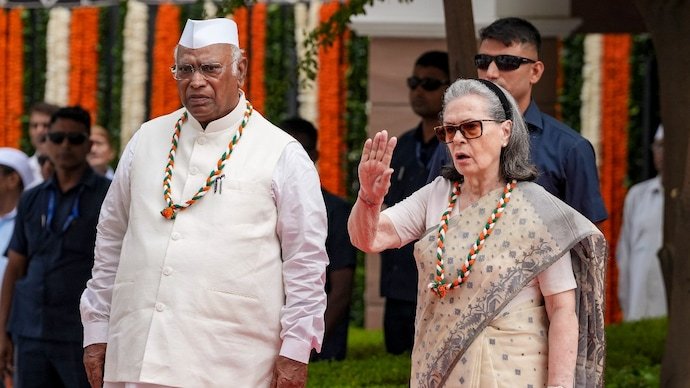
A political controversy over the singing of Vande Mataram at the congress headquarters in New Delhi has escalated into a police complaint seeking an FIR against Congress leaders Sonia Gandhi and Rahul Gandhi. The complaint alleges that their conduct during the Independence Day programme may have amounted to intentional disruption of the National Song’s rendition.
Filed by advocates Kunal Vinayak and Shubh Sharma, the complaint asks Delhi Police to examine whether the conduct attributed to the two Congress leaders falls within the provisions of the Prevention of Insults to National Honour (Amendment) Bill, 2026. Delhi Police has acknowledged receiving the complaint and said the matter is being enquired into.
The dispute centres on purported gestures by Sonia Gandhi during the rendition and remarks allegedly made by Rahul Gandhi. Congress has rejected the allegation that there was any attempt to stop the full version of Vande Mataram, while the BJP has demanded an apology from the Congress leadership.
What triggered the Vande Mataram controversy?
The controversy began during an Independence Day function at the Congress headquarters at Indira Bhawan in New Delhi. Sonia Gandhi was present at the event along with Congress president Mallikarjun Kharge and other party leaders when Vande Mataram was being sung.
According to the complaint, Sonia Gandhi appeared to make gestures and communicate with people present as the singers moved towards the stanzas that have previously been a point of disagreement within the Congress.
The later portions of the song contain Hindu religious imagery, and Congress leaders have argued that those portions can be objectionable to members of other faiths. That longstanding disagreement over the appropriate rendition of Vande Mataram has now become the basis of a fresh political and legal dispute.
The complainants have interpreted Sonia Gandhi’s alleged gestures differently, arguing that they could indicate an objection to continuing the rendition. They have asked authorities to determine the nature and intention behind those gestures rather than treating the allegations as established fact.
Complaint cites alleged remarks by Rahul Gandhi
The complaint also refers to purported video footage in which Rahul Gandhi is alleged to have said, “We are not singing Vande Mataram” during the rendition of the National Song.
The complainants argue that the statement, considered alongside the alleged gestures by Sonia Gandhi, warrants an Investigation into whether there was an intentional attempt to disrupt the singing.
However, the legal significance of any statement or gesture depends on its full context and the applicable law. The complaint itself asks the competent authority to investigate the exact nature, intention and purpose of the alleged conduct.
That distinction is important because the existence of a police complaint does not establish that an offence has occurred. The allegations still have to be examined by the authorities, and any criminal liability would ultimately depend on the applicable law and evidence.
What law has been cited in the complaint?
The complaint invokes the Prevention of Insults to National Honour (Amendment) Bill, 2026. According to the complaint, the proposed amendment seeks to extend penal protection currently available to the National Anthem to the National Song as well.
The complainants specifically refer to a proposed amended Section 3. They state that the provision would provide for imprisonment of up to three years, a fine, or both, where a person intentionally prevents the singing of the National Anthem or National Song or causes disturbance to an assembly engaged in such singing.
The wording cited in the complaint makes intentional prevention or disturbance central to the allegation. That means the question before authorities is not simply whether someone objected to a particular portion of a song, but whether the conduct satisfies the legal requirements of the provision being invoked.
The complaint therefore asks Delhi Police to first ascertain the applicability and legal status of the Vande Mataram-related provision before proceeding further.
Why the legal status of the amendment matters
The complaint’s reference to the Prevention of Insults to National Honour (Amendment) Bill, 2026) raises an important legal question: the difference between a proposed legislative amendment and a law that is already in force.
The complainants themselves have asked police to determine the applicability and legal status of the provision. That request is significant because the existence of a bill or proposed amendment does not automatically mean that its proposed penalties can be applied as an existing criminal offence.
Whether the provision can be invoked in a particular case depends on its legal status, the wording of the law actually in force and the circumstances of the alleged conduct. The supplied information does not establish that the proposed amendment has already become an enforceable law.
For that reason, the police inquiry will be important in determining which legal provisions, if any, apply to the allegations.
Complaint refers to Supreme Court judgment
The complainants have also cited a 2018 Supreme Court judgment concerning the statutory provision dealing with intentional prevention of the singing of the National Anthem or causing disturbance to an assembly engaged in its singing.
The reference is intended to support the legal basis of the complaint. However, the supplied material does not provide the full text or detailed reasoning of that judgment, so its precise application to the present Vande Mataram controversy cannot be established from the available information alone.
The broader legal issue remains whether conduct at the Congress function meets the relevant statutory requirements and whether those provisions apply to the National Song in the circumstances described in the complaint.
Delhi Police says complaint is being enquired into
Delhi Police has acknowledged receiving the complaint and said the matter is being enquired into.
This means the immediate stage is an examination of the allegations rather than a finding of criminal guilt. The complaint specifically asks for a fair, impartial and time-bound probe into the conduct attributed to Sonia Gandhi and Rahul Gandhi.
The inquiry will have to establish what happened during the rendition, what was actually said or done, and whether the conduct meets the requirements of any applicable criminal provision.
The distinction between an inquiry, an FIR and a conviction is important. A complaint can lead authorities to examine allegations, while an FIR formally sets a Criminal Investigation in motion where the legal requirements are met. A conviction, by contrast, requires the allegations to be established through the judicial process.
BJP demands apology from Sonia and Rahul Gandhi
The controversy has triggered a strong political response from the BJP. The party has accused the Congress leadership of disrespecting Vande Mataram and demanded an apology from Sonia Gandhi.
BJP leaders have focused particularly on the alleged gestures and the reported remarks attributed to Rahul Gandhi, arguing that they demonstrate opposition to the rendition of the National Song.
The Congress has rejected that interpretation. According to the supplied information, the party has denied that there was any attempt to stop the singing of the full version of Vande Mataram.
The disagreement therefore extends beyond the legal complaint and into a wider political argument over the song, its historical significance and the way it should be presented at national events.
Other complaints filed over the incident
The Delhi complaint is not the only legal or political action reported over the controversy. Two other complaints have also been filed against Sonia Gandhi and other Congress leaders.
One complaint was filed in Odisha by the BJP’s youth wing. BJP Yuva Morcha state president Abhilash Panda accused the Congress leaders of committing a punishable offence by allegedly disrespecting and obstructing Vande Mataram.
Another complaint was filed in Bengaluru, where the Yuva Morcha also held a protest near the BJP state headquarters.
Yuva Morcha state president and MLA Dheeraj Muniraju demanded an apology from Sonia Gandhi and Rahul Gandhi over what he described as alleged disrespect to Vande Mataram. He also warned that the protests would continue until the demand was met.
Why Vande Mataram remains politically sensitive
Vande Mataram has a distinctive place in India’s political and cultural history and has long been associated with the country’s freedom movement. Its status as the National Song gives it an important symbolic position alongside the National Anthem.
At the same time, debates over portions of the song have existed for decades. The controversy referenced in the present complaint concerns later stanzas containing Hindu religious imagery, which some Congress leaders have argued can create discomfort for members of other religious communities.
That distinction helps explain why the latest dispute has quickly moved beyond the events at one Independence Day function. For the BJP, the alleged interruption represents a question of respect for a national symbol. For the Congress, the issue has been framed differently, with the party denying that there was an attempt to prevent the complete rendition.
The competing interpretations demonstrate why establishing the precise sequence of events and the context of the alleged remarks and gestures will be central to any official inquiry.
What happens next?
The immediate question is whether Delhi Police’s inquiry will establish grounds for registration of an FIR and, if so, which provisions can legally be applied.
The complaint itself asks police to determine the legal status and applicability of the amendment cited by the complainants. Investigators may also have to examine available video footage and other material relating to the Independence Day function to establish what Sonia Gandhi and Rahul Gandhi actually said or did.
The political controversy is likely to continue independently of the police process. The BJP has already demanded an apology, while the Congress has rejected the allegation that the singing of Vande Mataram was deliberately stopped.
For now, the central issue is an allegation rather than a judicial finding. Delhi Police has confirmed that it received the complaint and is examining the matter. Whether the alleged conduct amounts to an offence will depend on the evidence, the applicable law and the outcome of the legal process.
The Vande Mataram row therefore sits at the intersection of Politics, national symbolism and criminal law. The next significant development will be whether the police inquiry finds sufficient legal grounds for further action and how authorities interpret the provisions cited in the complaint.
For breaking news and live news updates, like us on Facebook or follow us on Twitter and Instagram. Read more on Latest India on thefoxdaily.com.






COMMENTS 0