What should have been a routine public Infrastructure event celebrating improved rail connectivity between Mau and Delhi instead evolved into a heated political confrontation, exposing the deepening rivalry between the ruling Bharatiya Janata Party (BJP) and the opposition Samajwadi Party (SP) in Uttar Pradesh.
The Controversy erupted during the inauguration of the Mau-Anand Vihar train service, a project that local leaders describe as important for thousands of passengers who travel regularly between eastern Uttar Pradesh and the national capital. However, the event quickly became overshadowed by allegations of political intimidation, provocative remarks, and accusations involving criminal elements.
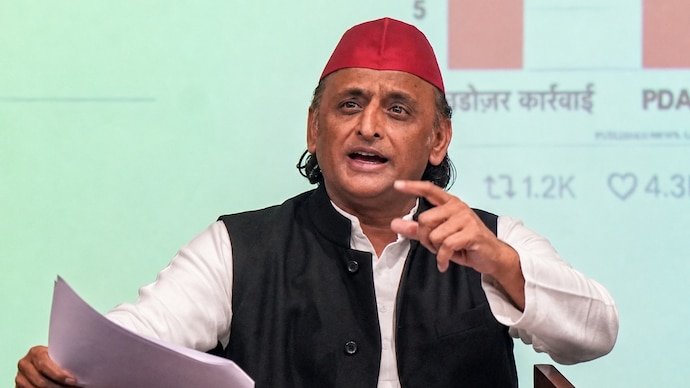
Samajwadi Party president Akhilesh Yadav subsequently demanded police action against those allegedly responsible for disrupting the programme, while also raising broader concerns about law and order, political patronage, and the influence of criminal networks in the state.
The episode has transformed a local railway function into a wider debate about governance, political conduct, and the use of public events as arenas for political confrontation.
What Triggered the Controversy?
The dispute centers around the inauguration of the Mau-Anand Vihar train service, a railway connection expected to benefit passengers traveling between eastern Uttar Pradesh and Delhi.
According to the Samajwadi Party, the train service became operational following sustained efforts by local Member of Parliament Rajeev Rai, who represents the region and had advocated for improved rail connectivity.
However, tensions emerged during the inauguration ceremony when an exchange involving political leaders reportedly altered the atmosphere of the event.
Instead of focusing on transportation improvements and public benefits, the programme became the subject of political accusations and public disagreements.
The resulting controversy has attracted attention far beyond Mau, becoming another chapter in Uttar Pradesh’s highly competitive political landscape.
Akhilesh Yadav’s Demand for Action
Following the incident, Akhilesh Yadav publicly called for action against what he described as criminal elements allegedly involved in disrupting the event.
He argued that individuals responsible for creating tension should be identified and investigated.
Yadav further alleged that people with criminal backgrounds were operating freely and questioned why stronger action had not been taken against them.
His criticism extended beyond the immediate incident, as he linked the controversy to larger concerns regarding law enforcement and political influence in the state.
The SP chief suggested that the incident reflected broader governance challenges and called for accountability from the administration.
The Role of Rajeev Rai in the Dispute
Rajeev Rai emerged as a central figure in the controversy after claiming that he was invited to the railway programme only to face humiliation during the event.
According to Rai, certain remarks made during the inauguration were directed toward him and contributed to the deterioration of the event’s atmosphere.
He also alleged that individuals present at the venue engaged in inappropriate behavior and created disruptions.
Rai subsequently raised concerns about the handling of the situation and questioned why stronger measures were not taken against those allegedly involved.
The dispute has therefore evolved beyond a disagreement between political parties and become a personal political confrontation involving prominent regional leaders.
The Remark That Became a Political Flashpoint
A major factor behind the controversy was a statement made during the event by Uttar Pradesh Energy Minister AK Sharma.
The comment, interpreted by many observers as a reference to Rajeev Rai, immediately drew attention because of an earlier dispute involving the two leaders.
Political statements often carry additional significance when viewed through the lens of previous rivalries, and this appears to have been the case in Mau.
What might otherwise have been dismissed as a passing remark quickly became the focal point of a larger political argument.
Opposition leaders viewed the statement as provocative, while supporters of the government maintained that the controversy had been exaggerated for political purposes.
Why Public Infrastructure Events Often Become Political Battlegrounds
The Mau incident reflects a broader trend in Indian politics where public infrastructure projects frequently become arenas for political competition.
Railway projects, highways, airports, and development initiatives often involve multiple stakeholders, including:
- Elected representatives.
- State governments.
- Central government agencies.
- Local administrations.
- Political parties.
Because infrastructure projects directly affect voters, political leaders often seek recognition for their role in bringing such projects to their constituencies.
This competition can sometimes result in disputes over credit, visibility, and political messaging.
The Strategic Importance of Rail Connectivity in Eastern Uttar Pradesh
Beyond the Political Controversy, the Mau-Anand Vihar train service carries genuine importance for regional development.
Eastern Uttar Pradesh has long depended on strong rail connectivity due to:
- High population density.
- Labour migration to metropolitan cities.
- Student travel.
- Business mobility.
- Religious tourism.
Delhi remains a major destination for workers, students, and families from eastern Uttar Pradesh. Improved rail services can significantly reduce travel difficulties and improve economic connectivity.
This is one reason why the inauguration attracted considerable local attention before being overshadowed by political disputes.
The Law-and-Order Dimension
One of the most significant aspects of Akhilesh Yadav’s response was his attempt to frame the controversy as a law-and-order issue rather than merely a political disagreement.
He alleged that criminal elements were being allowed to operate openly and questioned whether political patronage was protecting them.
Such allegations strike at one of the most sensitive issues in Uttar Pradesh politics: the relationship between governance, Crime, and political influence.
Successive governments in the state have frequently accused their predecessors and opponents of failing to curb criminal activity.
As a result, incidents involving alleged intimidation often become symbols of larger political narratives.
Comparison: Development Politics vs Confrontational Politics
| Development-Focused Event | Politically Confrontational Event |
|---|---|
| Focus on public benefits | Focus shifts to political disputes |
| Infrastructure achievements highlighted | Controversies dominate headlines |
| Citizen engagement emphasized | Party rivalry becomes central |
| Positive governance messaging | Allegations and counter-allegations |
| Public policy discussions | Political polarization increases |
The Growing Importance of Political Optics
Modern politics is increasingly shaped not only by policy decisions but also by public perception.
Events such as railway inaugurations are carefully watched because they generate powerful visual and political messages.
Political parties seek to demonstrate:
- Administrative effectiveness.
- Local influence.
- Public support.
- Development credentials.
- Leadership visibility.
When controversies emerge during such events, the narrative can quickly shift from development achievements to political conflict.
This appears to be precisely what happened in Mau.
An Overlooked Insight: The Battle for Political Credit
One important aspect often overlooked in discussions about such controversies is the competition for ownership of development projects.
Infrastructure initiatives rarely result from the efforts of a single individual or institution. Instead, they involve years of planning, funding approvals, administrative coordination, and political advocacy.
However, when projects are completed, political actors naturally seek recognition from voters.
The dispute in Mau reflects this broader reality.
Behind the immediate controversy lies a deeper struggle over who deserves credit for delivering public services and development benefits.
This competition has become increasingly intense in India’s politically significant states, where electoral margins can be influenced by perceptions of development performance.
Potential Political Impact Ahead of Future Elections
Although the incident itself may appear localized, political controversies often gain significance when they reinforce larger narratives.
For the Samajwadi Party, the event provides an opportunity to question the state’s law-and-order situation and accuse the government of protecting politically connected individuals.
For the ruling establishment, the challenge will be to prevent the controversy from overshadowing the development message associated with the new train service.
As future Elections approach, even seemingly small incidents can become part of broader campaigns and political messaging strategies.
Could Technology Play a Larger Role in Political Accountability?
A notable aspect of the controversy is the demand for AI-assisted identification of individuals allegedly involved in disruptions.
The increasing use of Technology in public administration has expanded possibilities for:
- Video analysis.
- Crowd monitoring.
- Facial recognition systems.
- Digital evidence verification.
- Public event security.
While such technologies can assist investigations, they also raise important questions about privacy, regulation, and appropriate oversight.
The Mau controversy may contribute to broader discussions about the role of technology in maintaining public order during political events.
Future Outlook
The immediate political fallout from the Mau railway event is likely to continue as both sides seek to shape public perception of what occurred. Investigations, if initiated, could further influence the narrative and determine whether the controversy remains a local dispute or evolves into a larger political issue.
Meanwhile, the Mau-Anand Vihar train service itself is expected to remain important for regional connectivity and public mobility, regardless of the political disagreement surrounding its inauguration.
The incident also highlights how development projects increasingly intersect with political competition, media attention, and public expectations in contemporary Indian politics.
Conclusion
The controversy surrounding the Mau-Anand Vihar train inauguration illustrates how quickly a public development event can transform into a political flashpoint. What began as a celebration of improved rail connectivity soon became a debate over political conduct, Law and Order, alleged intimidation, and accountability.
Akhilesh Yadav’s demand for action, Rajeev Rai’s allegations, and the exchange involving state leaders have elevated the issue beyond a local dispute. At its core, the episode reflects broader tensions in Uttar Pradesh politics, where infrastructure development, political influence, governance, and public perception increasingly intersect.
As authorities and political leaders respond to the controversy, the lasting significance of the incident may depend less on the confrontation itself and more on whether it leads to greater accountability, improved public discourse, and renewed focus on the development objectives that originally brought leaders together in Mau.
For breaking news and live news updates, like us on Facebook or follow us on Twitter and Instagram. Read more on Latest India on thefoxdaily.com.




COMMENTS 0