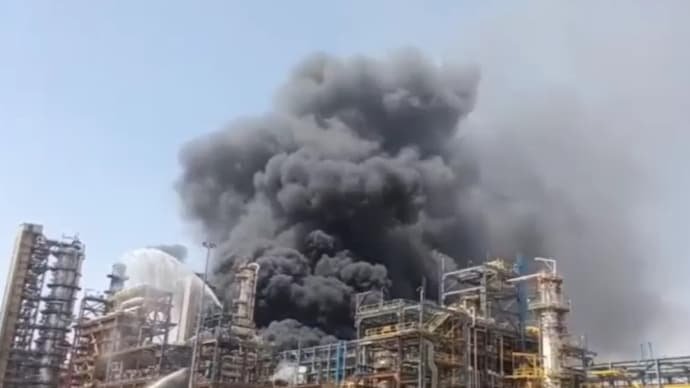
- Introduction: A String of Fires That’s Hard to Ignore
- The Global Timeline: Seven Fires in Just Over a Month
- Why Refineries Are Vulnerable by Nature
- The Geopolitical Context: Energy as a Weapon
- Coincidence vs Pattern: What Experts Are Debating
- A Missing Piece: Why Some Countries Remain Unaffected
- Real-World Impact: Why This Matters Globally
- New Insight: The Rise of “Perception Warfare” in Energy Markets
- What Comes Next: Key Risks to Watch
- Conclusion: A Pattern Without Proof But Not Without Consequences
Introduction: A String of Fires That’s Hard to Ignore
When a major oil refinery catches fire just days before its inauguration, it is bound to raise eyebrows. But when similar incidents begin appearing across multiple countries within weeks, the conversation shifts from isolated accidents to something far more unsettling.
In the past 45 days, oil installations in several countries including India, the United States, Australia, Mexico, and Ecuador have reported fires or operational disruptions. These incidents come at a time when global Energy Markets are already under strain due to escalating tensions linked to the Iran Conflict.
This raises a critical question: Are these refinery fires merely technical mishaps, or do they reflect a deeper pattern tied to geopolitical pressures?
To understand what’s really happening, we need to look beyond headlines and examine the broader context where energy, economics, and geopolitics intersect.
The Global Timeline: Seven Fires in Just Over a Month
The clustering of refinery incidents is what has caught the attention of analysts and policymakers alike. While each case has its own explanation, the timing is unusually tight.
| Date | Country | Location | Reported Cause |
|---|---|---|---|
| March 1 | Ecuador | Esmeraldas Refinery | Fire in charge pumps |
| March 17 | Mexico | Olmeca Refinery | Oily water spread leading to blaze |
| March 23 | USA | Texas (Valero) | Diesel unit fire/explosion |
| April 4 | India | Mumbai Offshore (ONGC) | Undisclosed/technical |
| April 10 | USA | El Paso (Marathon) | Technical issue |
| April 16 | Australia | Geelong (Corio Refinery) | Under investigation |
| April 20 | India | Rajasthan Refinery | Hydrocarbon leak (initial probe) |
Individually, these incidents may not seem extraordinary. Industrial facilities, especially oil refineries, operate under high pressure and temperature, making them inherently prone to risks.
But collectively, the pattern raises legitimate concerns.
Why Refineries Are Vulnerable by Nature
Before jumping to conclusions, it is important to understand the complexity of oil refineries.
These facilities:
- Process highly flammable hydrocarbons
- Operate under extreme heat and pressure
- Rely on intricate networks of pipes, valves, and heat exchangers
Even a minor failure like a valve leak or pressure imbalance can trigger a fire.
In fact, early reports from India’s Rajasthan refinery suggest that a hydrocarbon leak in a heat exchanger circuit may have caused the blaze. Similar technical explanations have been cited in other cases.
So yes, accidents do happen. But timing still matters.
The Geopolitical Context: Energy as a Weapon
What makes this situation more complex is the backdrop against which these incidents are occurring.
The ongoing tensions involving Iran have transformed energy into a strategic tool.
Key developments include:
- Disruptions in oil shipments through critical routes
- Attacks on energy infrastructure in conflict zones
- Sharp fluctuations in crude oil prices
Within weeks of the conflict escalating, Global Oil prices surged dramatically from moderate levels to well above $100 per barrel at one point.
This volatility highlights a simple reality: control over energy supply is power.
And in such an environment, even unrelated incidents begin to carry strategic implications.
Coincidence vs Pattern: What Experts Are Debating
There are two dominant schools of thought emerging around these refinery fires.
1. The “Coincidence” Argument
Many experts argue that these incidents are unrelated and stem from routine industrial risks.
- No confirmed evidence of coordinated attacks
- Technical causes identified in multiple cases
- Facilities located far from active conflict zones
This perspective emphasizes caution against overinterpreting random events.
2. The “Pattern” Hypothesis
Others believe the clustering is too significant to ignore.
- Timing aligns with heightened geopolitical tensions
- Multiple incidents affecting global refining capacity
- Potential for indirect or covert disruption strategies
While there is no concrete proof of sabotage, the possibility cannot be entirely dismissed especially in an era where cyber and hybrid warfare tactics are increasingly common.
A Missing Piece: Why Some Countries Remain Unaffected
One interesting observation is that not all major energy players have reported similar incidents.
For example, countries heavily dependent on crude imports and refining have not seen the same pattern of disruptions.
This uneven distribution raises further questions:
- Is it purely coincidental?
- Are safety standards playing a role?
- Or are some regions simply less exposed to risk factors?
These are questions that analysts will continue to explore in the coming months.
Real-World Impact: Why This Matters Globally
Even if these fires are unrelated, their combined effect is significant.
Refinery disruptions can:
- Reduce fuel production capacity
- Increase dependence on imports
- Push global oil prices higher
- Strain supply chains across industries
For countries like India, which rely heavily on imported crude, such disruptions can have a direct impact on Inflation, transportation costs, and economic stability.
Globally, the stakes are even higher. Energy markets are interconnected, meaning a disruption in one region can quickly ripple across continents.
New Insight: The Rise of “Perception Warfare” in Energy Markets
Here’s a critical angle often missed in mainstream coverage: perception itself can influence markets as much as reality.
Even the belief that refinery fires are part of a pattern can:
- Trigger speculative trading in oil markets
- Increase price volatility
- Create panic among industries dependent on fuel
In this sense, uncertainty becomes a tool whether intentional or not.
This phenomenon, sometimes described as “perception warfare,” means that narratives around Energy Security can shape global economics just as powerfully as actual supply disruptions.
What Comes Next: Key Risks to Watch
Looking ahead, several factors will determine whether concerns about a “pattern” grow or fade:
- Results of ongoing investigations into refinery fires
- Stability (or escalation) in Middle East tensions
- Future incidents at critical energy infrastructure
If similar events continue to occur, pressure will mount for deeper international scrutiny.
If not, the current wave may eventually be seen as an unfortunate but coincidental cluster.
Conclusion: A Pattern Without Proof But Not Without Consequences
At this stage, there is no definitive evidence linking the refinery fires across countries to a coordinated global pattern.
But the timing, frequency, and geopolitical backdrop make it impossible to dismiss the concerns outright.
Whether coincidence or something more complex, one thing is clear:
The global energy system is more vulnerable and more interconnected than ever before.
In a world where oil remains a cornerstone of economic stability, even isolated disruptions can carry global consequences.
And sometimes, the biggest impact comes not from what is proven but from what cannot yet be explained.
For breaking news and live news updates, like us on Facebook or follow us on Twitter and Instagram. Read more on Latest World on thefoxdaily.com.






COMMENTS 0