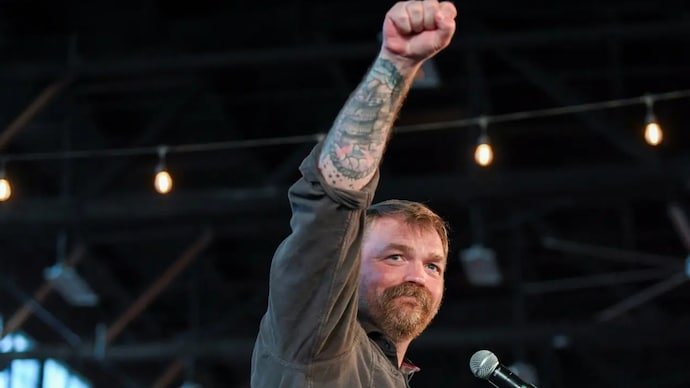
What began as a promising Senate campaign in Maine has suddenly become a test of political resilience after allegations surfaced that Democratic candidate Graham Platner exchanged sexually explicit messages with multiple women outside his marriage before launching his campaign. The revelations have emerged at a critical moment in a race that national Democrats view as essential to their efforts to regain control of the United States Senate.
The Controversy extends beyond personal behavior and touches on broader issues of campaign transparency, candidate scrutiny, voter trust, and the increasingly blurred line between private conduct and public accountability in American Politics. As political campaigns become more vulnerable to digital exposure, the Platner controversy offers a revealing case study of how personal History can rapidly reshape a high-stakes election.
Who Is Graham Platner?
Graham Platner entered the Senate race as a political outsider with a background that many Democrats believed could appeal to independent and moderate voters.
A former Marine Corps member, Platner sought to position himself as a fresh alternative in Maine politics, emphasizing service, leadership, and a commitment to addressing issues affecting working families.
His campaign had begun attracting attention in a state that has often served as a battleground between Democrats and Republicans. Challenging an incumbent senator is never easy, but party strategists viewed Maine as one of the competitive races that could influence the balance of power in Washington.
That momentum has now been disrupted by a controversy that has shifted attention away from policy and toward questions about character and judgment.
What Triggered the Controversy?
The controversy emerged after current and former campaign officials disclosed concerns about Platner’s past communications with multiple women outside his marriage.
According to reports, the issue surfaced during internal campaign vetting processes, when discussions regarding the candidate’s personal history were raised among senior campaign staff.
The revelations gained wider attention after reports claimed that sexually explicit messages had been exchanged with several women before the Senate campaign began.
The situation intensified when reports highlighted photographs allegedly connected to online messaging platforms, adding a visual element to a controversy that was already attracting significant media coverage.
Although the conduct reportedly occurred before the launch of the campaign, political observers note that timing is often less important than public perception once allegations become part of the election narrative.
The Role of Internal Campaign Vetting
One of the most significant aspects of the controversy is how it became public.
Modern political campaigns conduct extensive vetting processes designed to identify vulnerabilities before opponents or the media uncover them.
These reviews typically examine:
- Personal history
- Financial records
- Public statements
- Social Media activity
- Past Relationships
- Potential ethical concerns
The goal is not merely to avoid scandals but to prepare responses if potentially damaging information emerges.
In Platner’s case, reports suggest that concerns regarding his past conduct were discussed internally well before they became public, highlighting the increasingly sophisticated nature of political opposition research and campaign risk management.
Why Personal Conduct Matters in Modern Politics
The debate surrounding Platner’s campaign reflects a larger question facing voters worldwide: how much should a candidate’s personal life influence electoral decisions?
Opinions vary widely.
Some voters argue that personal conduct provides important insights into judgment, integrity, and leadership qualities. Others believe political campaigns should focus primarily on policies, qualifications, and public performance.
Regardless of perspective, recent political history demonstrates that personal controversies often become major campaign issues because they shape public trust.
Trust remains one of the most valuable assets for any political candidate, and once questions arise, campaigns frequently struggle to regain control of the narrative.
The Growing Influence of Digital Footprints
One reason personal controversies have become more common is the expansion of digital communication.
Text messages, social media platforms, private chats, dating apps, and messaging services create extensive digital records that can resurface years later.
For political candidates, this creates unprecedented exposure.
Actions that might once have remained private can now become headline news within hours.
| Past Political Era | Modern Political Era |
|---|---|
| Limited documentation | Permanent digital records |
| Local media exposure | Instant global distribution |
| Slower news cycles | 24-hour social media coverage |
| Fewer verification tools | Extensive digital investigations |
| Greater privacy expectations | Continuous public scrutiny |
This transformation has fundamentally changed how political campaigns operate and how candidates are evaluated.
The Political Stakes in Maine
The controversy is particularly significant because of the strategic importance of Maine’s Senate race.
Maine has a long history of competitive elections and independent-minded voters. The state frequently attracts national attention because close races there can influence control of the Senate.
For Democrats, defeating incumbent Senator Susan Collins represents an opportunity to strengthen their position in Congress.
For Republicans, retaining the seat remains a priority in maintaining political influence at the federal level.
As a result, any controversy affecting a major candidate is likely to receive extensive scrutiny from both national parties, political organizations, and media outlets.
The Impact on Campaign Messaging
Political campaigns depend heavily on message discipline.
Candidates typically spend months building narratives around key issues such as:
- Economic growth
- Healthcare
- National security
- Education
- Public safety
- Government reform
When a personal controversy emerges, those policy discussions often become secondary.
Instead of debating legislation or public priorities, campaigns may find themselves responding to questions about character, relationships, and personal decisions.
This shift can be particularly damaging because it allows opponents to redirect public attention away from the issues a campaign hoped to emphasize.
The Human Dimension Behind Political Scandals
Lost amid Political Analysis is the fact that controversies frequently involve families and personal relationships.
Public statements from Platner’s wife emphasized that the couple had worked through earlier difficulties and strengthened their relationship.
This highlights an important reality often overlooked during election cycles: political scandals are not solely political events. They can also involve deeply personal experiences that affect spouses, children, friends, and extended families.
While voters evaluate candidates through a political lens, the individuals involved frequently experience intense public scrutiny that extends far beyond campaign strategy.
A Comparison With Other Modern Political Controversies
Political scandals involving personal conduct are not new, but the way they unfold has changed dramatically.
| Traditional Scandals | Modern Digital Scandals |
|---|---|
| Often revealed by investigations | Frequently emerge from digital evidence |
| Slower public awareness | Immediate viral distribution |
| Limited media channels | Multiple online platforms |
| Localized political impact | National and global attention |
| Weeks to develop | Hours to dominate headlines |
The Platner controversy illustrates how rapidly political narratives can change in the digital age.
A Unique Insight: The End of the “Private Past” in Politics
Perhaps the most important lesson from this episode is that the concept of a truly private past is increasingly disappearing for public figures.
Political candidates today operate in an Environment where actions from years earlier can suddenly become relevant during a campaign.
This reality is reshaping candidate recruitment, campaign preparation, and political strategy.
Future candidates are likely to face even more intensive vetting processes as parties attempt to identify vulnerabilities before they become public controversies.
In many ways, political campaigns are evolving from contests over policy ideas into comprehensive examinations of a candidate’s entire digital and personal history.
What Happens Next?
The future impact of the controversy will depend on several factors.
- Voter reaction in Maine
- Campaign response strategies
- Media coverage intensity
- Additional disclosures, if any
- The ability to refocus attention on policy issues
Some political scandals fade quickly when voters prioritize economic or policy concerns. Others become defining moments that permanently alter the trajectory of a campaign.
At this stage, it remains unclear which path this controversy will follow.
Future Outlook
The incident serves as another example of how personal conduct can rapidly influence political fortunes in the digital era. Regardless of the eventual electoral outcome, the controversy is likely to be studied as a case of campaign risk management, candidate vetting, and the growing role of digital records in modern elections.
As the Senate race continues, voters will ultimately decide whether the allegations outweigh the issues and policies being debated in the campaign. Both parties will closely monitor public opinion, recognizing that competitive races can shift dramatically in response to unexpected developments.
Conclusion
The controversy surrounding Graham Platner’s Senate campaign underscores the challenges facing political candidates in an age of constant digital scrutiny. What began as a competitive effort to win a key Senate seat has become a broader conversation about personal conduct, public trust, and accountability.
Beyond the immediate political implications, the episode highlights how modern campaigns are increasingly shaped by candidates’ personal histories as much as their policy platforms. As voters in Maine prepare to make their decision, the race will test whether political priorities, personal character, or a combination of both ultimately determines electoral success in one of the nation’s most closely watched contests.
For breaking news and live news updates, like us on Facebook or follow us on Twitter and Instagram. Read more on Latest World on thefoxdaily.com.






COMMENTS 0