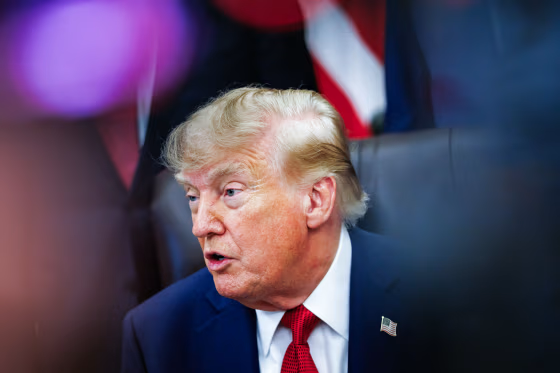
US President Donald Trump is sharpening his attacks on Democrats by repeatedly describing the party and some of its candidates as communist, but his political message is facing an unusual contrast as he prepares to host Chinese President Xi Jinping in Washington.
Xi leads China, a country governed by the Chinese Communist Party, yet Trump has increasingly spoken warmly about his relationship with the Chinese leader. At the same time, Trump’s administration has pursued government stakes in dozens of American companies, including major firms in strategic industries such as semiconductors, nuclear energy and critical minerals.
The combination has created a debate inside and outside the Republican Party about how Trump defines communism, socialism, government intervention and the political differences he wants voters to see between Republicans and Democrats before the November midterm elections.
Trump has argued that communism represents an existential ideological threat to the United States. At the same time, his administration’s economic policies and his personal diplomacy with Xi have given Democrats and some Republicans opportunities to question the consistency of that message.
Trump makes communism a central midterm attack
Trump has made anti-communist rhetoric an increasingly prominent part of his political messaging as Republicans prepare for the 2026 midterm elections.
At a recent Republican midterm convention in Dallas, Trump repeatedly characterized Democrats as communists and warned that the United States could become a communist country if Democrats regained power.
He also argued that Democratic candidates associated with democratic socialism represented a significant ideological shift within the party. Trump pointed to primary victories by candidates aligned with democratic socialist Politics in states including Michigan, Colorado, New York, Florida and Pennsylvania.
Trump has presented those contests as evidence that the Democratic Party has moved further to the left. Republicans have similarly used the victories of progressive candidates to argue that Democrats are becoming less aligned with traditional American political and economic institutions.
The Democrats, however, are a broad political coalition that includes moderates, liberals, progressives and democratic socialists. Democratic socialist ideas also differ from traditional communist systems in important ways, particularly over private ownership, multiparty elections and the role of democratic institutions.
That distinction has become part of the broader argument over Trump’s language. Calling individual Democratic politicians or policies communist is a political characterization, rather than evidence that the United States or the Democratic Party has adopted a communist economic system.
Xi visit creates a striking political contrast
Trump’s planned meeting with Xi makes the timing of his anti-communist rhetoric particularly notable.
Xi is the leader of China and the general secretary of the Chinese Communist Party, which has governed the country since 1949. China remains a one-party political system in which the Communist Party controls the country’s central political institutions.
Despite Trump’s repeated warnings about communism inside the United States, he has developed a notably personal diplomatic relationship with Xi.
Trump has spoken positively about his encounters with the Chinese president and has described his visit to Beijing in warm terms. He has also discussed preparations at the White House for Xi’s visit, including a new helicopter landing area and plans for a future ballroom.
Trump has even compared the proposed White House ballroom with the Great Hall of the People in Beijing, reflecting the degree to which the upcoming diplomatic engagement has become intertwined with his personal presentation of the relationship.
The White House’s approach reflects a distinction that Trump has frequently made between ideological competition with China and direct diplomacy with its leadership. His administration continues to describe China as a major strategic competitor, while Trump has also emphasized his personal rapport with Xi as a tool for negotiating economic and security issues.
Trump’s relationship with Xi has changed over time
Trump’s current tone toward Xi differs considerably from some of his rhetoric during the 2016 presidential campaign.
In 2015, while campaigning for the White House, Trump mocked the idea of treating Xi with elaborate diplomatic ceremony. He suggested that the Chinese leader could simply be taken to McDonald’s before returning to negotiations.
After becoming president, however, Trump’s public comments about Xi became considerably more complimentary. In 2018, he praised Xi’s political position in China and remarked that Xi had become president for life after China removed presidential term limits.
The evolution illustrates one of the recurring features of Trump’s foreign policy: his willingness to separate personal relationships with foreign leaders from his broader criticism of their governments.
Trump has similarly spoken warmly about other powerful leaders, including Russian President Vladimir Putin, North Korean leader Kim Jong Un and Hungarian Prime Minister Viktor Orbán.
Marc Selverstone, director of presidential studies at the University of Virginia’s Miller Center, has described Trump’s interest in strongman leaders as a recurring pattern in his approach to foreign affairs.
Government ownership complicates Trump’s economic message
The contrast over communism is not limited to Trump’s relationship with Xi. It also extends to the economic policies of his administration.
The federal government has accumulated stakes or negotiated ownership arrangements involving dozens of American companies. The portfolio includes firms connected to semiconductors, nuclear power, steel, rare earth minerals and other industries considered important to national security.
Among the most prominent examples is Intel, where the federal government acquired a substantial stake. The administration has also pursued arrangements involving Westinghouse and a range of companies involved in critical mineral and technology supply chains.
The administration has presented these deals as tools for strengthening strategic industries, protecting supply chains and supporting American manufacturing and national security.
Critics, however, argue that government ownership of private companies represents a significant departure from traditional Republican free-market principles.
Republican Senator Rand Paul has questioned the approach, asking whether government ownership of part of a company such as Intel could itself be viewed as a step toward socialism.
That criticism is significant because it comes from within Trump’s own party. Republicans have historically emphasized private ownership, limited government intervention and market competition as alternatives to socialist and communist economic systems.
Democrats also accuse Trump of excessive government intervention
Democrats have seized on the government’s growing corporate stakes to challenge Trump’s political argument.
At a House committee hearing, Democratic Representative Jim Himes of Connecticut described the administration’s economic policies in stark terms, arguing that he could think of no recent administration that had intervened in the economy to the same degree.
The White House has rejected the broader implication that government investments amount to a move toward socialism or communism. The administration has instead emphasized the strategic nature of the deals and the national security interests involved.
That distinction is important. Government ownership of a minority stake in a private company is not the same as a centrally planned economy in which the state controls most production and investment decisions. The economic systems are fundamentally different.
Still, the expansion of government equity ownership has raised questions about how far a conservative administration should go in directing private-sector investment and selecting companies considered strategically important.
Former Trump official says Republicans risk losing a clear contrast
Marc Short, who served as chief of staff to former Vice President Mike Pence and worked in Trump’s first administration, has argued that Republicans have legitimate reasons to criticize Democrats for moving further to the left.
But Short has also warned that Trump’s economic policies could make it harder for Republicans to maintain a clear ideological distinction.
He has pointed to government ownership stakes, proposals involving direct payments to Americans and Trump’s support for interventions aimed at lowering prices for products such as pharmaceuticals as examples of policies that expand the federal government’s role in the economy.
Short has not argued that the United States is becoming a socialist economy like China. Instead, his criticism centers on whether Republicans can maintain a consistent argument for limited government while the administration increasingly uses federal power to influence private companies and prices.
That debate could become more important as the midterm campaign develops because economic policy is often a central issue in congressional elections.
Trump’s China rhetoric also shifted after election interference claims
Trump has not abandoned criticism of the Chinese government. In a primetime address earlier this summer, he accused China of interfering in US elections in 2020 and described the alleged activity as sinister.
Trump subsequently announced the declassification of documents that he said demonstrated Chinese interference. His broader claims about the 2020 election, however, did not establish that China changed the outcome of the election.
The disclosures also did not produce a major shift in US policy toward Xi. Trump later appeared to soften the issue, saying the alleged interference had occurred some time ago and suggesting that China could be different now.
Senior administration officials have not clearly indicated whether the allegations of Chinese election interference will be a major part of Trump’s discussions with Xi.
That is another reason the upcoming meeting carries significance for Trump’s political message. The president can simultaneously portray China as a strategic competitor, criticize communist ideology at home and pursue direct engagement with China’s communist leadership.
Domestic politics and foreign policy are increasingly connected
The timing of Trump’s anti-communist campaign is also important because Republicans face several domestic political pressures ahead of the midterms.
The administration is dealing with concerns about Inflation, criticism over its handling of the war in Iran and questions about Trump’s approval ratings. These issues can influence the political environment in which Republican candidates seek to defend their congressional majorities.
Against that backdrop, portraying Democrats as too far left provides Republicans with a straightforward campaign argument. Trump has repeatedly attempted to frame the election as a choice between his vision of America and what he describes as an increasingly radical Democratic Party.
But his approach to China and his economic interventions introduce complications into that argument. Democratic candidates can point to government ownership of private companies and Trump’s close relationship with Xi, while Republicans can argue that strategic government investments and diplomatic engagement are different from adopting communist or socialist systems.
The disagreement is therefore not simply about terminology. It reflects competing views about the proper role of government, how America should compete with China and how much economic intervention is justified in industries considered critical to national security.
Trump’s Xi relationship is likely to remain under scrutiny
As Trump prepares to host Xi, the president’s personal relationship with the Chinese leader is likely to receive renewed attention.
Trump has repeatedly demonstrated that he prefers leader-to-leader diplomacy and often places significant value on personal rapport. At the same time, his administration continues to treat China as a major strategic and economic competitor.
Those two approaches can coexist, but they create a more complicated political message when Trump is simultaneously presenting communism as America’s greatest ideological threat.
The question for Republicans is whether voters will distinguish between Trump’s criticism of communist ideology and his willingness to negotiate and socialize diplomatically with leaders of communist states. For Democrats, the issue provides an opportunity to challenge the consistency of Trump’s rhetoric and economic policies.
Trump’s response is likely to remain centered on the distinction between confronting what he describes as communist ideology inside the United States and dealing with foreign governments in pursuit of American interests.
A political message facing multiple contradictions
Trump’s attacks on Democrats as communists are becoming a prominent feature of his 2026 midterm strategy, but the administration’s own policies have complicated the simplicity of that message.
His planned meeting with Xi highlights the foreign-policy side of the contradiction, while government equity stakes in American companies raise questions about the domestic economic side. Trump views China as a strategic competitor and has continued to criticize aspects of its policies, but he has also emphasized his personal relationship with Xi and the importance of direct negotiation.
Meanwhile, the federal government’s growing role as an investor has prompted criticism from Democrats and some Republicans who argue that Washington is becoming more involved in directing private economic activity.
None of those developments by themselves establish that Trump’s policies are communist or socialist. They do, however, illustrate why the political debate over those labels is becoming more complicated as the midterm elections approach.
With Trump preparing to meet Xi while campaigning against what he describes as communist influence at home, the coming weeks will put both his foreign-policy strategy and his domestic economic approach under an increasingly political spotlight.
With PTI Inputs
For breaking news and live news updates, like us on Facebook or follow us on Twitter and Instagram. Read more on Latest World on thefoxdaily.com.






COMMENTS 0