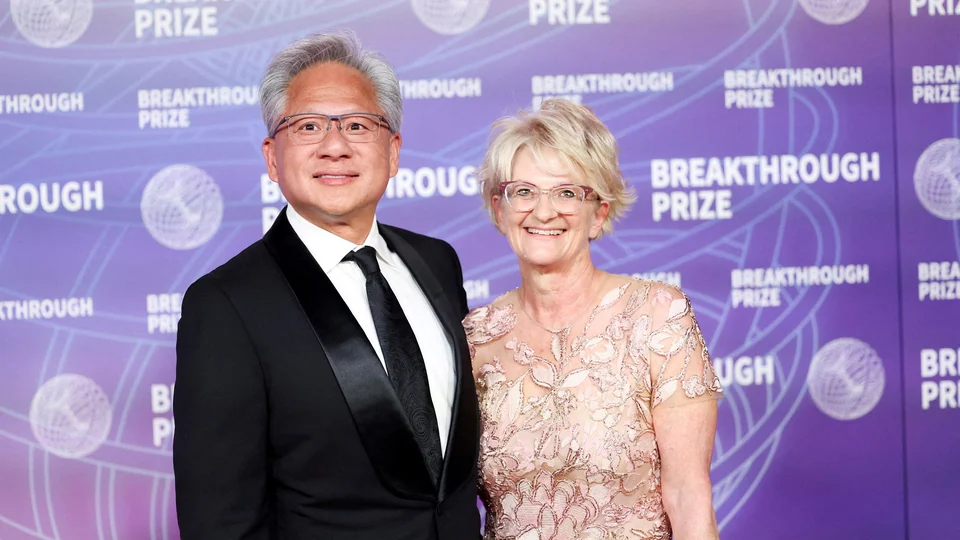
Jensen Huang and his wife, Lori Huang, began their journey with two young children and only six months of living expenses in the bank. When Jensen co-founded Nvidia in 1993, there was little indication that the semiconductor company would eventually make them one of the wealthiest couples in the world. More than three decades later, their fortune extends far beyond the shares associated with the Nvidia chief executive. It includes an extensive network of family trusts, limited liability companies and a major philanthropic foundation.
Their financial empire has attracted renewed attention following the controversy surrounding Jensen Huang’s reported resignation from Nvidia after allegations of extramarital affairs came to light. The developments have also raised questions about the company’s leadership and the future of the artificial intelligence investment boom. Nvidia shares reportedly fell 28% following his departure, reducing the value of the couple’s holdings by billions of dollars.
Despite that decline, the Huangs remain associated with approximately 870 million Nvidia shares, recently valued at more than $109 billion. Their ownership is distributed across different legal structures, making their wealth more complicated than a straightforward calculation of shares held in personal accounts.
Regulatory filings reveal how the couple have arranged their assets over several decades. Their holdings include a living trust, irrevocable trusts, limited liability companies and a private foundation that has grown into one of the largest philanthropic organisations in the United States. These structures serve different purposes, from managing investments and planning for future generations to supporting charitable activities.
From Six Months of Savings to a Fortune Built on Nvidia
Jensen and Lori Huang met while studying electrical engineering at Oregon State University. Their relationship began before Nvidia became a household name in the technology industry. Jensen later recalled noticing Lori because she was particularly attractive to him, describing their early relationship during an appearance on Guy Raz’s podcast, How I Built This.
After graduating, the couple worked in Silicon Valley. Lori eventually stepped away from her professional career to raise their two children while Jensen pursued the ambitious plan of building a semiconductor company.
When Jensen co-founded Nvidia in 1993, the family was operating with limited financial resources. He recalled during an interview at Stanford Graduate School of Business that they had only enough money in the bank to cover approximately six months of living expenses.
The early years required the couple to manage financial uncertainty while Jensen worked to establish the company. Nvidia’s subsequent growth transformed that situation dramatically. The company became a major supplier of graphics processing units, initially gaining prominence in computer graphics and gaming before expanding into artificial intelligence, data centres and high-performance computing.
As Nvidia’s business expanded, the value of the shares held by its founders and early investors increased substantially. The Huangs also began arranging their financial affairs through trusts and other structures, with estate planning starting not long after the company was established.
That planning became particularly important as Nvidia’s market value grew. Rather than holding all their wealth directly, the couple distributed ownership and control across several entities that could manage assets, support family succession and facilitate long-term charitable giving.
How Much Nvidia Stock Do Jensen and Lori Huang Control?
According to securities filings, Jensen and Lori Huang directly and indirectly own or control approximately 3.6% of Nvidia. Their combined holdings include around 70 million shares owned directly by Jensen and approximately 800 million shares over which they may be considered to have shared ownership.
The distinction between direct ownership and shared or indirect ownership matters. Not every share associated with the couple is necessarily held in an individual brokerage account. Significant portions are owned through trusts, limited liability companies and their philanthropic foundation.
Based on the reported valuation, the approximately 870 million shares associated with the Huangs were recently worth more than $109 billion. The figure illustrates the scale of their wealth, but it should not be confused with cash available to the couple. Shares held by trusts and charitable organisations are subject to different legal arrangements and cannot automatically be treated as personal spending money.
The largest portion of their Nvidia holdings sits within a family living trust created in 1995. Other shares are held through companies connected to the trust, while separate irrevocable trusts and the foundation account for additional holdings.
The Living Trust That Holds Nearly 468 Million Nvidia Shares
The Jen-Hsun and Lori Huang Living Trust, established in 1995, holds nearly 468 million Nvidia shares, making it the largest identified component of the couple’s shareholding structure.
Wealth-planning specialists describe living trusts as common arrangements used by families to manage assets during their lifetimes and simplify the transfer of property to beneficiaries after death. The Huangs are listed as co-trustees, meaning they share responsibility for decisions involving the trust’s assets.
Justin Miller, national director of wealth planning at Evercore Wealth Management, explained that the arrangement is likely a joint revocable trust. Such trusts generally allow the people who establish them to retain substantial control over the assets while they are alive, subject to the trust’s terms.
Revocable trusts can also help families organise investments and plan for the transfer of wealth without relying entirely on the distribution process that follows a person’s death. Their precise legal and tax treatment depends on the trust document and applicable law.
Another approximately 133 million Nvidia shares are held by limited liability companies whose sole member is the living trust, according to regulatory filings.
These companies add another layer to the ownership structure. Miller said limited liability companies can be used to provide asset protection against certain legal claims or to prepare for future estate-planning arrangements. The filings identify the ownership connections, although they do not establish that every structure was created for a single specific purpose.
For wealthy families, separating assets across trusts and companies can make it easier to manage different investments, establish succession arrangements and organise responsibilities. It can also create a more complicated picture for anyone trying to calculate how much wealth a family personally owns.
Why the Huangs Transferred Shares Into Irrevocable Trusts
Beyond their living trust, the Huangs established several irrevocable trusts that hold substantial Nvidia shareholdings. These arrangements are particularly important because they can transfer future investment growth to beneficiaries outside the founders’ taxable estates, depending on how the trusts are structured.
In 2012, the couple created an irrevocable trust holding slightly more than 31 million Nvidia shares. Beneficiaries of such trusts are often children or other family members. Depending on the arrangement, they can also include future generations who have not yet been born.
The basic estate-planning principle is to transfer assets when their value is relatively low, allowing subsequent appreciation to benefit the trust’s beneficiaries rather than increasing the value of the original owner’s estate.
Jonathan Blattmachr, a New York-based estate-planning lawyer, described this as one of the most common strategies used by wealthy families. The objective is to give away assets before a major increase in value so that the future appreciation can remain outside the donor’s estate for applicable tax purposes.
For the Huangs, that strategy became especially consequential because Nvidia’s shares experienced extraordinary growth as demand for its chips increased. Shares transferred into trusts before the company’s major expansion could therefore become worth substantially more over time.
The couple also established an irrevocable remainder trust in 2016 that holds approximately 109 million Nvidia shares. Their estate-planning arrangements included multiple grantor retained annuity trusts, commonly known as GRATs, which can be used to transfer future appreciation to beneficiaries while meeting specific legal and tax requirements.
Such arrangements can allow wealthy families to move assets into longer-term structures while retaining certain financial rights for a specified period. The assets may eventually pass into another trust, depending on the terms of the arrangement.
The Huangs are listed as co-trustees of the two irrevocable trusts, giving them fiduciary responsibilities to manage the assets in accordance with the interests of the beneficiaries. Unlike a revocable living trust, an irrevocable trust generally cannot be changed or cancelled freely by the people who created it.
The distinction is important when assessing the couple’s wealth. Shares held in an irrevocable trust may be associated with the family, but their legal ownership and control are not necessarily the same as shares held personally by Jensen or Lori Huang.
What Could Happen to the Wealth in a Divorce?
The ownership arrangements have also drawn attention because of the allegations surrounding Jensen Huang’s personal life. Lori Huang has not publicly commented on the reported infidelities, and the supplied information does not establish that the couple are seeking a divorce.
However, the legal distinction between revocable and irrevocable trusts could become relevant if their marital circumstances were to change.
California, where the Huangs live, generally follows community-property principles. As a broad starting point, assets acquired during marriage may be treated as belonging equally to both spouses, subject to exceptions and the specific circumstances of each asset. Property arrangements, marital agreements and the way assets were acquired or transferred can affect the outcome.
Justin Miller explained that assets acquired during marriage and held through a revocable trust, including connected limited liability companies, could generally be subject to a 50-50 division in a divorce, unless a valid marital agreement or other applicable legal arrangement provides otherwise.
Irrevocable trusts are different. Assets properly transferred into such trusts are generally outside the grantors’ estates, meaning they may not automatically become part of a marital-property division. However, the circumstances in which the trusts were created and funded could still be challenged.
This distinction highlights why the Huangs’ financial structure cannot be understood simply by adding together every Nvidia share associated with their names. Legal ownership, beneficial interests, trustee responsibilities and marital-property rules can all affect who ultimately has rights over particular assets.
The Huang Foundation Has Become a Major Philanthropic Force
The couple’s wealth is not limited to investments and family trusts. Their philanthropic organisation, the Jen-Hsun & Lori Huang Foundation, has also become a major holder of Nvidia shares and a significant source of charitable funding.
Lori Huang is listed as the foundation’s president, while Jensen Huang serves as its secretary and chief financial officer. Regulatory filings do not list other officers or directors.
The foundation holds nearly 59 million Nvidia shares, according to a securities filing from this year. Those shares legally belong to the charitable organisation rather than being directly owned by the couple for personal use.
The foundation’s financial growth has closely followed Nvidia’s rise. Its assets increased from approximately $12.6 million in 2007 to $9.2 billion at the end of 2024, according to its most recent available Internal Revenue Service filing cited in the supplied report.
That valuation would place the organisation at approximately 13th among the largest private foundations in the United States in 2024, according to Jon Bergdoll of Indiana University’s Lilly Family School of Philanthropy.
The scale of the foundation demonstrates how Nvidia’s growth has created not only personal wealth for its founders but also substantial resources for charitable activities. Its grants have supported education, cultural institutions, food assistance and other causes.
Opera, Universities and Community Organisations Among Its Beneficiaries
The Huangs have supported a range of organisations, particularly in the San Francisco Bay Area, where they live. Their philanthropic commitments include universities, cultural institutions and organisations working on social needs.
Last year, the couple announced a multiyear commitment to the San Francisco Opera. They have also hosted private cultural events, including a showing of Mozart’s The Marriage of Figaro at the opera house on election night earlier this month. Guests reportedly included OpenAI co-founder Greg Brockman, Salesforce chief executive Marc Benioff and Intel chief executive Lip-Bu Tan.
Vanderbilt University announced a $75 million grant from the Huang foundation this summer to establish a college of art, architecture and design at its San Francisco campus. The commitment reflects the foundation’s interest in supporting education and creative disciplines alongside technology-related fields.
Stanford University has also benefited from the couple’s giving. An engineering centre at the university is named after Jensen Huang, who earned a master’s degree there. Other recipients include Second Harvest of Silicon Valley, a food bank serving communities across the region.
The foundation’s grants have also reached Oregon State University, where the couple first met, the Asia Society and several organisations working in mental health.
Another part of its activities involves providing computing resources to researchers and nonprofit organisations. According to a securities filing, the foundation has purchased computing power from AI cloud company CoreWeave to support universities and other nonprofits working on open science and artificial intelligence research.
These initiatives show how the foundation’s resources are being directed towards areas connected to education, research, culture and community support.
Why Donor-Advised Funds Are a Significant Part of the Foundation’s Giving
One of the largest recurring categories of the foundation’s distributions has been contributions to donor-advised funds, or DAFs, maintained at Charles Schwab.
In 2024, the foundation contributed more than $80 million to these funds. Donor-advised funds allow donors to make charitable contributions to an account administered by a sponsoring organisation. The money can then be recommended for distribution to eligible charities over time.
For private foundations in the United States, contributions to qualifying donor-advised funds can count towards the minimum annual distribution requirement. Private foundations are generally required to distribute an amount equivalent to at least 5% of their assets each year for qualifying charitable purposes.
However, money placed in a donor-advised fund does not necessarily have to reach an operating charity immediately. It can remain in the fund until grants are recommended and distributed to eligible organisations.
This feature has attracted criticism from people who argue that donor-advised funds can allow charitable money to remain invested for extended periods rather than being directed promptly towards organisations delivering services.
For foundations such as the Huangs’, donor-advised funds offer flexibility in managing charitable distributions. They also illustrate how philanthropy among the ultrawealthy can involve sophisticated financial structures similar to those used in private wealth management.
A Fortune Built on Nvidia, Structured for Generations
The financial story of Jensen and Lori Huang reflects the extraordinary rise of Nvidia and the planning that accompanied the company’s growth. What began with a young family living on limited savings has developed into a multibillion-dollar network of investments, trusts, companies and charitable assets.
Their approximately 870 million Nvidia shares represent the most visible part of that wealth, but the ownership arrangements reveal a more complex picture. The living trust holds a substantial portion of the shares, irrevocable trusts preserve assets for beneficiaries, limited liability companies provide additional ownership structures, and the foundation directs billions of dollars towards philanthropic purposes.
The reported 28% decline in Nvidia shares following Jensen Huang’s departure illustrates how closely the couple’s financial position remains connected to the company’s market performance. Yet the scale of their holdings means that even a substantial fall in share value does not erase the fortune accumulated during Nvidia’s expansion.
Their story also demonstrates how wealth creation and wealth preservation are separate exercises. Building a successful company can generate enormous financial returns, but managing those returns across generations requires decisions about ownership, taxation, inheritance and philanthropy.
For the Huangs, Nvidia provided the foundation of their fortune. The trusts, investment entities and charitable foundation show how that fortune has been organised to extend beyond the company’s day-to-day business and potentially shape the family’s financial and philanthropic legacy for decades to come.
For breaking news and live news updates, like us on Facebook or follow us on Twitter and Instagram. Read more on Latest World on thefoxdaily.com.




COMMENTS 0