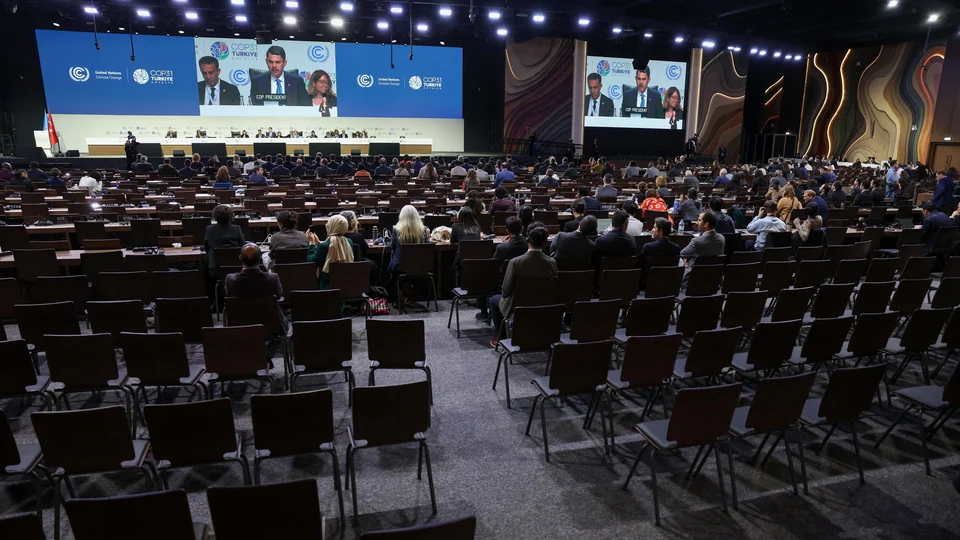
The United Nations’ latest climate conference has ended in an extraordinary breakdown after countries failed to reach agreement on a final political declaration, exposing deep divisions over fossil fuels, carbon capture and the pace of global climate action. COP31, held in Antalya, Turkey, from November 9, 2026, was expected to produce a common statement outlining the next steps in implementing the Paris climate agreement. Instead, negotiations continued nearly 48 hours beyond their scheduled conclusion before collapsing in a tense final plenary on November 22.
The immediate dispute centred on the proposed final document, known as the cover text, which was intended to summarise the summit’s political decisions. The European Union rejected the draft shortly before it was expected to be formally adopted, arguing that its failure to mention a transition away from fossil fuels made it unacceptable. Several other countries followed the EU’s position, leaving the conference without consensus on the overarching agreement.
Turkey’s Environment Minister and COP31 President Murat Kurum subsequently walked out of the proceedings and told reporters that there would be no further attempt to produce another version of the text. The failure marked a significant departure from the familiar pattern of UN climate negotiations, where countries frequently appear close to deadlock before eventually agreeing on a compromise.
This time, the divisions proved too difficult to bridge. The breakdown also exposed a larger problem facing international climate diplomacy: countries have increasingly struggled to translate ambitious declarations into concrete commitments, even as global temperatures continue to rise and the consequences of Climate Change become more severe.
Why COP31 Collapsed at the Final Negotiating Session
The decisive confrontation took place during the closing plenary on Sunday, November 22. The European Union objected to the proposed cover text, arguing that the document failed to reflect the urgency of reducing dependence on fossil fuels. Dozens of other countries subsequently opposed the draft, preventing the conference from adopting the central political declaration.
The disagreement was not simply about the wording of a sentence. It reflected competing positions on the future of the global energy system, the responsibilities of fossil-fuel-producing countries and the extent to which international climate agreements should explicitly commit governments to moving away from coal, oil and natural gas.
For countries seeking stronger climate commitments, the absence of a clear fossil-fuel transition was a major setback. They argued that an agreement addressing climate change could not avoid naming the principal sources of greenhouse-gas emissions.
Countries opposed to stronger language were reluctant to accept a declaration that could be interpreted as requiring a faster reduction in fossil-fuel production or consumption. Some governments have emphasised energy security, economic development and the continued role of existing energy infrastructure.
With neither side willing to accept the proposed wording, the final plenary became the point at which the negotiations broke down publicly. Kurum’s decision to abandon further attempts to produce a replacement text confirmed that the conference had failed to reach the political compromise its organisers had sought.
The atmosphere was unusual even by the standards of climate negotiations. After proceedings resumed, participants heard an unusually direct acknowledgement that the problems extended beyond the particular disagreements at Antalya. Simon Stiell, executive secretary of the United Nations Framework Convention on Climate Change, told delegates that the process itself needed to evolve.
His warning reflected growing frustration with a negotiating system that requires agreement among countries with sharply different economic interests, energy requirements and political priorities.
How the Fossil-Fuel Dispute Reopened Divisions From COP28
The dispute at COP31 cannot be understood without looking at the diplomatic breakthrough achieved at COP28 in Dubai in 2023. That conference produced an important development in international climate negotiations by explicitly acknowledging the need for a transition away from fossil fuels in energy systems.
The final COP28 statement called for “transitioning away from fossil fuels in energy systems, in a just, orderly and equitable manner”. Although the wording did not establish a binding timetable for ending fossil-fuel use, it was widely regarded as a significant diplomatic achievement.
For the first time, a final COP declaration directly recognised the need to move away from fossil fuels. The agreement gave countries seeking stronger climate action a political reference point for subsequent negotiations.
However, the commitment was not consistently carried forward. At COP30 in Belém, Brazil, the previous year, disagreements prevented the inclusion of similarly explicit language in the final declaration. The political struggle continued at COP31, where Saudi Arabia, Russia and other countries pushed for the omission of any direct reference to a transition away from fossil fuels.
The resulting draft avoided the issue entirely. For the European Union and several climate-vulnerable countries, this represented a retreat from the direction established in Dubai.
The disagreement demonstrated how difficult it has become to preserve even broad political commitments across successive climate conferences. A phrase that required extensive negotiations to secure in 2023 became the centre of another major diplomatic confrontation just three years later.
The issue is particularly sensitive because fossil fuels remain central to the economies of major producers and are still widely used to generate electricity, power transport and support industrial activity. A transition therefore involves questions about employment, investment, energy prices, infrastructure and national development strategies, not just environmental targets.
Why the EU Rejected the Proposed Antalya Pact
The European Union emerged as the most prominent opponent of the proposed final declaration. Darragh O’Brien, Ireland’s climate minister and the EU’s representative at COP31, criticised the absence of fossil-fuel transition language and said the bloc would not accept what he described as a backward movement in climate negotiations.
O’Brien called the draft’s failure to mention fossil fuels “unconscionable”. His position reflected the EU’s argument that the international climate process should build on earlier commitments rather than weaken or abandon them.
The EU was not alone. Britain, Belize, Fiji, the Marshall Islands, Norway, Panama and Vanuatu were among the countries that supported stronger language on moving away from fossil fuels.
For many smaller and climate-vulnerable nations, the issue is directly connected to their ability to protect communities from rising temperatures, extreme weather, coastal threats and other climate-related risks. They argue that countries responsible for large emissions should make stronger commitments to reduce the use of fossil fuels.
Their objections also reflected concerns about the credibility of the COP process. If a commitment made at one summit can disappear from the next major declaration, vulnerable countries may question whether international agreements are delivering meaningful progress.
The EU’s rejection therefore became a broader confrontation over the direction of global climate diplomacy. Accepting the proposed text would have meant allowing the conference to conclude without an explicit reference to the transition that had become a central part of climate negotiations since COP28.
Carbon Capture Became Another Flashpoint in the Negotiations
While the proposed Antalya text avoided mentioning a transition away from fossil fuels, it included supportive language on expanding technologies for carbon capture and storage. This created another source of disagreement between countries with different views about how the world should reduce emissions.
Carbon capture and storage, commonly known as CCS, involves capturing carbon dioxide from industrial processes or other sources before it enters the atmosphere and transporting it for long-term storage. The technology is intended to prevent some emissions from contributing to Global Warming.
Supporters argue that carbon capture could help reduce emissions in industries where alternatives are difficult to deploy, including certain heavy industrial processes. They also see it as one possible component of a broader strategy for reaching climate targets.
Critics, however, warn that an excessive emphasis on carbon capture could allow fossil-fuel producers to continue expanding or operating existing infrastructure rather than reducing dependence on coal, oil and gas.
That concern is particularly relevant when carbon capture is presented as an alternative to directly reducing fossil-fuel consumption. Capturing a portion of emissions does not eliminate the wider environmental and economic challenges associated with continued fossil-fuel dependence.
For climate-vulnerable countries, the combination of strong support for carbon capture and the absence of a clear fossil-fuel transition was unacceptable. They feared that the proposed language could legitimise continued fossil-fuel use without establishing sufficiently ambitious emissions-reduction commitments.
The disagreement highlighted a wider question in Climate Policy: should governments prioritise reducing fossil-fuel consumption, invest more heavily in technologies that capture emissions, or pursue both approaches under strict conditions?
Although carbon capture may have a role in certain sectors, the technology remains controversial as a central pillar of climate strategies. Its effectiveness depends on how much carbon is captured, how securely it is stored and whether it leads to additional emissions reductions rather than delaying changes in energy systems.
Some Climate Decisions Were Adopted, but Major Measures Remained Unfinished
The collapse of the final political declaration did not mean that every part of COP31’s agenda failed. Delegates managed to adopt some decisions that had already been mandated by previous climate conferences and the Paris agreement.
Among the areas where progress was made was the development of a programme intended to prevent the costs and practical difficulties of shifting towards renewable energy from restricting development in poorer countries.
This issue is particularly important for developing economies, which face the challenge of expanding electricity access, building infrastructure and creating employment while reducing the emissions associated with economic growth.
Renewable energy projects can require significant upfront investment, modern electricity grids, energy storage systems and technical expertise. Countries with limited financial resources may struggle to make this transition without international support.
However, other important areas of work remained unresolved. Measures intended to help countries reduce their carbon emissions more quickly were delayed or pushed into future negotiations.
The unfinished business exposed the limits of the conference’s partial achievements. Countries could still agree on selected technical or procedural decisions, but the larger political agreement needed to provide direction for global climate action remained out of reach.
This distinction matters because the Paris agreement relies on countries setting and strengthening their own climate commitments. International cooperation is needed to maintain pressure for more ambitious targets, support developing nations and ensure that national pledges translate into measurable action.
Without a clear political framework, the process risks becoming increasingly focused on administrative procedures while the pace of emissions reductions remains insufficient.
Why the UN Climate Conference System Is Facing a Deeper Crisis
The failure at COP31 exposed a structural weakness in the way international climate negotiations operate. The UN climate process brings together countries with different economic systems, development priorities, energy resources and political interests. Decisions require broad consensus, making it difficult to reach agreement when major disagreements emerge.
At previous conferences, disputes over the final wording often continued until the last hours. Delegates frequently warned that negotiations were close to collapse, only for governments to accept a compromise at the final moment.
That pattern helped sustain the impression that each summit could deliver at least one major political declaration, even when the practical achievements were limited.
Paul Watkinson, a former European Union climate negotiator, has described the growing importance attached to broad political commitments as an understandable response to the worsening effects of climate change. When practical progress is difficult to achieve, governments and campaigners place greater emphasis on the symbolic value of final declarations.
These statements can help establish international expectations, influence national policies and provide a common reference point for future negotiations. However, their importance can also become disproportionate when the underlying commitments are not supported by concrete implementation.
COP31 exposed the weakness of relying so heavily on this approach. The final political text became so contentious that the conference could not secure agreement even on a broad statement of direction.
The problem is not simply that countries disagree about fossil fuels. It is that the consensus-based process struggles to produce stronger commitments when governments have fundamentally different views about the costs and responsibilities of climate action.
Simon Stiell’s call for the system to evolve therefore raises difficult questions about what reform could realistically achieve. Changing the way negotiations are organised may help improve efficiency, but it cannot automatically resolve disagreements between countries whose economic interests are in direct conflict.
Global Warming Is Moving Beyond the Paris Agreement’s 1.5°C Ambition
The diplomatic breakdown comes as the world continues to approach and move beyond the temperature threshold that governments agreed to pursue under the Paris climate agreement.
The 2015 agreement committed countries to holding the increase in global average temperature to well below 2°C above pre-industrial levels while pursuing efforts to limit warming to 1.5°C.
That more ambitious target became a central reference point for international climate policy because the risks associated with higher temperatures are expected to increase as warming intensifies.
The temperature for 2026 is expected to be approximately 1.6°C above the pre-industrial average, according to the assessment described in the supplied report. The current El Niño event has contributed to higher temperatures by adding a temporary warming influence to the climate system.
However, the underlying long-term warming trend remains the more important concern. Natural climate variability can push individual years above or below the broader trend, but it does not remove the influence of human-caused greenhouse-gas emissions.
It is also important to distinguish a single year’s temperature from the long-term warming level used to assess the Paris agreement’s goals. A year above 1.5°C does not, by itself, mean that the long-term threshold has been permanently crossed. Nevertheless, repeated record-breaking temperatures show how little room remains for delaying emissions reductions.
The gap between the scale of the climate challenge and the pace of international action was a central source of frustration at COP31. Countries are being asked to accelerate the transition to cleaner energy while the diplomatic system struggles to agree on even basic language about reducing fossil-fuel dependence.
Why the Failure Matters for Developing and Climate-Vulnerable Countries
The collapse of the Antalya negotiations has implications beyond the diplomatic relationship between major economies. Developing countries and small island states often face some of the most serious consequences of climate change despite having contributed relatively little to historical global emissions.
For these countries, international climate agreements are not merely symbolic documents. They can influence access to finance, technology, renewable energy investment and support for adapting to environmental changes.
A country attempting to expand electricity access while moving away from fossil fuels may need substantial investment in renewable generation, transmission networks, storage and modern infrastructure. Without affordable financing and technical assistance, the transition can become more expensive and slower.
Climate-vulnerable nations also need resources to prepare for rising sea levels, changing rainfall patterns, extreme heat and damaging weather events. Delays in international negotiations can complicate efforts to establish predictable support and stronger cooperation.
The inability to agree on a final political declaration therefore risks weakening confidence in the process among countries that depend on international commitments to advance their climate priorities.
At the same time, the disagreement reflects a continuing divide over responsibility. Developing nations have argued that wealthier countries, which industrialised using fossil fuels and contributed heavily to historical emissions, should provide greater financial and technological assistance.
That debate remains one of the most difficult issues in climate diplomacy. It is closely linked to questions about fairness, economic development and how the costs of transitioning to cleaner energy should be shared.
What Happens After COP31’s Breakdown?
The failure to adopt the proposed Antalya Pact leaves the international climate process with unresolved political disagreements and unfinished work. Some decisions were adopted, but the conference did not deliver the overarching declaration that many countries had expected.
Future negotiations will have to address the same difficult questions: how explicitly governments should commit to moving away from fossil fuels, what role carbon capture should play, how developing countries can finance the energy transition and how emissions reductions can be accelerated.
The immediate challenge is restoring confidence among countries that rejected the final draft. Governments that supported stronger fossil-fuel language will want future negotiations to build on the commitment made at COP28 rather than retreat from it. Countries that opposed such language will continue to defend their positions on energy security, economic development and national circumstances.
Reaching a new compromise will require more than changing the wording of a declaration. It will require governments to address the economic and political interests that make the fossil-fuel debate so difficult.
COP31’s collapse also raises a broader question about the future of the UN climate conference system. The process was designed to bring nearly every country into a common framework for addressing global warming. But the same requirement for consensus that gives the system international legitimacy can also prevent it from producing stronger decisions when divisions become entrenched.
The failure in Antalya does not end international climate cooperation, nor does it erase the commitments already made under the Paris agreement. It does, however, expose how difficult it has become to turn those commitments into a shared political direction.
As global temperatures continue to rise, the distance between climate science and diplomatic agreement is becoming harder to ignore. COP31 was expected to demonstrate that countries could move forward together. Instead, its final hours revealed a climate process struggling to agree on the language of transition, let alone the speed and scale of action required.
For breaking news and live news updates, like us on Facebook or follow us on Twitter and Instagram. Read more on Latest World on thefoxdaily.com.






COMMENTS 0