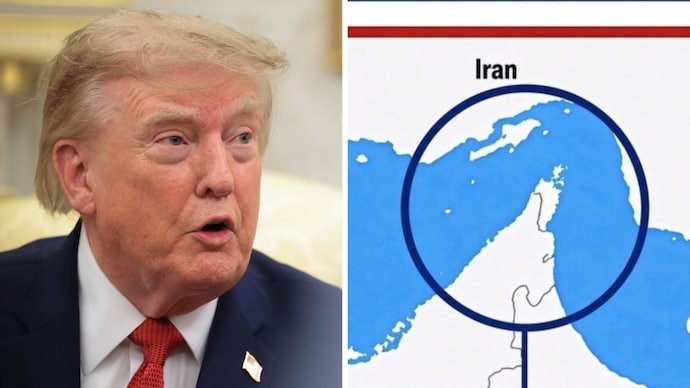
US President Donald Trump has escalated his confrontation with Iran over the Strait of Hormuz, posting a map on Truth Social that labelled the strategically important waterway as “new US territory” while claiming that the United States has “total control” over the passage.
The move adds a striking new dimension to an already tense standoff over the waterway, which connects the Persian Gulf with the Gulf of Oman and the Arabian Sea. Iran, meanwhile, has indicated that the strait will remain closed until Washington meets a series of demands, leaving the future of commercial navigation uncertain.
Trump’s territorial language goes beyond a conventional warning over maritime security. By presenting the waterway as “new US territory” on a publicly shared map, the US president has framed the confrontation in terms of control over a strategically vital passage rather than simply access for commercial shipping.
Trump labels Strait of Hormuz “new US territory”
The map posted by Trump on Truth Social represented the latest escalation in his public confrontation with Iran. Alongside the map, Trump claimed that the United States had “total control” over the Strait of Hormuz.
The declaration comes as Tehran continues to restrict access to the waterway. The result is a standoff in which Washington is asserting control while Iran maintains that normal commercial traffic will not resume until its conditions are addressed.
The Strait of Hormuz is particularly sensitive because of its location. It provides the maritime connection between the Persian Gulf and the waters leading toward the Gulf of Oman and the Arabian Sea. That makes developments around the strait important not only to the countries immediately involved but also to commercial shipping using the route.
Trump’s latest post therefore carries significance beyond its wording. The map places the question of WHO controls the waterway at the centre of the confrontation at a time when Iran is refusing to restore unrestricted navigation.
Why the Strait of Hormuz matters
The Strait of Hormuz is a narrow maritime passage linking the Persian Gulf to the Gulf of Oman and the Arabian Sea. Its geographic position makes it a crucial route for international maritime traffic and energy shipments.
That importance explains why any prolonged disruption can create concern well beyond the immediate US-Iran confrontation. Commercial operators depend on predictable access to major maritime routes, while governments closely monitor developments that could affect energy transportation and regional stability.
The current dispute places that strategic importance under pressure. Iran’s decision to keep the waterway closed means the disagreement is no longer confined to political statements between Washington and Tehran. It directly involves the movement of commercial traffic through one of the world’s most strategically important maritime passages.
For the United States, asserting control over the waterway sends a forceful message about its ability and willingness to influence navigation there. For Iran, maintaining the closure provides leverage in negotiations with Washington.
Iran refuses to reopen the waterway for now
Tehran has made clear that it has no immediate plans to restore unrestricted commercial traffic through the Strait of Hormuz.
Iran’s position is tied to a series of demands that it wants Washington to address before the waterway is reopened. The supplied information does not specify the full list of those demands, but it makes clear that Tehran is treating access to the strait as part of the wider confrontation with the United States.
That creates a direct clash between the two positions. Trump is portraying the United States as having “total control” of the waterway, while Iran is using continued closure to maintain pressure on Washington.
The standoff therefore has two separate but connected questions: who can exercise effective control over navigation and what conditions must be met before Iran allows commercial traffic to resume.
A territorial claim adds a new dimension to the confrontation
Trump’s decision to label the Strait of Hormuz “new US territory” is particularly notable because it changes the language surrounding the dispute.
Control of an international maritime route is normally discussed in terms of navigation, security, access and freedom of movement. Trump’s map instead uses territorial language, giving the issue a much more direct political character.
The supplied material does not establish what legal or diplomatic consequences, if any, follow from Trump’s map. It does, however, show how sharply the rhetoric surrounding the Strait of Hormuz has intensified.
For observers of the US-Iran confrontation, the distinction between political messaging and an actual change in territorial status is important. A social-Media map and a formal territorial or legal action are not the same thing. The available information describes Trump’s post and his claim of control, but does not provide evidence of a formal change in the legal status of the waterway.
The standoff puts navigation at the centre of US-Iran tensions
The Strait of Hormuz has now become a central point of confrontation between Washington and Tehran. Iran’s continued closure gives the country a mechanism for maintaining pressure, while Trump’s claim of American control signals that the United States intends to challenge that position.
The immediate issue is whether commercial shipping can move through the waterway without restriction. As long as the answer remains uncertain, the dispute has the potential to affect businesses and governments that depend on predictable maritime routes.
The confrontation also creates uncertainty over what happens next. If Washington and Tehran reach an understanding that satisfies Iran’s demands, commercial traffic could move toward normalisation. If the disagreement continues, the waterway could remain at the centre of the broader standoff.
What Trump’s “total control” claim means
Trump’s statement that the United States has “total control” of the Strait of Hormuz is one of the strongest claims made in the latest confrontation. However, the supplied material does not provide operational details explaining what Trump means by total control or how that control is being exercised.
That distinction matters. Political statements can communicate intent, but the practical situation on the waterway depends on whether commercial vessels can actually navigate through it safely and without restrictions.
Iran’s continued closure indicates that Tehran still considers itself capable of determining whether unrestricted commercial traffic resumes. Trump’s assertion, meanwhile, indicates that Washington disputes or seeks to overcome that position.
The gap between those two claims is at the heart of the current crisis.
Why the dispute could have wider consequences
The significance of the Strait of Hormuz extends beyond the United States and Iran because it is a major connection between the Persian Gulf and international waters beyond it.
A prolonged restriction on commercial traffic can create uncertainty for companies planning maritime shipments and for governments monitoring Energy Security. The longer uncertainty persists, the more attention is likely to focus on whether alternative routes, diplomatic arrangements or other measures can reduce the impact of the disruption.
However, the supplied information does not provide specific figures on the volume of trade currently affected, changes in oil prices or the number of vessels prevented from passing through the strait. Those details should not be assumed from the political developments alone.
What can be established from the available material is that the waterway’s closure has become an important component of the US-Iran confrontation and that Tehran has linked reopening to demands directed at Washington.
Trump’s message raises questions about what comes next
The next phase of the standoff will depend heavily on whether the United States and Iran can resolve the demands surrounding the waterway.
If Iran maintains its closure, pressure on Washington to respond is likely to remain focused on the Strait of Hormuz. If the United States seeks to enforce Trump’s claim of control, the confrontation could take on an even more direct maritime dimension.
Another possibility is renewed diplomatic engagement aimed at restoring commercial navigation without either side abandoning its broader position. The available information does not establish which path the two countries will take.
What is clear is that the language coming from Washington and the position maintained by Tehran remain far apart. Trump is publicly claiming American control, while Iran is refusing to reopen the waterway until its demands are met.
The difference between rhetoric and a change in control
One of the most important points for readers to understand is the difference between Trump’s public declaration and an established change in the status of the Strait of Hormuz.
The map posted on Truth Social is a political statement. The supplied information does not indicate that the United States has formally incorporated the waterway into US territory through a legal or diplomatic process.
Likewise, Trump’s assertion of “total control” does not by itself demonstrate that unrestricted commercial navigation has been restored. Iran’s continued closure shows that the practical dispute over access remains unresolved.
This distinction is especially important because territorial language can generate an impression of a formal change when the underlying dispute may still be one of military, political and maritime control.
What to watch in the Strait of Hormuz
Several developments will determine how the confrontation evolves.
- Iran’s demands: The key question is whether Tehran changes its position on reopening the waterway and what conditions it requires from Washington.
- US response: Trump’s claim of total control raises questions about how Washington intends to respond to the continued closure.
- Commercial navigation: The restoration of unrestricted traffic would be a major indication that the immediate maritime standoff is easing.
- Further escalation: Additional territorial or military claims could deepen the confrontation and increase uncertainty around the waterway.
- Diplomatic negotiations: Any agreement between Washington and Tehran could provide a path toward reopening the strait.
A strategically important waterway at the centre of a widening dispute
The latest developments have pushed the Strait of Hormuz to the forefront of the US-Iran confrontation. Trump’s decision to label the waterway “new US territory” and his assertion of “total control” represent an unusually forceful statement of American intent.
Iran’s response has been equally significant in practical terms: Tehran is keeping the waterway closed and linking its reopening to demands directed at Washington.
For now, neither side appears to have accepted the other’s position. That leaves the Strait of Hormuz at the centre of an unresolved confrontation in which political rhetoric, maritime access and strategic interests are increasingly intertwined.
The most important development to watch will be whether the dispute moves toward negotiation or further escalation. Until Iran agrees to restore unrestricted commercial traffic, and until Washington and Tehran narrow their differences, the status of the waterway will remain a major point of uncertainty in the confrontation.
For breaking news and live news updates, like us on Facebook or follow us on Twitter and Instagram. Read more on Latest World on thefoxdaily.com.





COMMENTS 0