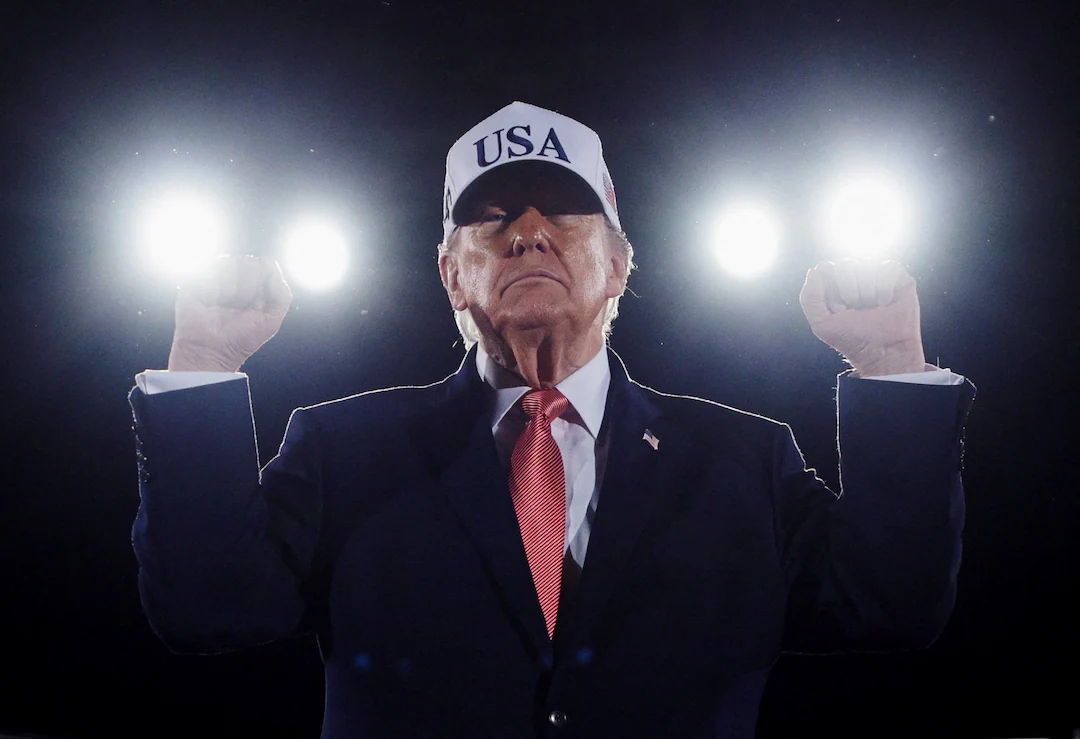
US President Donald Trump has sought to rally Republican voters in North Carolina, predicting strong election results despite mounting political challenges ahead of the November 3 midterm elections. Speaking at a campaign event in Greenville on Tuesday, October 20, Trump urged supporters to back his preferred candidates as Republicans face competitive races that could determine the balance of power in Washington.
Trump’s visit came as polls showed former Democratic Governor Roy Cooper holding a substantial lead over Republican Senate candidate Michael Whatley. The contest is for the seat being vacated by Republican Senator Thom Tillis, whose disagreements with Trump over tax legislation and defence policy have highlighted divisions within the party.
The president has intensified his campaign appearances in recent weeks, travelling more than 29,000 miles since late September to support Republican candidates. His return to North Carolina for a second visit in as many months underscored the importance of the state to the party’s efforts to retain control of Congress.
Despite the difficult polling environment, Trump told hundreds of supporters gathered at the local airport that he expected Republicans to outperform expectations.
“I think you’re gonna see some amazing results,” Trump said, arguing that polls consistently underestimated his political support. He added that Republicans had greater enthusiasm among their supporters.
North Carolina Senate race emerges as a major challenge for Republicans
The Senate contest between Cooper and Whatley has become a significant focus of the midterm campaign. Cooper, a former Democratic governor, has held a commanding lead in multiple polls, while Whatley, a former senior Republican Party official, has struggled to secure the same level of national party support.
The seat is being vacated by Tillis, a former Trump ally who has broken with the president over major policy questions, including a landmark tax bill and defence matters. Tillis offered a bleak assessment of Republican prospects in a Tuesday interview with Politico, warning that his party was heading towards what he described as a “train wreck” in November.
Trump rejected that pessimistic outlook during his Greenville appearance, backing Whatley and predicting that the results would surprise political observers. His remarks reflected an effort to maintain Republican morale and encourage supporters to vote despite unfavourable polling.
However, the Senate Leadership Fund, the main political action committee supporting Republican Senate candidates, stopped spending in North Carolina earlier in October as Cooper continued to post double-digit leads in polls, according to the report.
The withdrawal of that support presents an additional challenge for Whatley, whose campaign is competing in a race that could influence which party controls the Senate after the elections.
Trump’s approval rating falls to a new low
Trump’s campaign push comes as his public approval rating has weakened. According to the latest Reuters/Ipsos survey cited in the report, his approval rating has fallen to 31%, the lowest level recorded during either of his two terms in office.
Economic concerns appear to be contributing to voter dissatisfaction. The survey found that 68% of Americans disapproved of Trump’s handling of the economy, including 37% of respondents who identified themselves as Republicans.
Rising gasoline and diesel prices have added to those concerns following the military strikes on Iran ordered by Trump in February alongside Israel. The resulting conflict has intensified pressure on energy markets, making fuel costs a prominent issue for households and businesses.
Democrats are seeking to turn dissatisfaction over prices and the administration’s policies into electoral gains. While Trump won North Carolina in all three of his presidential campaigns, the midterm contest presents a different political test, with voters weighing the performance of the administration and the candidates seeking congressional seats.
Early voting figures raise questions for Republicans
Early voting data in North Carolina offered another challenge for Republicans. According to state figures cited in the report, Democrats had cast ballots at twice the rate of Republicans during the early-voting period.
The figures suggest stronger early participation among Democratic voters, although they do not establish how the final election results will turn out. Election outcomes will also depend on turnout on polling day, voter preferences among those who have not yet voted and the competitiveness of individual races.
Republican candidates used Trump’s appearance to urge supporters to participate early and maintain the party’s position in the state.
“This is a Republican majority district,” said Laurie Buckhout, a Trump-backed candidate running for a congressional seat in a largely rural eastern district. “We have the momentum. We have the message. Now we need you.”
Buckhout is challenging Democratic Representative Don Davis in a race that has attracted substantial outside spending. Republicans currently hold 10 of North Carolina’s 14 House seats, but several districts are considered competitive this election cycle.
Millions of dollars flow into competitive House races
North Carolina’s congressional contests have attracted significant financial backing from outside groups, reflecting the importance of the state to the broader battle for control of the House of Representatives.
A Reuters analysis of campaign filings found that outside groups had spent $21 million on the race between Buckhout and Davis since September 1. That made it the third-most expensive contest in the country during the period covered by the analysis.
In western North Carolina, outside groups had spent $14.5 million on the race between Democrat Jamie Ager and Republican Jennifer Balkcom.
The spending reflects the stakes for both parties as they attempt to win competitive districts. Republicans are defending their existing House majority, while Democrats are looking for opportunities to gain seats amid public dissatisfaction with the administration.
Although Trump’s visit was designed to boost Republican candidates, the scale of spending and the concentration of political attention in closely contested districts show how much the outcome may depend on local races as well as the national political environment.
Voters express frustration over fuel prices and White House policies
Economic concerns featured prominently in accounts from voters in Greenville. Taylor Smith, who described herself as a housewife and said she had always voted Republican, told Reuters that the Trump administration’s internal turmoil had made her reconsider her political support.
Smith said disorganisation within the White House appeared to be affecting policy decisions and described the administration as lacking focus.
“Anything good that could be happening is being co-opted by the tomfoolery that’s just going on,” she said.
She also criticised high fuel prices and urged the president to “tighten that ship up”. Her comments illustrate the challenge facing Republicans as they try to maintain support among voters who have traditionally backed the party but are concerned about the economy and the administration’s direction.
Fuel costs can have a direct effect on household budgets and transportation expenses, making changes at the petrol pump a highly visible measure of economic conditions for voters. Continued dissatisfaction over prices could complicate Republican efforts to persuade voters that the administration’s policies are delivering tangible benefits.
Trump highlights proposed investments in North Carolina
During the Greenville rally, Trump also highlighted what he described as new investments in North Carolina, seeking to emphasise economic development and industrial activity.
Commerce Secretary Howard Lutnick announced on stage that Sibelco, an industrial minerals mining and processing company, was expanding its operations in the state. He did not provide specific details about the scale of the expansion, and the company did not immediately respond to a request for comment.
Trump also said the US Department of Defense would invest $1.5 billion in semiconductor chip production in North Carolina. He did not identify the location of the proposed investment or explain how the money would be allocated.
The announcements formed part of the president’s broader effort to highlight manufacturing and investment during campaign appearances. However, the available details did not establish the timeline, scope or implementation arrangements for the investments mentioned at the rally.
Trump promises $5,000 payments if Republicans retain Congress
Towards the end of his speech, Trump repeated a promise to give $5,000 to every American adult if Republicans maintained their hold on Congress after the midterm elections.
“If we lose,” he said, “you get nothing.”
The pledge was presented as part of his appeal for Republican support, linking the party’s electoral fortunes to a proposed financial benefit for voters. The remarks, however, did not provide details about how the payments would be funded, who would qualify or what legislative steps would be required to implement the proposal.
The promise came as the president sought to energise supporters despite concerns about inflation, fuel prices and his declining approval rating. Whether the proposal influences voters will depend in part on how they assess its feasibility alongside other economic and political issues.
What North Carolina means for the 2026 midterm elections
North Carolina has emerged as an important battleground for both parties because its Senate and House contests could affect the balance of power in Washington. Trump’s decision to return to the state reflects the importance Republicans attach to defending their congressional position.
The Senate race between Cooper and Whatley is particularly significant, given the polling advantage enjoyed by the Democratic candidate and the decision by a major Republican Senate fundraising group to withdraw its spending from the contest. Meanwhile, expensive House races in eastern and western North Carolina show that both parties are investing heavily in districts where the outcome remains contested.
Republicans are attempting to counter these challenges through campaign appearances, appeals for early voting and promises of investment. Democrats, meanwhile, are seeking to capitalise on dissatisfaction over the economy, fuel prices and the administration’s handling of the Iran conflict.
Trump has predicted that Republicans will outperform expectations, but the available polling and early-voting figures point to significant challenges for his party. The final outcome will depend on turnout, individual candidates’ performances and voters’ assessments of the national and local issues shaping the campaign.
With the November 3 midterm elections approaching, North Carolina is set to remain a major focus of the contest over congressional control, offering an important test of whether Trump’s campaign efforts can overcome the political headwinds facing Republicans.
For breaking news and live news updates, like us on Facebook or follow us on Twitter and Instagram. Read more on Latest World on thefoxdaily.com.




COMMENTS 0