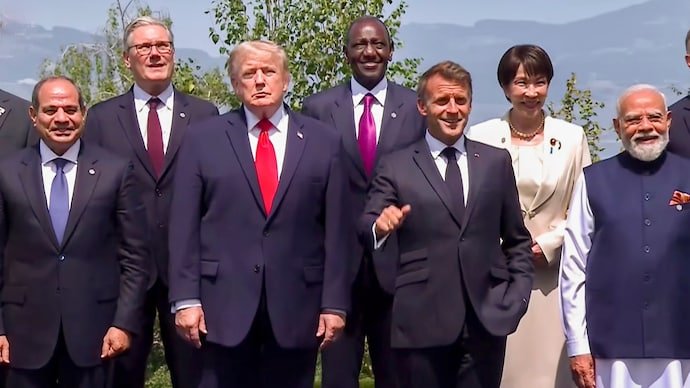
Few World Leaders understand the power of a headline better than US President Donald Trump. Whether through policy announcements, campaign rallies, social media posts, or off-the-cuff remarks, Trump has built a political brand around commanding attention. His latest viral moment came during the G7 Summit in France, where he walked into a meeting of world leaders and casually declared, “I am the boss.”
The comment immediately generated global media coverage, political debate, and countless social media reactions. Was it a joke? A display of confidence? A reflection of America’s influence? Or simply another example of Trump’s ability to keep himself at the center of every major event?
Now, in an interview with Axios, Trump has offered his explanation, insisting that the remark was intended as a humorous and light-hearted comment rather than a serious declaration of authority.
Yet the episode raises broader questions about Leadership styles, Global Diplomacy, political communication, and Trump’s unique approach to International Relations.
What Happened at the G7 Summit?
The incident occurred during a gathering of world leaders at the G7 Summit in France.
According to Trump’s account, several leaders were already seated around a large conference table when he entered the room.
As he walked in, Trump reportedly looked around and remarked:
“I am the boss.”
The comment drew laughter from leaders present at the meeting and quickly became one of the most talked-about moments of the summit.
What might have remained a brief humorous exchange soon became international news, generating discussion across political circles, media outlets, and social platforms.
Trump’s Explanation: “I Was Just Being Funny”
In his interview with Axios, Trump addressed the widespread attention surrounding the remark.
When asked how many world leaders actually believed he was the boss, Trump initially replied:
“All of them. But I was just being funny.”
He later clarified that he did not intend the statement literally.
According to Trump, the setting itself inspired the joke. He described entering a room containing a very large conference table designed for many more attendees than were actually present.
The unusual arrangement, he said, made the moment feel humorous.
Trump emphasized multiple times that the comment was spontaneous and not part of any prepared remarks.
He stated that he was trying to be “cute and funny” rather than assert dominance over the other leaders.
Why the Comment Went Viral
Many politicians make jokes during international meetings, yet few generate worldwide headlines.
The reason Trump’s remark spread so rapidly lies in the unique combination of his personality, political reputation, and global influence.
Several factors contributed to its viral nature:
- Trump’s reputation for bold statements.
- The setting involving major world leaders.
- The timing following major diplomatic developments.
- Public curiosity about international power dynamics.
- Social media’s tendency to amplify memorable moments.
For supporters, the remark reflected confidence and humor. For critics, it reinforced perceptions of an overly dominant leadership style.
Regardless of interpretation, it achieved something Trump has consistently mastered throughout his political career: commanding attention.
The Context: A Summit Dominated by Trump
The comment did not occur in isolation.
Trump arrived at the summit following a period of significant diplomatic activity involving the United States and Iran.
Recent negotiations contributed to easing tensions in the Middle East and helped facilitate the reopening of the Strait of Hormuz, one of the world’s most strategically important energy corridors.
As a result, Trump entered the summit with considerable political momentum.
Many discussions during the gathering revolved around issues where US influence remained central, including:
- Global trade.
- Energy security.
- Middle East stability.
- Economic cooperation.
- Geopolitical risk management.
This broader context helps explain why even a seemingly casual joke attracted so much attention.
Who Was in the Room?
The meeting included several influential world leaders participating in discussions on trade, economic growth, and international cooperation.
Among those present were:
- :contentReference[oaicite:0]{index=0}
- :contentReference[oaicite:1]{index=1}
- :contentReference[oaicite:2]{index=2}
- Other heads of government and invited participants.
Trump specifically referenced Modi during the interview, describing him as a “great guy” while discussing the gathering.
The presence of multiple prominent leaders contributed to the significance of the moment and its subsequent media coverage.
The Rise of Personality-Driven Diplomacy
The incident highlights a broader trend in modern international relations: personality-driven diplomacy.
Historically, diplomatic engagements often emphasized carefully scripted statements and formal protocols.
Today’s political Environment is different.
Leaders increasingly communicate directly with global audiences through television, social media, interviews, and unscripted interactions.
As a result, personality often becomes as important as policy.
Trump represents one of the clearest examples of this shift.
His approach frequently relies on:
- Humor.
- Informal language.
- Unexpected remarks.
- Media-friendly moments.
- Direct audience engagement.
This style helps generate attention but can also create ambiguity regarding intent.
Was the Remark Really Just a Joke?
The answer depends partly on perspective.
On one level, Trump’s explanation appears plausible. Leaders often make light-hearted comments during meetings, particularly when entering a room or breaking tension before discussions begin.
At the same time, political communication experts often note that jokes can serve multiple purposes.
A humorous remark may simultaneously:
- Entertain an audience.
- Project confidence.
- Establish presence.
- Signal authority.
- Shape media narratives.
Whether intentional or not, the “I am the boss” comment reinforced Trump’s image as a leader comfortable occupying the center of attention.
How Global Leadership Has Changed
The episode also reflects changing expectations surrounding political leadership.
In previous decades, international summits were largely defined by policy announcements and diplomatic communiqués.
Today, viral moments often receive equal or greater attention.
| Traditional Diplomacy | Modern Political Communication |
|---|---|
| Formal speeches | Viral moments |
| Official statements | Social media clips |
| Closed-door negotiations | Public personality branding |
| Protocol-focused | Audience-focused |
| Policy-driven headlines | Leader-driven headlines |
Trump’s comment perfectly illustrates this transformation.
India’s Growing Role at Global Summits
An important aspect of Trump’s remarks was his reference to India and Prime Minister Modi.
Although India is not a permanent member of the G7, it has increasingly been invited as a guest participant due to its growing economic and geopolitical influence.
India’s expanding role reflects several factors:
- Rapid economic growth.
- Strategic importance in Asia.
- Leadership within the Global South.
- Increasing influence in technology and manufacturing.
- Growing diplomatic engagement worldwide.
The regular presence of Indian leadership at major global forums demonstrates how international institutions are adapting to changing geopolitical realities.
A Unique Insight: Trump Understands the Attention Economy Better Than Most Leaders
Perhaps the most overlooked aspect of the Controversy is not whether Trump intended the remark seriously but how effectively it captured global attention.
In today’s media environment, attention itself has become a form of political capital.
Many leaders spend significant resources attempting to generate public engagement. Trump often accomplishes the same objective with a single spontaneous comment.
Whether one agrees with his style or not, his ability to dominate news cycles remains one of his most powerful political skills.
The fact that a brief joke during a summit generated worldwide discussion days later demonstrates the effectiveness of that approach.
What the Incident Reveals About Trump’s Leadership Style
Trump’s explanation offers insight into how he views leadership and public communication.
Several characteristics stand out:
- Comfort with improvisation.
- Preference for direct communication.
- Use of humor as a political tool.
- Confidence in high-profile settings.
- Willingness to challenge conventional diplomatic norms.
These traits have defined his political career and continue to distinguish him from many contemporary leaders.
Future Outlook
The “I am the boss” remark will likely be remembered as one of the lighter moments of the G7 Summit, but it also reflects broader trends in global Politics. As diplomacy becomes increasingly public and media-driven, leaders are likely to continue using personality and spontaneity as communication tools.
For Trump, the incident reinforces a familiar pattern: even when discussing major geopolitical issues, he remains capable of turning a casual moment into an international headline.
Whether viewed as humor, confidence, or strategic messaging, the remark succeeded in keeping attention firmly focused on him throughout the summit.
Conclusion
Donald Trump’s viral “I am the boss” comment at the G7 Summit may have been intended as a joke, according to his own explanation. Yet the widespread reaction demonstrates how even casual remarks can carry significant weight when made by one of the world’s most recognizable political figures.
The episode highlights the evolving nature of global diplomacy, where personality, media narratives, and public perception increasingly shape international discourse alongside traditional policy discussions. While Trump insists he was simply being funny, the moment ultimately served as another reminder of his unique ability to dominate political conversations on the world stage.
In modern politics, sometimes a single unscripted sentence can generate as much attention as an entire summit—and few leaders understand that reality better than Donald Trump.
For breaking news and live news updates, like us on Facebook or follow us on Twitter and Instagram. Read more on Latest World on thefoxdaily.com.



COMMENTS 0