- A Familiar Headline with Unfamiliar Implications
- What Makes Cluster Munitions So Significant?
- From Nuclear Deterrence to Tactical Flexibility
- The Technology Behind the Test
- Why Timing Matters More Than Ever
- The Influence of Modern Warfare Trends
- Regional Security: A Growing Challenge for Defenses
- A Subtle Message in Plain Sight
- Cluster Munitions vs Traditional Warheads: Why the Difference Matters
- The Bigger Picture: A Changing Nature of Conflict
- What Comes Next?
- Conclusion: A Quiet Shift with Loud Consequences
A Familiar Headline with Unfamiliar Implications
North Korea testing missiles is no longer unusual. It happens often enough that headlines can start to blur together launch detected, leaders condemn, tensions rise, repeat.
But the latest development stands apart. This time, the focus isn’t just on the missile it’s on what the missile is carrying.
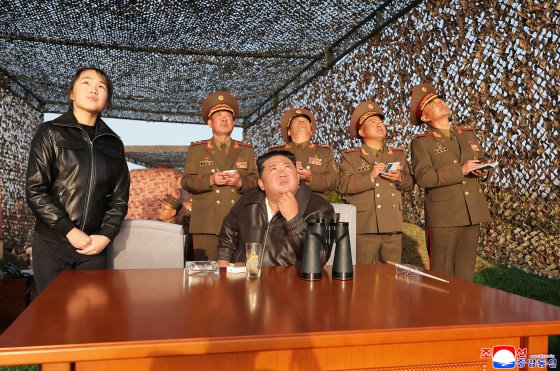
In April 2026, North Korea conducted another round of launches off its east coast, testing ballistic missiles equipped with cluster munitions. The tests were personally observed by leader Kim Jong Un, accompanied by his daughter a detail that adds a layer of political symbolism to an already significant military event.
At first glance, this may seem like a technical upgrade. In reality, it signals something far more consequential: a shift in how North Korea may plan to fight not just deter future conflicts.
What Makes Cluster Munitions So Significant?
To understand why this test matters, it’s important to look at the weapon itself.
Cluster munitions are designed to open mid-air and release dozens of smaller explosives over a wide area. Instead of a single, concentrated blast, they create a spread of impacts that can cover entire fields, runways, or military formations.
This makes them highly effective in certain battlefield scenarios but also deeply controversial.
- They can strike multiple targets simultaneously
- They are difficult to intercept once dispersed
- Unexploded submunitions can remain lethal long after a conflict ends
Because of these risks, much of the world has moved to ban them. Yet several key military powers have not, arguing that such weapons still hold strategic value. North Korea’s latest test suggests it is doubling down on that belief.
From Nuclear Deterrence to Tactical Flexibility
For years, North Korea’s military identity has been built around its nuclear program. nuclear weapons serve as a powerful deterrent but they also come with limitations. They are, by design, weapons that are difficult to use without triggering catastrophic escalation.
What Pyongyang appears to be doing now is expanding beyond that framework.
By integrating cluster munitions into short-range ballistic missiles, North Korea is developing weapons that are:
- Less escalatory than nuclear arms
- More practical in regional conflicts
- Capable of overwhelming defenses through volume
This reflects a broader shift from relying solely on deterrence to building a toolkit for actual battlefield engagement. In simple terms, these are weapons that could realistically be used not just threatened.
The Technology Behind the Test
The missiles used in the recent launches are believed to be part of the Hwasong-11 family, a class of short-range ballistic missiles designed for tactical operations. Unlike long-range systems aimed at distant continents, these are intended for targets much closer to home primarily South Korea and nearby regions.
The key upgrade lies in their payload flexibility.
Instead of carrying a single warhead, these missiles can now disperse multiple submunitions, turning each launch into a wide-area attack. This has two major advantages from a military perspective:
- It increases the likelihood of hitting multiple targets in a single strike
- It complicates interception by missile defense systems
Modern missile defenses are highly advanced, but they are not invincible. They are typically designed to track and destroy individual incoming warheads. A cluster payload changes the equation by multiplying the number of threats mid-flight.
Why Timing Matters More Than Ever
North Korea’s weapons tests are rarely random. They are often timed to coincide with broader geopolitical developments and this case appears no different.
With major diplomatic activity expected in the coming months, including high-level international engagements involving key global powers, the timing of these tests suggests a deliberate strategy.
By demonstrating new capabilities now, Pyongyang may be aiming to:
- Strengthen its bargaining position in potential negotiations
- Remind the world of its growing military sophistication
- Shape the agenda before talks even begin
This is a familiar pattern. North Korea has long used military demonstrations not just as defense measures, but as tools of Diplomacy.
The Influence of Modern Warfare Trends
Another factor that cannot be ignored is the influence of ongoing global conflicts. Military planners around the world closely study real-world battlefields, looking for tactics that work and adapting them quickly.
Recent conflicts have shown how difficult it can be to defend against weapons that saturate an area rather than strike a single point. Cluster munitions, in particular, have proven effective at challenging even advanced air defense systems.
North Korea appears to be applying those lessons.
This highlights a broader trend: warfare is becoming more adaptive, more experimental, and more interconnected. What happens in one region increasingly shapes strategies in another.
Regional Security: A Growing Challenge for Defenses
For countries in East Asia, the implications are immediate.
South Korea and Japan both rely heavily on missile defense systems designed to intercept incoming threats. These systems are highly capable but they face new challenges when dealing with cluster payloads.
Instead of tracking one target, they may need to deal with dozens. This creates pressure on both technology and response time.
The risks include:
- Defense systems becoming overwhelmed during coordinated attacks
- Critical infrastructure facing increased vulnerability
- Shorter decision windows in crisis situations
For the United States, which provides security guarantees in the region, the challenge is strategic. Maintaining credible defense commitments becomes more complex as threats evolve.
A Subtle Message in Plain Sight
One of the most intriguing aspects of the launch had nothing to do with the missile itself.
Kim Jong Un was accompanied by his daughter, a figure who has appeared more frequently in recent public events. While this might seem like a personal detail, it carries deeper political meaning.
In a highly controlled political system, public appearances are rarely accidental. Bringing her to such a significant military event sends multiple signals:
- Continuity of leadership
- Confidence in long-term stability
- A reminder that the current strategy is not temporary
It’s a subtle but powerful form of messaging one aimed as much at domestic audiences as at the international community.
Cluster Munitions vs Traditional Warheads: Why the Difference Matters
| Factor | Cluster Munitions | Conventional Warheads |
|---|---|---|
| Strike Pattern | Wide-area dispersion | Single-point impact |
| Defense Complexity | High | Moderate |
| Battlefield Role | Area denial and saturation | Precision targeting |
| Post-Conflict Risk | Significant due to unexploded bomblets | Relatively limited |
The Bigger Picture: A Changing Nature of Conflict
The real significance of this test goes beyond North Korea itself. It reflects a broader transformation in how wars may be fought in the future.
We are entering an era where:
- Weapons are designed to overwhelm rather than outmatch
- The line between conventional and strategic systems is increasingly blurred
- Technological adaptation is happening faster than diplomatic response
In this environment, even incremental changes like adding a new type of warhead can have outsized consequences.
What Comes Next?
Looking ahead, several trends are likely to continue.
- North Korea will likely conduct further tests to refine these capabilities
- Regional powers will invest more heavily in advanced defense systems
- Diplomatic efforts will intensify but with growing complexity
Perhaps the most important question is whether global institutions and agreements can keep pace with these changes. So far, the answer remains uncertain.
Conclusion: A Quiet Shift with Loud Consequences
The latest developments surrounding North Korea’s cluster munitions test may not carry the immediate shock of a nuclear breakthrough, but they represent something equally important: evolution.
By moving toward more flexible, more deployable weapons, North Korea is reshaping its military strategy in ways that could lower the threshold for conflict while increasing its potential impact.
It’s a reminder that in today’s world, the most significant changes are not always the most dramatic ones. Sometimes, they arrive quietly embedded in the details of a Missile Test before reshaping the rules entirely.
And that is exactly what makes this moment worth watching.
For breaking news and live news updates, like us on Facebook or follow us on Twitter and Instagram. Read more on Latest World on thefoxdaily.com.






COMMENTS 0