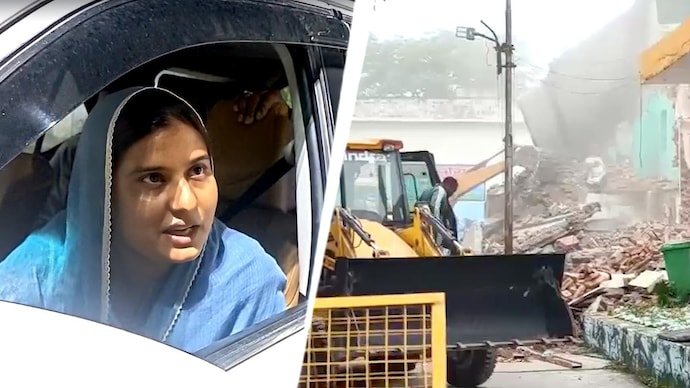
Samajwadi Party MP Iqra Hasan has alleged that she was placed under house arrest at her Kairana residence after authorities moved to demolish a mosque located inside the Saharanpur District Magistrate’s office complex. The demolition followed a legal dispute over whether the structure was illegally occupying government land.
Hasan, who represents the Kairana Lok Sabha constituency, said a large police deployment arrived outside her residence when she was preparing to travel to Saharanpur to meet officials and raise the concerns of people affected by the action. She alleged that the police presence effectively prevented her from leaving.
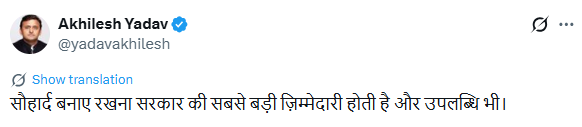
The incident has quickly developed into a political controversy, with Samajwadi Party chief Akhilesh Yadav responding with a brief but pointed message on social media. Bahujan Samaj Party chief Mayawati also criticised the demolition, arguing that authorities should exercise greater caution when dealing with religious structures.
The mosque itself had been the subject of proceedings before the City Magistrate and subsequent judicial review. A district court decision on September 4 upheld the earlier finding that the structure was illegal, clearing the way for the administration to carry out the demolition.
Iqra Hasan alleges she was placed under house arrest
Iqra Hasan said she intended to travel from Kairana to Saharanpur after learning about the administration’s action. According to her, a substantial police force was deployed outside her residence to prevent her from making the journey.
The MP questioned the democratic implications of restricting an elected representative from travelling to meet government officials on an issue affecting constituents.
She argued that public representatives are expected to communicate the concerns of people in their constituencies and said stopping her from reaching Saharanpur amounted to an attempt to suppress that voice.
The allegation has become one of the central political issues surrounding the demolition. The administration, however, has framed its security arrangements in terms of preventing possible unrest around a sensitive dispute rather than as an action directed specifically at the MP.
Why Saharanpur matters to Iqra Hasan
Although Hasan represents Kairana, the Saharanpur district falls within the Kairana Lok Sabha constituency. That gives the MP a direct political connection to the area and provides context for her decision to intervene after the demolition.
Her stated intention was to meet officials and discuss the concerns arising from the removal of the religious structure. The dispute therefore quickly moved from a property and administrative matter into a question of political representation and law-and-order management.
The timing was also significant. Authorities carried out the demolition under heavy security after a district court upheld the previous order, indicating that officials anticipated the possibility of Protests or confrontation.
What happened to the Saharanpur mosque?
The mosque stood inside the Saharanpur collectorate complex, the same government premises where district-level administrative functions are carried out.
The dispute centred on the administration’s claim that the structure had been built on government land without legal authorisation. Authorities also maintained that the presence and use of the premises created security and confidentiality concerns because the collectorate houses sensitive government operations.
The issue had been pending for months before the latest demolition. In July, City Magistrate Kuldeep Singh ruled against the occupants and ordered the structure to be removed while also imposing a financial liability of approximately Rs 6.41 crore.
The order was subsequently challenged, but the district judge’s court dismissed the appeal on September 4. That decision removed a major legal obstacle to the administration’s implementation of the demolition order.
The complaint that triggered the dispute
The case originated with a complaint filed by Vikas Tyagi, a former provincial coordinator of the Bajrang Dal. Tyagi alleged that the mosque had been constructed illegally within the government complex.
The complaint went beyond the question of religious construction. It also alleged that parts of the premises were being used for commercial purposes, including a post office and rooms that were rented to outsiders.
According to the allegations presented in the case, the mosque management committee was collecting rent from those using the additional spaces. The administration considered these activities relevant because they allegedly represented a misuse of government property.
These claims formed part of the proceedings that eventually resulted in the order declaring the occupation unauthorized.
Why did the administration order demolition?
City Magistrate Kuldeep Singh’s order treated the structure as an encroachment and directed its removal. Authorities cited not only the alleged occupation of government land but also concerns about how the premises were being used.
Officials argued that the location of the structure inside a government office complex raised issues involving security and confidentiality. The collectorate is a sensitive administrative area, and the presence of an unauthorized structure and unrelated activities was presented as incompatible with its official use.
The administration’s position is therefore that the demolition was an enforcement action based on the legal status and use of government property, rather than a decision based solely on the religious identity of the structure.
Critics, however, argue that demolitions involving places of worship require particular caution because of their potential to create social tension and because legal compliance must be demonstrated at every stage.
Akhilesh Yadav’s cryptic reaction
The demolition and Hasan’s alleged house arrest drew a brief response from Samajwadi Party president Akhilesh Yadav. Rather than directly referring to the court proceedings or the police action, Yadav posted a short message focusing on the government’s responsibility to preserve social harmony.
His remarks reflected the broader political framing adopted by the Samajwadi Party, which has accused the BJP-led Uttar Pradesh government of preventing Hasan from travelling to Saharanpur so that she could not raise the issue with officials.
The response is significant because the party has positioned the incident as more than a dispute over government land. For the Samajwadi Party, the allegations involving Hasan’s movement and the demolition raise questions about the treatment of elected representatives, religious sensitivities and the government’s approach to law-and-order situations.
Mayawati also criticises the demolition
Bahujan Samaj Party chief Mayawati separately criticised the demolition, describing the government’s approach toward religious structures declared illegal as excessively hasty.
In a detailed social media post, she called for such demolition drives to be stopped and argued that alternative legal solutions should be explored wherever possible.
Mayawati’s intervention adds another political dimension to the dispute because the BSP has historically sought to maintain a position that combines constitutional governance with protections for communities across religious lines.
She said a constitutional and secular government has an obligation to provide equal respect and protection to people of different religions and to their places of worship.
Mayawati raises broader concerns about demolitions
The BSP leader also expanded her criticism beyond the Saharanpur mosque. She raised concerns about cases in which houses belonging to people accused of crimes are demolished without following proper legal procedures.
Her argument focused on the principle of individual responsibility: an accused person may face legal action, but family members and other occupants should not automatically become targets of collective punishment.
She called for the rule of law to be enforced through legal procedures and urged the government and judiciary to examine contentious demolition cases carefully.
Her remarks place the Saharanpur controversy within a larger debate in Uttar Pradesh over the use of demolition as an administrative or enforcement tool.
The legal dispute did not begin with the demolition
The demolition was the final step in a dispute that had been developing for a considerable period. In July 2026, the City Magistrate’s court ruled that the mosque was an unauthorized structure on government land and ordered its removal.
The order also imposed a financial liability of roughly Rs 6.41 crore on the occupants. The mosque’s side challenged the decision, and the matter subsequently reached the district judge’s court.
On September 4, the district court rejected the challenge and upheld the earlier decision. The administration then proceeded with the demolition under heightened security arrangements.
This sequence is important because the latest action was not simply an overnight administrative decision. It followed a chain of proceedings in which the legality of the structure had already been considered by two levels of the local judicial system.
Dispute over the mosque’s age
Another issue that emerged during the legal proceedings concerned the history of the structure. The mosque’s side reportedly claimed that it was several decades old, with some accounts putting forward an even older origin.
However, the courts did not find sufficient documentary evidence to establish the historical claim in a manner that would override the administration’s position concerning the legal status of the occupation.
This distinction matters in property disputes. The age of a structure does not automatically establish legal ownership or authorisation, particularly when the underlying dispute concerns government land and statutory rules governing public premises.
The legal proceedings therefore focused on evidence relating to occupation, use and authorisation rather than the religious character of the structure alone.
Heavy police deployment after the court ruling
The administration maintained a significant security presence during the demolition because of the sensitive nature of the issue. Authorities appeared determined to prevent gatherings from escalating into protests or clashes.
The alleged deployment of police outside Hasan’s residence was part of the wider preventive-security measures that accompanied the operation, although the MP interpreted the action as an attempt to stop her from carrying out her political responsibilities.
The administration’s explanation and Hasan’s allegation represent two different interpretations of the same security operation. A final assessment would depend on official records concerning the orders issued to police and the exact restrictions placed on the MP’s movement.
Why the Saharanpur demolition is politically sensitive
Religious structures located on government land occupy a particularly sensitive space in Indian public life. Authorities have a legal responsibility to protect public property and enforce land-use rules, but actions involving places of worship can have consequences extending far beyond the immediate Property Dispute.
That tension is visible in Saharanpur. The administration has emphasized legality, government land and security concerns, while opposition leaders have focused on religious sensitivities, due process and political restrictions.
The controversy is therefore unlikely to remain confined to the original question of whether the structure was authorized. It also raises questions about how governments should enforce court orders when the subject is a place of worship and how political representatives should be treated during sensitive operations.
Uttar Pradesh’s wider demolition debate
The Saharanpur case comes amid a broader debate in Uttar Pradesh over the removal of religious structures that authorities say were illegally constructed or occupy public land.
Supporters of such actions argue that government land cannot be occupied indefinitely because a structure has acquired religious significance over time. They say the law must apply equally to all unauthorized construction.
Critics respond that demolition involving religious sites should be handled with exceptional procedural safeguards and sensitivity. They also point to judicial scrutiny of demolition practices and the need to ensure adequate notice, hearings and compliance with court directions.
The legal framework surrounding demolitions has become an increasingly important issue because the consequences can extend beyond the structure itself to residents, surrounding businesses and the broader social Environment.
What happens next in the Iqra Hasan case?
The political dispute surrounding Hasan’s alleged house arrest could continue even after the demolition has been completed. Questions remain about the precise legal basis for preventing her from travelling and whether the administration formally ordered restrictions on her movement.
The mosque dispute itself could also continue through further legal proceedings depending on whether the affected parties seek additional remedies. The district court’s decision is a significant development, but legal disputes over property, compensation and procedural compliance can extend beyond a single demolition action.
For the Samajwadi Party, the incident provides another opportunity to challenge the Uttar Pradesh government’s handling of sensitive law-and-order and religious matters. For the BJP-led administration, the central argument remains that enforcement was based on the legal status of an encroachment inside a government complex.
A legal dispute that has become a political flashpoint
The Saharanpur mosque demolition has brought together several issues that rarely remain separate in Uttar Pradesh politics: government land, religious sites, judicial orders, preventive policing and the role of elected representatives.
Iqra Hasan’s allegation of house arrest has added a political confrontation to an already sensitive legal dispute, while Akhilesh Yadav’s message and Mayawati’s criticism show that opposition parties see wider implications in the administration’s approach.
At the same time, the demolition followed a judicial process in which the structure was declared unauthorized and a subsequent appeal was dismissed. The central challenge now is ensuring that the competing claims over legality, due process, public order and religious sensitivity are examined separately rather than reduced to a purely political confrontation.
As the controversy develops, attention will remain on whether further legal challenges are filed, how authorities justify the restrictions placed on Hasan and whether the Saharanpur action becomes part of a larger debate over the removal of religious structures from government land across Uttar Pradesh.
For breaking news and live news updates, like us on Facebook or follow us on Twitter and Instagram. Read more on Latest India on thefoxdaily.com.






COMMENTS 0