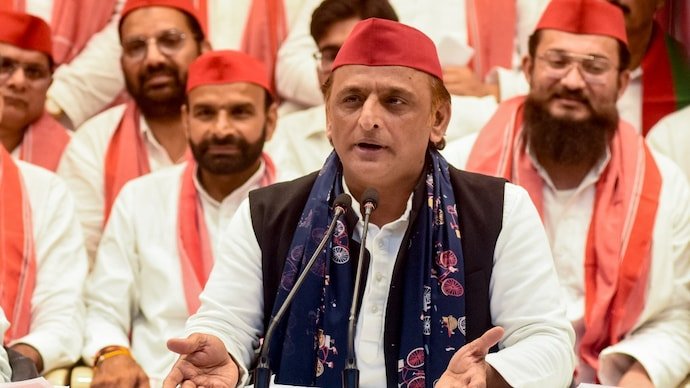
Samajwadi Party chief Akhilesh Yadav has stepped up his political campaign for the 2027 Uttar Pradesh assembly election, accusing the BJP government led by Chief Minister Yogi Adityanath of being the most corrupt administration in the state’s history.
The SP has begun a booth-level organisational campaign aimed at strengthening its presence across Uttar Pradesh well before voters return to the polls. Yadav said district presidents and members of district executive committees would be tasked with highlighting what the party describes as corruption and the alleged “humiliation” of backward classes, Dalits and minorities.
The campaign reflects the SP’s attempt to convert its performance in the 2024 Lok Sabha election into a stronger challenge for the state Assembly polls. The party is also relying heavily on its PDA strategy, referring to Pichhda, Dalit and Alpsankhyak, or backward classes, Dalits and minorities.
Rather than waiting for the formal election campaign to begin, the party is seeking to build its organisation at the grassroots level and establish its political narrative early.
Why the Samajwadi Party is starting its 2027 campaign early
Uttar Pradesh is India‘s most populous state and has a particularly large and politically competitive Assembly. Winning an election there requires more than a strong statewide campaign; parties also need effective booth-level organisation and the ability to mobilise voters locally.
The SP’s latest initiative is designed around that reality.
Yadav said the party’s district-level functionaries would begin publicly raising issues that the SP believes could influence voters, particularly allegations of corruption and concerns involving PDA communities.
The move also gives the party considerable time to identify organisational weaknesses before the 2027 election.
For the SP, the challenge is to turn the momentum of the 2024 Lok Sabha election into an Assembly-level victory. That requires maintaining voter support across constituencies where parliamentary and state-level voting behaviour can differ significantly.
SP’s electoral journey from 2022 to 2024
The political backdrop to the new campaign is the SP’s changing electoral position in Uttar Pradesh.
The party won 111 seats in the 2022 Uttar Pradesh Assembly election. It remained in opposition after that election, with the BJP retaining power in the state.
Two years later, however, the SP emerged as Uttar Pradesh’s largest party in the 2024 Lok Sabha election, winning 37 seats.
That performance significantly changed the political conversation around the party. The SP demonstrated that its organisational network and social coalition could produce a strong result in a statewide parliamentary contest.
The challenge now is whether that coalition can be maintained and expanded in an Assembly election.
The 2027 contest will therefore be an important test of whether the 2024 result represented a lasting shift in Uttar Pradesh Politics or a combination of circumstances specific to the Lok Sabha election.
PDA remains at the centre of Akhilesh Yadav’s strategy
Yadav’s latest campaign announcement places the PDA bloc at the centre of the SP’s electoral strategy.
The party has increasingly sought to broaden its traditional support base by bringing backward classes, Dalits and minorities together under a common political framework.
For the SP, the appeal of the strategy is straightforward: Uttar Pradesh’s social composition is highly diverse, and a broad coalition can be electorally powerful if the party can translate it into votes across constituencies.
But maintaining such a coalition requires more than a slogan. The party must convince different social groups that their interests will be represented and that the organisation has enough strength at the local level to compete effectively.
That is one reason the booth-level campaign matters.
By placing district and grassroots functionaries at the heart of the initiative, the SP is trying to ensure that its PDA message reaches voters through local political networks rather than remaining limited to speeches by senior leaders.
Corruption becomes a major campaign issue
Yadav’s most aggressive criticism was directed at the BJP government over allegations of corruption.
He described the current dispensation as the most corrupt Uttar Pradesh had seen, making the issue one of the central themes of the SP’s early campaign.
The accusation is political in nature and reflects the opposition party’s broader effort to create an alternative narrative around the BJP’s governance record.
Yadav also accused the government of “selling” government institutions and questioned its handling of public assets.
Such claims are likely to become part of the SP’s campaign material as the party begins its booth-level outreach.
For an opposition party, corruption allegations can serve two purposes: they allow it to attack the incumbent government’s record while giving local workers a set of issues to raise with voters.
The effectiveness of that strategy will depend on whether voters view the allegations as credible and whether the SP can connect them to issues affecting everyday life.
The JPNIC dispute adds another political flashpoint
One of the specific issues raised by Yadav concerns the Jayaprakash Narayan International Centre in Lucknow.
The JPNIC has become a recurring political point of confrontation between the SP and the BJP, with competing allegations over the centre’s construction, management and use.
Yadav accused the BJP government of “selling” the institution and questioned the value being placed on the property.
His remarks followed criticism from Chief Minister Yogi Adityanath, who had accused Yadav and his family of “looting” the JPNIC and alleged irregularities in its construction.
The exchange illustrates how specific infrastructure and public-property disputes can become symbols in a broader election campaign.
For the SP, the JPNIC issue is being used to argue that public institutions are being mishandled. For the BJP, allegations surrounding the centre have provided an opportunity to question the previous SP government’s handling of public resources.
With the election still ahead, the issue is likely to remain part of the larger political contest over governance and accountability.
Yadav raises the issue of government schools
Education is another area Yadav has brought into the early campaign.
He alleged that around 26,000 government schools had been shut and said the SP would organise programmes at these schools on Teachers’ Day on September 5.
The allegation gives the party another issue with which to engage local communities, particularly parents, teachers and students.
Government schools are politically significant because they directly affect large sections of the population. Questions surrounding school closures, infrastructure, staffing and access to education can quickly become local election issues.
However, the specific claim about school closures remains an allegation made by Yadav and should not be treated as an independently established figure without supporting official data.
The political importance lies in the fact that the SP intends to use education and public institutions as part of its grassroots campaign narrative.
Electoral rolls become another battleground
Yadav has also raised concerns about the proposed revision of electoral rolls in Uttar Pradesh.
He alleged that the BJP government was working in “collusion” with the Election Commission to manipulate voter lists.
The allegation is significant because electoral-roll revision can have major political consequences in a closely contested election. Voter lists determine who is eligible to vote, and disputes over names, deletions, additions or corrections can become politically sensitive.
At the same time, allegations of manipulation need to be distinguished from the ordinary administrative process of revising electoral rolls.
The Election Commission has established procedures for updating voter lists, correcting errors and addressing objections. Any specific allegation of manipulation would therefore need to be supported by evidence rather than political claims alone.
For the SP, raising the issue early could also serve an organisational purpose: encouraging party workers to pay closer attention to voter registration and electoral-roll changes in their areas.
SP attacks the Uttar Pradesh Police STF
Yadav has also targeted the Uttar Pradesh Police‘s Special Task Force, describing it as a “caste-based torture force”.
He alleged that members of PDA communities continued to face harassment and said that alleged fake encounters would be investigated if the SP returned to power.
The accusations are part of a wider political argument over policing, law enforcement and the treatment of different social groups.
For the SP, promising investigations into alleged abuses allows Yadav to position his party as a potential corrective to the current administration’s policing approach.
But claims involving police encounters are serious and require case-by-case Investigation. Political allegations alone cannot establish that an encounter was unlawful or staged.
The issue could nevertheless become an important campaign theme, particularly in constituencies where local policing and law-and-order concerns have political resonance.
AI-generated videos add a new dimension to the campaign
Yadav has also alleged that AI-generated videos are being used to target him and his wife, Mainpuri MP Dimple Yadav.
The allegation highlights a growing challenge for political campaigns: synthetic or manipulated digital content can circulate rapidly through social-media networks, making it increasingly difficult for voters to distinguish authentic statements and images from fabricated material.
For political parties, this creates a new communications problem. Campaigns must increasingly monitor Social Media, respond quickly to misleading content and establish clear channels for authentic information.
The issue is particularly relevant to Uttar Pradesh because political campaigns increasingly operate across television, messaging platforms and social media rather than relying solely on traditional rallies and print advertising.
What the SP needs to accomplish before 2027
The new booth-level campaign gives the Samajwadi Party an opportunity to address several organisational challenges before the election.
First, it needs to maintain the coalition that helped it perform strongly in the 2024 Lok Sabha election. Second, it needs to strengthen its presence in constituencies where the BJP remains dominant. Third, it needs to turn broad issues such as corruption and social justice into local political narratives that voters can relate to.
Booth-level organisation can help with all three, but it is not a guarantee of electoral success.
The BJP has a substantial organisational network and has governed Uttar Pradesh for a decade. The SP therefore faces the difficult task of challenging an incumbent with established structures while simultaneously keeping its own social coalition intact.
Why 2024 and 2027 could produce different results
The SP’s strong performance in the 2024 Lok Sabha election is an important reference point, but parliamentary and Assembly Elections are not identical.
Lok Sabha elections are shaped partly by national leadership, national issues and broader alliances. Assembly elections tend to place greater emphasis on state-level governance, local candidates, constituency issues and the performance of the state government.
That means the SP cannot assume that its 2024 vote base will automatically translate into an Assembly majority.
The party’s decision to begin booth-level mobilisation early suggests that its leadership recognises this challenge.
It will need to turn parliamentary momentum into a durable state-level organisation capable of contesting hundreds of constituencies.
What could shape the 2027 Uttar Pradesh election?
The eventual contest will likely be shaped by a combination of governance, social alliances, local candidates, employment and development concerns, law and order, welfare delivery and the performance of the competing political organisations.
For the SP, PDA mobilisation will remain a central pillar of its strategy. The party will also seek to make corruption and institutional accountability major campaign themes.
For the BJP, defending a decade-long record in government while maintaining its own social coalition will be the central challenge.
The political Environment will also depend on alliances. The composition of opposition partnerships and the distribution of seats between allied parties can significantly affect the electoral arithmetic in a state as large and diverse as Uttar Pradesh.
A long campaign has already begun
Akhilesh Yadav’s latest announcement signals that the Samajwadi Party does not intend to wait until the formal election season to begin organising for 2027.
The party is taking its campaign to the booth level while building its message around corruption allegations, public institutions, education, electoral rolls, policing and the political representation of PDA communities.
Its recent electoral history gives the strategy a clear foundation. The SP’s 111 Assembly seats in 2022 were followed by 37 Lok Sabha seats in Uttar Pradesh in 2024, when it became the state’s largest party in Parliament.
The next test is considerably harder: turning that parliamentary success into control of the Uttar Pradesh government.
For now, the SP’s campaign is focused on organisation and narrative-building rather than the final election battle. Whether its PDA strategy can remain cohesive, whether its allegations against the BJP resonate with voters, and whether its grassroots machinery can match the strength of the incumbent will become clearer as the 2027 contest moves closer.
What is already clear is that the Samajwadi Party has started preparing early. By putting booth-level workers, social coalition-building and attacks on the BJP government’s record at the centre of its strategy, Akhilesh Yadav is positioning the 2027 Uttar Pradesh Assembly election as a direct contest over governance, representation and political change.
For breaking news and live news updates, like us on Facebook or follow us on Twitter and Instagram. Read more on Latest India on thefoxdaily.com.


COMMENTS 0