- Fuel Prices Rise After Four-Year Freeze
- Global Oil Prices Have Changed Dramatically
- Congress Turns Inflation Into a Political Weapon
- Trinamool Congress Questions BJP’s Tax Policy
- Akhilesh Yadav Uses Humor to Target the Government
- The Government Faces a Difficult Economic Balancing Act
- Why Fuel Prices Become Politically Explosive in India
- The Bigger Political Battle Is About Inflation
- Could More Fuel Price Volatility Lie Ahead?
- Conclusion: The Fuel Price Debate Is Now a Political Flashpoint
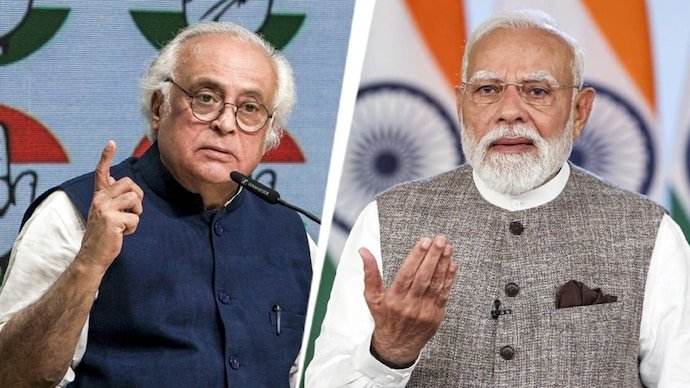
The hike in petrol, diesel and CNG prices has triggered a fierce political battle, with opposition parties accusing Prime Minister Narendra Modi’s government of burdening ordinary citizens immediately after the conclusion of key Assembly elections.
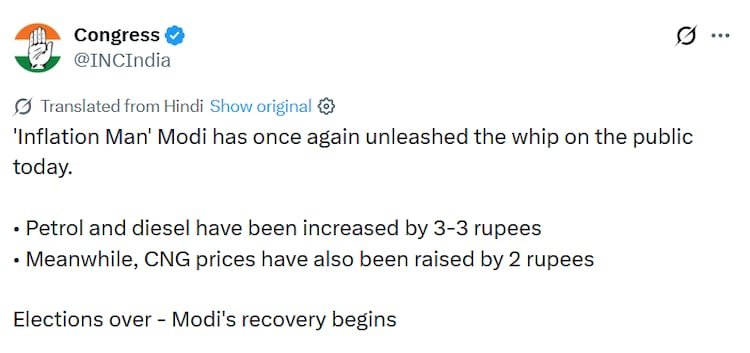
Leading the attack, the Congress coined a fresh political jibe “Mehngai Man Modi” alleging that the BJP-led Centre waited until polling ended before increasing fuel prices.
The phrase quickly became central to the opposition’s criticism, reflecting growing frustration over inflation, household expenses and rising transportation costs.
“Elections over, Modi’s collection begins,” the Congress said, accusing the government of prioritising revenue generation over relief for citizens already struggling with high living costs.
The political Controversy erupted after state-owned oil companies increased petrol and diesel prices by Rs 3 per litre, ending a prolonged four-year freeze in retail fuel price revisions.
Fuel Prices Rise After Four-Year Freeze
Under the revised rates:
- Petrol in Delhi increased from Rs 94.77 to Rs 97.77 per litre
- Diesel rose from Rs 89.67 to Rs 90.67 per litre
- CNG prices also witnessed an upward revision in several cities
The timing of the increase has become politically explosive because it came just over two weeks after Assembly elections concluded in states including Assam, Kerala, Tamil Nadu and West Bengal.
Opposition parties argue the government deliberately avoided revising prices during the election period to minimise voter backlash.
The BJP and the Centre, however, are likely to point toward global crude oil trends and geopolitical instability as the primary reasons behind the increase.
Global Oil Prices Have Changed Dramatically
One major factor behind the price revision is the sharp rise in international crude oil prices following escalating tensions and conflict in West Asia.
India imports a large majority of its crude oil requirements, making domestic fuel pricing highly sensitive to global market movements.
| Period | Average Crude Oil Price | Impact |
|---|---|---|
| Before West Asia conflict | Around USD 69 per barrel | Relatively stable fuel pricing |
| After conflict escalation | USD 113–114 per barrel | Pressure on fuel costs and imports |
The jump in crude prices significantly increased India’s oil import bill, putting pressure on both oil marketing companies and government finances.
Fuel prices had remained largely unchanged during the election season despite these rising international costs, which is precisely why opposition parties are now accusing the government of political timing.
Congress Turns Inflation Into a Political Weapon
The Congress Party has increasingly focused on inflation and cost-of-living issues as a core political strategy against the Modi government.
The term “Mehngai Man Modi” is designed to directly connect the Prime Minister’s image with rising prices and economic stress faced by middle-class and lower-income households.
Fuel prices hold enormous political significance in India because they affect nearly every sector of the economy.
Higher fuel prices influence:
- Transportation costs
- Food prices
- Delivery and logistics expenses
- Public transport fares
- Agricultural input costs
- Household inflation overall
That ripple effect makes petrol and diesel prices politically sensitive regardless of which party is in power.
Opposition leaders understand that fuel inflation creates immediate and visible frustration among voters because consumers encounter these costs almost daily.
Trinamool Congress Questions BJP’s Tax Policy
The Trinamool Congress also launched a sharp attack, with party leaders accusing the BJP of predictable post-election price increases.
Trinamool MP Derek O’Brien criticised both the Centre and the newly formed BJP government in West Bengal, questioning whether the state administration would now reduce VAT on petrol and diesel.
His comments reflected another important aspect of India’s fuel pricing debate: taxation.
Fuel prices in India are not determined solely by crude oil costs. Taxes imposed by both the Centre and state governments contribute significantly to retail prices.
| Fuel Price Component | Controlled By |
|---|---|
| Crude oil cost | Global markets |
| Excise duty | Central government |
| VAT | State governments |
| Dealer commission | Oil companies |
This complex structure often allows both the Centre and states to blame each other for high fuel prices.
Political parties frequently demand tax reductions while in opposition, but fiscal realities often complicate those promises once they enter government.
Akhilesh Yadav Uses Humor to Target the Government
Samajwadi Party chief Akhilesh Yadav took a lighter but politically sharp approach by promoting bicycles as an alternative to expensive fuel.
Sharing a caricature of himself riding a bicycle, he sarcastically remarked that “the bicycle is the only option” if people want to move forward.
The symbolism was politically strategic because the bicycle is also the Samajwadi Party’s election symbol.
Humorous political messaging often spreads rapidly online because it converts economic frustration into easily shareable public sentiment.
Fuel price hikes have historically generated strong Social Media reactions in India, particularly when linked to election cycles.
The Government Faces a Difficult Economic Balancing Act
Although opposition criticism has intensified, the broader economic context is more complicated.
The Indian government faces several simultaneous pressures:
- Rising global crude oil prices
- Foreign exchange outflow concerns
- Inflation management challenges
- Fiscal deficit targets
- Energy security risks
Prime Minister Modi recently urged citizens to reduce fuel consumption, use public transportation more frequently and adopt work-from-home practices where possible.
Those comments reflected growing concern about India’s dependence on imported oil.
India remains one of the world’s largest crude oil importers, making the economy vulnerable to geopolitical instability in oil-producing regions.
The West Asia Conflict has therefore created not only political pressure but also genuine economic strain.
Why Fuel Prices Become Politically Explosive in India
Fuel pricing is among the most politically sensitive issues in Indian politics because it directly affects both urban and rural populations.
Unlike many economic indicators that feel abstract to ordinary citizens, fuel prices are immediately visible.
Consumers notice:
- Higher commuting costs
- More expensive groceries
- Increased ride fares
- Costlier deliveries
- Rising transport expenses
That visibility makes fuel prices a powerful political weapon for opposition parties.
Historically, governments across party lines have often attempted to avoid major fuel price increases during election periods to reduce public backlash.
The timing of the latest hike has therefore naturally fueled accusations of political calculation.
The Bigger Political Battle Is About Inflation
Beyond petrol and diesel prices, the broader political issue is inflation itself.
The opposition increasingly wants to frame the national political debate around everyday affordability rather than only large-scale development narratives.
This strategy reflects a wider shift in Indian politics where economic anxieties particularly among middle-class and lower-income voters are becoming increasingly important.
While the BJP continues emphasizing Infrastructure growth, welfare delivery and India’s global standing, opposition parties are trying to focus public attention on:
- Household expenses
- Food inflation
- Fuel prices
- Employment concerns
- Income pressures
The “Mehngai Man Modi” slogan is part of that broader attempt to personalize economic frustration politically.
Could More Fuel Price Volatility Lie Ahead?
Much will depend on international oil markets.
If tensions in West Asia continue escalating, crude oil prices could remain elevated or even rise further. That would increase pressure on both governments and oil companies.
At the same time, reducing fuel taxes significantly could affect government revenues at a time when large infrastructure and welfare spending commitments remain central to policy planning.
This creates a difficult dilemma:
- Cut taxes and reduce revenue
- Maintain taxes and face public anger
That balancing act explains why fuel pricing remains one of the toughest political and economic decisions for any Indian government.
Conclusion: The Fuel Price Debate Is Now a Political Flashpoint
The latest fuel price hike has once again transformed petrol and diesel costs into a major political battlefield.
For the opposition, the timing of the increase offers an opportunity to sharpen attacks on inflation and portray the Modi government as disconnected from the financial pressures facing ordinary citizens.
For the Centre, the challenge lies in defending the move against the backdrop of rising global crude prices and geopolitical uncertainty.
The political slogan “Mehngai Man Modi” may dominate headlines for now, but the deeper issue extends far beyond partisan attacks.
India’s heavy dependence on imported crude oil means fuel prices will continue to remain vulnerable to global events, conflicts and market volatility.
And as long as petrol and diesel prices influence nearly every aspect of daily life, they will remain among the most politically sensitive economic issues in the country.
For breaking news and live news updates, like us on Facebook or follow us on Twitter and Instagram. Read more on Latest India on thefoxdaily.com.


COMMENTS 0