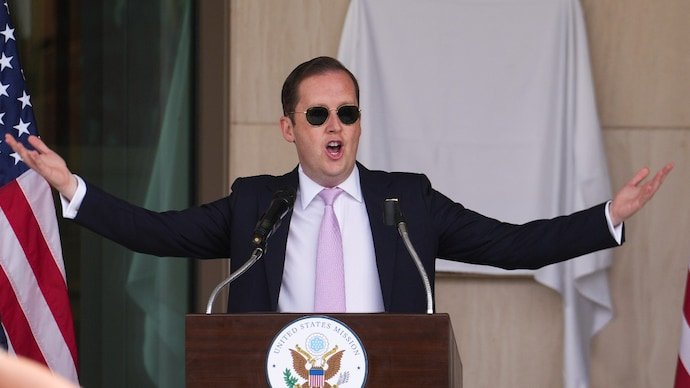
The growing economic partnership between India and the United States received another powerful endorsement after US Ambassador to India Sergio Gor said he was “simply blown away” by Indian companies committing more than $20.5 billion to the American economy.
His remarks came during the dedication ceremony of the new US Embassy Support Annex Building in New Delhi, but the message carried significance far beyond Diplomacy or ceremonial speeches. The statement reflected a major transformation underway in India-US relations one increasingly driven not only by Geopolitics and defence cooperation, but also by investment flows, technology partnerships, energy collaboration and deepening business confidence.
The timing of Gor’s comments was especially important. US Secretary of State Marco Rubio had just met Prime Minister Narendra Modi for high-level discussions covering defence, trade, energy security, strategic technologies and the Indo-Pacific region. Rubio also extended an invitation from President Donald Trump for PM Modi to visit the White House in the near future.
Together, these developments point toward a larger geopolitical and economic reality: India and the United States are entering a new phase of partnership where trade, investment and strategic cooperation are becoming deeply interconnected.
Why the $20.5 Billion Investment Figure Matters
Indian companies investing more than $20 billion into the United States is not just an economic headline. It represents a major shift in how Indian businesses are positioning themselves globally.
For decades, the economic relationship between India and the US was largely viewed through the lens of outsourcing, IT services and back-office operations. That perception is rapidly changing.
Today, Indian firms are investing directly into the American economy across sectors such as:
- Technology and software
- Pharmaceuticals
- Manufacturing
- Energy and renewables
- Automotive components
- Artificial intelligence
- Healthcare and biotechnology
- Hospitality and infrastructure
These investments create jobs, build manufacturing capacity and strengthen economic integration between the two democracies.
Gor’s reaction highlights how American policymakers increasingly see India not merely as a market, but as a long-term economic partner contributing directly to US growth and industrial competitiveness.
The Real Story: India Is No Longer Just a Recipient of Foreign Investment
One of the biggest shifts competitors are missing is that India is rapidly evolving from a capital-importing economy into a global investor.
Indian multinational companies are no longer limited to regional ambitions. Many are now competing globally, acquiring assets abroad, building factories overseas and investing strategically in advanced markets like the United States.
This transition matters because it changes the nature of India-US relations.
Instead of a one-directional partnership where American companies simply invest in India, the relationship is becoming increasingly balanced and interdependent.
That creates stronger long-term stability because both countries now have economic stakes in each other’s success.
| Old India-US Economic Model | New Emerging Model |
|---|---|
| US companies investing in India | Two-way strategic investment flows |
| IT outsourcing focus | Technology and manufacturing partnerships |
| Services-driven relationship | Integrated supply chains and innovation |
| Trade-centric engagement | Strategic economic alignment |
| Limited defence cooperation | Multi-sector geopolitical partnership |
Marco Rubio’s India Visit Is About Much More Than Diplomacy
Rubio’s four-day India tour is officially focused on bilateral cooperation, but the broader strategic implications are enormous.
The visit comes during a period when the global order is becoming increasingly competitive and fragmented.
The United States is seeking stronger partnerships across Asia to counter economic and geopolitical uncertainty, while India is positioning itself as a major global power with expanding influence.
Several key themes are expected to dominate discussions during Rubio’s visit:
- Trade expansion and investment
- Defence and Military cooperation
- Energy security partnerships
- Artificial intelligence collaboration
- Semiconductor supply chains
- Quad coordination in the Indo-Pacific
- Strategic technology sharing
The inclusion of strategic technologies in the talks is particularly important.
Modern geopolitics is no longer defined solely by military alliances. Control over semiconductors, AI systems, critical minerals, cybersecurity and energy networks increasingly determines geopolitical influence.
The $500 Billion Trade Target Reflects Massive Ambition
Ambassador Gor highlighted the long-term goal of reaching $500 billion in bilateral trade between India and the United States.
That figure illustrates how dramatically both governments expect the relationship to expand over the next decade.
Achieving such a target would require significant growth across multiple sectors, including:
- Digital commerce
- Energy exports
- Defence manufacturing
- Pharmaceutical trade
- Technology services
- Semiconductor cooperation
- Advanced manufacturing
- Education and research partnerships
The trade relationship has already expanded significantly in recent years, but both countries believe the current partnership still represents only a fraction of its long-term potential.
Why the US Wants Closer Economic Ties With India
Washington’s growing interest in deeper economic engagement with India is driven by several strategic calculations.
Supply Chain Diversification
Global companies and governments are actively trying to reduce overdependence on china-centric manufacturing systems.
India is increasingly viewed as one of the few countries capable of becoming a large-scale alternative manufacturing and technology hub.
Democratic Technology Partnerships
The US sees India as a democratic partner in emerging technology sectors such as AI, semiconductors and cybersecurity.
Economic Scale
India’s rapidly growing economy and large consumer market make it strategically important for American companies.
Geopolitical Stability
A stronger India is viewed by many US strategists as contributing to balance and stability in the Indo-Pacific region.
Energy Security Is Emerging as a Key Pillar
Another major but underappreciated aspect of the India-US relationship is energy cooperation.
Rubio’s earlier remarks about expanding US energy exports to India reflect how central energy security has become in bilateral discussions.
India remains one of the world’s largest energy importers, while the United States has become a leading producer and exporter of oil and natural gas.
This creates a strong strategic fit:
- India gains diversified energy supplies
- The US gains a stable long-term buyer
- Both reduce vulnerability to geopolitical disruptions
- Economic ties deepen beyond traditional trade
Concerns surrounding instability in the Middle East and the Strait of Hormuz have further increased the importance of reliable energy partnerships.
The White House Invitation Carries Political Weight
Rubio extending an invitation from President Donald Trump to Prime Minister Modi for a White House visit is diplomatically significant.
High-profile invitations often serve as signals of political alignment and strategic importance.
The invitation suggests that the Trump administration intends to maintain India as a top-tier strategic partner.
It also reinforces personal diplomacy between leaders, which increasingly plays a major role in International Relations.
Direct leader-level engagement can accelerate decisions on trade, defence and technology cooperation that might otherwise take years through bureaucratic channels.
Quad Cooperation Will Shape the Indo-Pacific
Rubio’s visit also comes just ahead of the Quad foreign ministers’ meeting in New Delhi.
The Quad involving India, the US, Japan and Australia has evolved into one of the most influential strategic forums in the Indo-Pacific.
While not formally a military alliance, the Quad increasingly focuses on:
- Maritime security
- Supply chain resilience
- Technology standards
- Cybersecurity
- Infrastructure development
- Regional connectivity
- Disaster response coordination
Many analysts see the Quad as part of a broader effort to maintain stability and balance in Asia amid rising geopolitical competition.
People-to-People Ties Remain a Hidden Strength
Beyond trade and geopolitics, India-US relations are also strengthened by strong educational, cultural and diaspora connections.
Indian-origin professionals play major roles across Silicon Valley, healthcare, finance, academia and entrepreneurship in the United States.
Meanwhile, American universities, technology firms and research institutions continue expanding engagement with India.
These people-to-people ties create resilience in the relationship even during periods of political disagreement.
That depth distinguishes India-US relations from many purely transactional global partnerships.
Challenges Still Exist Despite Growing Cooperation
Although relations are stronger than ever, challenges remain.
Areas that occasionally create friction include:
- Trade tariffs and market access
- Data and digital regulations
- India’s strategic ties with Russia
- Visa and immigration issues
- Human rights concerns raised in Washington
However, both governments increasingly appear focused on managing disagreements pragmatically while protecting the broader strategic partnership.
That marks a major evolution from earlier decades when disputes often overshadowed cooperation.
The Bigger Geopolitical Message Behind Gor’s Comments
The most important insight from Sergio Gor’s remarks may not be the investment figure itself, but what it symbolizes.
Indian companies investing heavily in America signal confidence in long-term economic stability and strategic partnership.
At the same time, the US openly celebrating Indian investment reflects a growing recognition that India is no longer merely an emerging economy it is becoming a major global economic actor capable of shaping international investment trends.
This is not simply a diplomatic relationship anymore.
It is increasingly becoming a partnership built on shared economic interests, strategic alignment and long-term geopolitical calculations.
Conclusion: India-US Relations Are Entering a More Powerful Phase
Sergio Gor’s statement about being “simply blown away” by Indian investment in America captured a broader transformation underway in global politics and economics.
India and the United States are moving beyond traditional diplomacy into a far deeper partnership involving trade, technology, energy, defence and global strategy.
Marco Rubio’s India visit, the upcoming Quad discussions and the White House invitation for PM Modi all point toward one conclusion: both countries increasingly see each other as indispensable long-term partners.
As global supply chains shift, geopolitical rivalries intensify and technology becomes central to national power, the India-US relationship could become one of the defining international partnerships of the 21st century.
The next phase of cooperation will likely shape not only bilateral trade and investment, but also the future balance of power across the Indo-Pacific and beyond.
For breaking news and live news updates, like us on Facebook or follow us on Twitter and Instagram. Read more on Latest World on thefoxdaily.com.






COMMENTS 0