For nearly three decades, Mamata Banerjee has been the undisputed face of the Trinamool Congress (TMC). She built the party from the ground up, defeated the Left Front’s long-standing dominance in West Bengal, and transformed the TMC into one of India‘s most influential regional political forces.
Today, however, the party finds itself confronting a challenge that many political observers once considered unthinkable: the possibility of a major internal rebellion.
Claims of a secret hotel meeting involving dozens of legislators, reports of growing anger within party ranks, the expulsion of rebel leaders, and the absence of a large number of MLAs from a key meeting convened by Mamata Banerjee have fueled speculation that a significant faction may be preparing to break away.
While many of the claims remain unverified, the developments have raised a critical political question: could a rebel group actually split the Trinamool Congress and stake claim to its famous twin-flower election symbol?
Why the Current Crisis Is Different from Previous TMC Challenges
The Trinamool Congress has faced rebellions before. Senior leaders have left, internal disputes have surfaced, and defections have occurred over the years.
However, the current situation appears more serious because it involves elected legislators rather than isolated leaders.
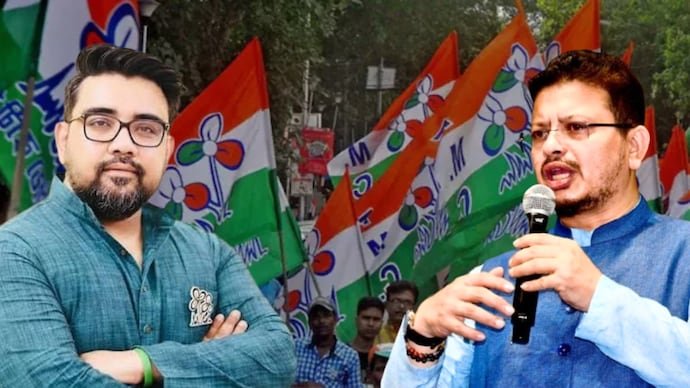
The Controversy erupted after allegations surfaced regarding forged signatures linked to the appointment of the Leader of the Opposition in the West Bengal Assembly. The issue triggered internal dissent and eventually led to the expulsion of MLAs Ritabrata Banerjee and Sandipan Saha.
What followed was a series of events that intensified concerns within the party.
- Reports of a closed-door meeting involving legislators
- Public criticism of the party leadership
- Growing dissatisfaction among newly elected MLAs
- Low attendance at a meeting called by Mamata Banerjee
- Speculation regarding a possible breakaway faction
Taken individually, these incidents may not indicate a split. Together, they suggest a party grappling with significant internal unrest.
The Mathematics Behind a Potential Split
In politics, numbers matter as much as narratives.
The reason claims involving “50 MLAs” have generated so much attention is because of India’s anti-defection law.
Under the Tenth Schedule of the Constitution, legislators who defect from a political party can face disqualification unless a significant portion of the legislative party merges or splits under legally recognized circumstances.
With the TMC holding approximately 80 seats in the Assembly, any breakaway group would need support from around two-thirds of legislators to comfortably survive anti-defection scrutiny.
| Assembly Factor | Approximate Number |
|---|---|
| Total TMC MLAs | 80 |
| Two-Thirds Threshold | 53 |
| Claimed Rebel Strength | Around 50 |
| Gap to Threshold | Approximately 3 MLAs |
This explains why reports mentioning around 50 MLAs have become politically explosive.
If such numbers were ever formally demonstrated, the rebellion would move from political gossip to a serious institutional challenge.
Can Rebels Actually Claim the TMC Symbol?
One of the most discussed aspects of the controversy is whether a rebel faction could seek control of the Trinamool Congress symbol.
Indian political History provides several examples where internal party disputes evolved into legal battles over names and symbols.
Recent years have seen high-profile cases involving regional parties where rival factions approached the Election Commission claiming to represent the “real” party.
In such situations, the Election Commission examines multiple factors, including:
- Support among elected legislators
- Support among organizational office-bearers
- Party constitution provisions
- Documentary evidence of leadership backing
- Legislative and organizational strength
Simply announcing a rebellion is not enough.
A faction must demonstrate substantial support and organizational legitimacy before any claim over a party’s symbol can be seriously considered.
The Emergence of Ritabrata Banerjee as a Rallying Point
Much of the current discussion revolves around Ritabrata Banerjee.
Once a prominent leader associated with the Left, Ritabrata later joined the Trinamool Congress and quickly emerged as an influential figure.
Following his expulsion from the party, reports began circulating that a section of legislators viewed him as a potential alternative leader within the Assembly.
His criticism of the current leadership structure has resonated with some disgruntled party members.
Particularly notable were his remarks suggesting that there was insufficient internal democracy within the organization and limited space for dissenting voices.
Whether these criticisms translate into actual political numbers remains unclear.
Why Mamata Banerjee Is Still a Formidable Force
Despite the speculation, writing off Mamata Banerjee would be politically premature.
Few leaders in Indian Politics possess her combination of organizational experience, mass appeal, and electoral resilience.
Since founding the TMC in 1998, she has survived numerous political crises, including:
- Intense battles with the Left Front
- Factional disputes
- Leadership exits
- National political realignments
- Repeated challenges from the BJP
Each time, she has managed to retain control of the party machinery.
The TMC’s organizational structure also remains heavily centered around her leadership, making any rebellion significantly more difficult than it may appear on paper.
What the Absence of 60 MLAs Really Means
One development that attracted widespread attention was the absence of around 60 MLAs from a meeting convened by Mamata Banerjee.
Political symbolism matters.
Even if legislators had genuine reasons for missing the meeting, such a large absence inevitably raises questions.
Political parties often use attendance at leadership meetings as an informal measure of loyalty and organizational discipline.
When attendance drops dramatically, speculation about dissatisfaction naturally follows.
However, absence alone does not automatically indicate rebellion.
Many political crises have generated headlines before ultimately fading without producing a formal split.
The Real Issue: A Leadership Transition Debate?
Beyond the immediate controversy lies a deeper question facing the Trinamool Congress.
As the party matures, discussions about future leadership and succession are becoming increasingly unavoidable.
Many political analysts believe some of the current tensions reflect broader debates about the party’s future direction.
Questions surrounding organizational reform, internal democracy, generational change, and decision-making structures are likely contributing to the current unrest.
Such debates are not unique to the TMC.
Political parties across the world often experience internal friction when dominant founding leaders remain central to decision-making for extended periods.
How the BJP Could Benefit
The Bharatiya Janata Party is closely monitoring developments.
Any significant fragmentation within the TMC could dramatically alter West Bengal’s political landscape.
A divided opposition often creates opportunities for rival parties to expand their influence.
Even if no formal split occurs, prolonged internal Conflict can weaken organizational effectiveness, reduce campaign coordination, and distract leadership from Governance and electoral preparation.
For the BJP, political instability within the TMC could provide a strategic opening ahead of future electoral contests.
Historical Lessons from Political Splits in India
Indian politics offers numerous examples of party splits producing unexpected outcomes.
Some rebellions have successfully created powerful new political formations. Others have collapsed after initial excitement faded.
Several factors typically determine success:
- Leadership credibility
- Organizational network strength
- Financial resources
- Grassroots support
- Legislative numbers
- Public perception
Most importantly, successful breakaway groups usually require a compelling political narrative beyond personal grievances.
Voters often support rebels only when they believe the new faction offers a distinct vision rather than merely internal factionalism.
Possible Scenarios Ahead
Scenario 1: Rebellion Fizzles Out
The most likely short-term outcome may be that negotiations, disciplinary action, and political pressure gradually restore stability within the party.
Scenario 2: Limited Breakaway Group Emerges
A smaller faction could separate from the TMC but fail to reach the numbers required to challenge the party’s organizational control.
Scenario 3: Major Legislative Split
If rebel numbers approach the anti-defection threshold, the conflict could escalate into a battle over legislative recognition and party legitimacy.
Scenario 4: Leadership Reconciliation
The controversy may eventually force internal reforms aimed at addressing concerns raised by dissatisfied legislators.
Conclusion: Crisis or Political Theatre?
The Trinamool Congress is undoubtedly facing one of its most challenging internal moments in recent years. Allegations of secret meetings, public criticism by expelled leaders, low attendance at key gatherings, and claims of a potential legislative revolt have created an atmosphere of uncertainty.
Yet politics is often driven as much by perception as by reality.
At present, there is no verified evidence that enough MLAs have formally united behind a rebellion capable of threatening Mamata Banerjee’s control of the party or its symbol.
What is clear, however, is that the unrest within the TMC is real. Whether it evolves into a historic political split or becomes another crisis successfully managed by Mamata Banerjee will likely determine the future direction of West Bengal politics.
For now, the claims of a 50-MLA rebellion remain unproven. But the fact that such a scenario is being seriously discussed at all shows how significant the current turmoil inside the Trinamool Congress has become.
For breaking news and live news updates, like us on Facebook or follow us on Twitter and Instagram. Read more on Latest India on thefoxdaily.com.






COMMENTS 0