- A State Brought to a Standstill
- The Incidents That Sparked the Crisis
- Twin Shutdowns: Valley and Hills in Parallel Protest
- When Protests Turn Violent
- Legal Community Steps In
- Political Fallout: Calls for Action and Dialogue
- The Bigger Context: A State in Prolonged Conflict
- Comparison: Then and Now
- The Psychology of Fear and Anger
- What Needs to Happen Next?
- Conclusion: A Fragile Calm Tested Again
A State Brought to a Standstill
Manipur has once again slipped into paralysis.
What began as outrage over the tragic deaths of two children has quickly escalated into widespread protests, shutdowns, and renewed fears of instability. Across both valley and hill districts, daily life has come to a halt schools closed, markets deserted, and transport off the roads.
The immediate triggers are clear: a deadly explosion in Bishnupur that killed two young siblings, and a separate militant attack on a civilian convoy in Ukhrul that claimed two more lives. But beneath these incidents lies a deeper, more troubling reality a region still struggling to recover from years of ethnic violence and mistrust.
This is not just a law-and-order issue. It is a reflection of a fragile peace that continues to fracture under pressure.
The Incidents That Sparked the Crisis
The latest unrest can be traced to two separate but equally disturbing events.
1. The Bishnupur Blast
In a quiet village, a late-night explosion tore through a home, killing a five-year-old boy and his six-month-old sister as they slept. Their mother survived but was injured.
The brutality of the incident shocked the state. The victims were not combatants or targets in any strategic sense they were children. The randomness of the violence intensified public anger, turning grief into protest.
2. The Ukhrul Convoy Attack
Days later, a convoy of civilian vehicles came under fire in a hill district. The attack killed a retired Army personnel and another civilian, raising fresh concerns about militant activity and the safety of ordinary travel.
While geographically separate, the two incidents became symbolically linked fueling a broader narrative of insecurity across Manipur.
Twin Shutdowns: Valley and Hills in Parallel Protest
The response was swift and widespread.
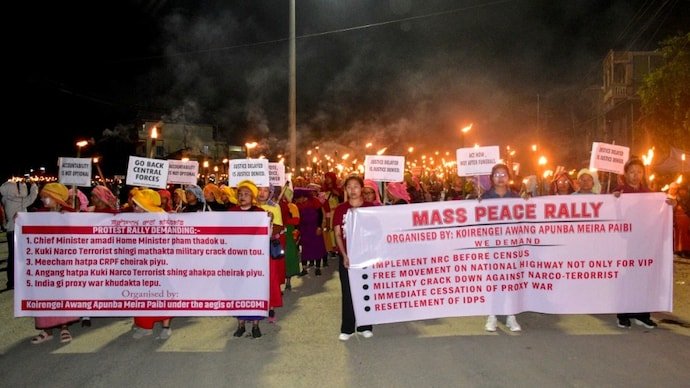
In the valley districts, women-led groups organized a multi-day shutdown, staging sit-in protests and demanding accountability. These groups have historically played a powerful role in civil movements, and their involvement signaled the depth of public outrage.
At the same time, hill districts witnessed a separate shutdown called by regional organizations protesting the convoy attack.
The result was a rare but telling moment: both valley and hill regions, often divided by ethnic and political differences, were simultaneously shut down though for different reasons.
This parallel unrest underscores how instability in Manipur is no longer confined to one community or geography it is widespread and interconnected.
When Protests Turn Violent
As tensions rose, protests in some areas escalated beyond peaceful demonstrations.
In one instance, a confrontation between protesters and Security forces turned deadly. Reports indicate that a mob stormed a security camp, prompting a response that resulted in the deaths of three individuals and injuries to many others.
This incident has added another layer of complexity to the situation.
- Questions are being raised about the use of force
- Demands for accountability are growing louder
- Public trust in institutions faces renewed strain
What began as protests over violence has now expanded into a broader debate about governance and response.
Legal Community Steps In
The unrest has also drawn a strong reaction from the legal fraternity.
Lawyers and legal organizations have taken to the streets, calling for:
- A judicial inquiry into the firing on protesters
- Thorough investigation into both incidents
- Arrests of those responsible for the killings
This intervention is significant. It signals that concerns are no longer limited to public sentiment they are now institutional, involving voices that shape legal and constitutional accountability.
Political Fallout: Calls for Action and Dialogue
As expected, the crisis has triggered political reactions.
opposition leaders have criticized the handling of the situation, pointing to the prolonged instability in the state. They have called for:
- Restoration of law and order
- Relief measures for affected communities
- Dialogue among stakeholders to address underlying tensions
The emphasis on dialogue reflects a growing recognition that enforcement alone cannot resolve the crisis. Manipur’s challenges are deeply rooted, requiring political and social solutions alongside security measures.
The Bigger Context: A State in Prolonged Conflict
To understand the current unrest, it is essential to look beyond the immediate events.
Manipur has been grappling with ethnic violence since 2023, with clashes between communities leading to:
- Hundreds of deaths
- Mass displacement of families
- Deep divisions across regions
Despite periods of relative calm and administrative interventions, including central rule, the underlying issues remain unresolved.
This means that every new incident no matter how isolated has the potential to reignite broader tensions.
Comparison: Then and Now
| Aspect | Initial Phase of Conflict (2023–2024) | Current Situation (2026) |
|---|---|---|
| Nature of Violence | Large-scale ethnic clashes | Localized but recurring incidents |
| Public Response | Mass displacement and fear | Targeted protests and shutdowns |
| Security Approach | Heavy deployment and emergency measures | Continued presence with reactive interventions |
| Stability Level | Highly volatile | Fragile and unpredictable |
The Psychology of Fear and Anger
Beyond politics and security, there is a human dimension to the crisis.
The death of children often acts as a powerful emotional trigger. It cuts through political divides and evokes a universal sense of grief and anger. In Manipur’s already tense Environment, this emotional response can quickly translate into collective action.
At the same time, repeated incidents reinforce a sense of insecurity:
- People begin to feel that violence can strike anywhere
- Trust in safety mechanisms weakens
- Communities become more reactive and defensive
This psychological cycle makes recovery more difficult, as each new incident reopens old wounds.
What Needs to Happen Next?
Breaking the cycle of unrest in Manipur will require more than immediate responses.
Key priorities include:
- Transparent investigations to establish accountability
- Improved coordination between security agencies and local communities
- Dialogue-driven solutions addressing ethnic and regional tensions
- Economic and social support to rebuild trust and stability
Without these steps, the state risks remaining trapped in a loop of incident, protest, and partial recovery.
Conclusion: A Fragile Calm Tested Again
The twin shutdowns in Manipur are not just reactions to isolated tragedies they are symptoms of a deeper, unresolved crisis.
The deaths of innocent civilians, the eruption of protests, and the paralysis of daily life all point to one reality: stability in the state remains fragile.
Yet, within this uncertainty lies an opportunity. Each crisis also brings renewed attention and urgency to address the root causes of Conflict.
The question is whether this moment will lead to meaningful change or become another chapter in an ongoing cycle of unrest.
For breaking news and live news updates, like us on Facebook or follow us on Twitter and Instagram. Read more on Latest India on thefoxdaily.com.






COMMENTS 0