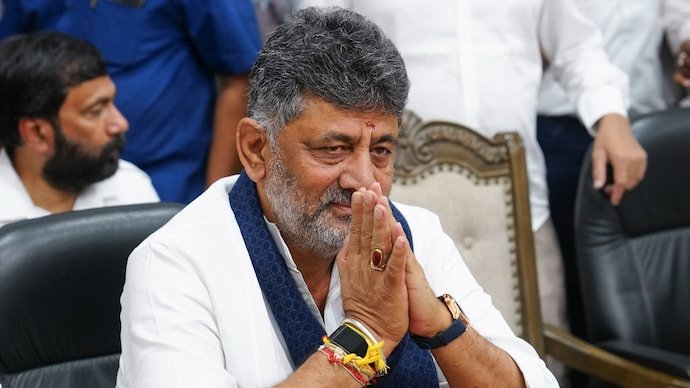
For nearly a decade, Karnataka Congress politics revolved around one central rivalry: Siddaramaiah versus DK Shivakumar.
Now, as DK Shivakumar prepares to become Karnataka’s Chief Minister, that long internal battle appears to have finally reached its defining conclusion.
His rise has not been sudden.
It is the result of years of organisational manoeuvring, political survival, factional negotiations, legal controversies, electoral rebuilding and patient positioning within the Congress party.
Few leaders in modern Karnataka politics have experienced such dramatic shifts in fortune.
At different points, Shivakumar was:
- Blocked from Leadership roles
- Seen as too controversial for top office
- Investigated by central agencies
- Jailed in a money laundering case
- Dismissed as politically finished by rivals
Yet today, he stands on the verge of occupying the most powerful political office in Karnataka.
His journey says as much about Congress’s internal power struggles as it does about his own political instincts.
The Beginning of the Siddaramaiah–Shivakumar Rivalry
The political tension between Siddaramaiah and DK Shivakumar did not begin recently.
Its roots stretch back more than a decade.
When Siddaramaiah became Karnataka Chief Minister in 2013, he quickly emerged as the dominant face of the Congress in the state. His mass appeal, AHINDA social coalition strategy, and administrative image gave him enormous influence over the party structure.
But DK Shivakumar represented a different kind of political power.
Unlike Siddaramaiah’s mass ideological appeal, Shivakumar built his strength through:
- Organisational networking
- Resource mobilisation
- Grassroots political management
- Strong regional influence, especially in Old Mysuru
- Close equations with Congress leadership
The two leaders operated from different political models, but their ambitions increasingly collided.
Why Siddaramaiah Initially Resisted Shivakumar
One of the earliest flashpoints came shortly after Siddaramaiah assumed office in 2013.
At the time, Shivakumar faced scrutiny over allegations linked to illegal mining and land-related controversies.
Siddaramaiah, who was attempting to build a Governance-focused image, reportedly resisted Shivakumar’s inclusion in the cabinet.
However, Shivakumar was already known inside Congress circles as a formidable negotiator.
Rather than backing down, he directly lobbied the Congress high command in Delhi.
Eventually, sustained pressure from the central leadership helped him secure a cabinet berth in January 2014.
That episode established an important political reality:
Even if Siddaramaiah controlled Karnataka Congress politics, Shivakumar had powerful networks beyond the state.
The 2016 Episode That Changed Everything
The most critical turning point in Shivakumar’s rise came in 2016.
At the time, the Congress leadership was considering replacing Karnataka Pradesh Congress Committee (KPCC) president G Parameshwara.
According to party insiders, then Congress president Sonia Gandhi informally discussed the possibility of Shivakumar becoming state Congress chief.
For Shivakumar, this was potentially transformational.
Control of the KPCC would have allowed him to shape ticket distribution, organisation-building and future leadership dynamics.
But the move reportedly triggered strong resistance from Siddaramaiah.
Congress insiders claimed Siddaramaiah mobilised support within the party to block Shivakumar’s elevation.
The high command eventually sought feedback from senior ministers.
The result was politically damaging for Shivakumar:
- Most ministers reportedly refused to openly support him
- The leadership change was shelved
- Parameshwara retained the post
Years later, Shivakumar himself publicly described the episode with a memorable line:
“I tried to play chess, but Siddaramaiah played football.”
The remark captured both frustration and admiration for Siddaramaiah’s aggressive political style.
Shivakumar’s Strategic Patience Paid Off
What makes Shivakumar’s rise politically fascinating is that he did not react impulsively after setbacks.
According to reports, he privately acknowledged that even if he had secured the KPCC presidency in 2016, becoming Chief Minister in 2018 would still have been unlikely.
Instead, he focused on the long game.
That strategic patience ultimately became one of his greatest strengths.
Unlike many regional leaders who split parties or openly rebel after being denied power, Shivakumar stayed within Congress and continued building influence systematically.
The 2019 Crisis That Transformed Shivakumar’s Position
The year 2019 became a major political turning point.
Congress suffered severe setbacks in Karnataka:
- Poor Lok Sabha election performance
- Collapse of the Congress-JD(S) coalition government
- Organisational instability
- Internal factional tensions
At the same time, Shivakumar himself faced a major personal and political crisis.
He was arrested by the Enforcement Directorate in a money laundering case and sent to Delhi’s Tihar Jail.
Ordinarily, such a development might weaken a politician permanently.
But in Indian politics, legal battles often reshape public perception rather than end careers.
Shivakumar’s arrest generated sympathy among Congress workers and supporters, many of whom viewed the action through a political lens.
A particularly symbolic moment came when Sonia Gandhi visited him in jail.
Within Congress circles, that gesture carried enormous political meaning.
It signalled that despite controversies, Shivakumar still enjoyed the confidence of the party’s top leadership.
How Shivakumar Rebuilt Karnataka Congress
In July 2020, DK Shivakumar officially became Karnataka Congress president.
That appointment changed the state party’s power structure completely.
Over the next three years, Shivakumar focused intensely on rebuilding the organisation from the ground level.
His approach emphasised:
- Booth-level strengthening
- Cadre mobilisation
- Regional coordination
- Aggressive campaigning
- Micro-management of party structure
Unlike many leaders who focus primarily on media visibility, Shivakumar concentrated heavily on organisational machinery.
Congress workers across Karnataka increasingly viewed him as the operational engine behind the party’s revival.
That groundwork became crucial in the 2023 Karnataka Assembly elections.
The 2023 Election Victory Changed the Power Balance
Congress’s decisive victory in the 2023 Karnataka elections transformed Shivakumar’s political standing permanently.
The result was not merely an electoral win.
It validated years of organisational rebuilding.
However, the Chief Ministerial contest reopened old rivalries immediately.
Both Siddaramaiah and Shivakumar emerged as strong contenders for the top post.
Eventually, the Congress leadership chose Siddaramaiah as Chief Minister while Shivakumar accepted the Deputy Chief Minister role.
Reports at the time suggested a possible rotational arrangement, although the Congress never officially confirmed such a formula.
Still, Shivakumar’s supporters believed his turn would eventually come.
Why DK Shivakumar Matters to Congress Nationally
Shivakumar’s importance extends beyond Karnataka.
Inside Congress, he is increasingly viewed as one of the party’s most effective regional operators.
His strengths include:
- Electoral management
- Fundraising ability
- Coalition negotiation skills
- Strong cadre connect
- Crisis management
He also played visible roles during several high-profile political crises nationally, including managing Congress legislators during periods of instability in other states.
For a national party struggling organisationally in many regions, leaders capable of building and sustaining political machinery are becoming increasingly valuable.
The Leadership Style Difference Between Siddaramaiah and Shivakumar
One reason the rivalry became so significant is because the two leaders represent contrasting political styles.
| Siddaramaiah | DK Shivakumar |
|---|---|
| Mass welfare politics | Organisational politics |
| Ideological positioning | Operational management |
| Broad social coalition strategy | Network-based mobilisation |
| Public policy image | Political negotiation image |
| Grassroots populism | Power management skills |
Together, they shaped Congress’s modern Karnataka strategy.
But eventually, coexistence became increasingly difficult as succession politics intensified.
The Challenges Waiting for Shivakumar as Chief Minister
Becoming Chief Minister may be the culmination of Shivakumar’s political struggle, but it also marks the beginning of his toughest phase.
He will now face enormous expectations:
- Managing Congress factions
- Balancing regional interests
- Handling governance challenges
- Maintaining electoral momentum
- Preparing for future national elections
He will also need to transition from being viewed primarily as an organisational strategist to a full-scale administrator.
That transition is often more difficult than winning power itself.
Conclusion
DK Shivakumar’s rise to the Karnataka Chief Minister’s office is not simply a story of political ambition fulfilled.
It is the story of survival, persistence and long-term strategy inside one of India’s most competitive political environments.
From being blocked for the KPCC presidency in 2016 to rebuilding Congress after years of decline, Shivakumar steadily transformed himself from factional contender to central power figure.
His journey also reflects the realities of modern Indian politics, where organisational strength, patience and resilience often matter as much as charisma.
The rivalry with Siddaramaiah shaped Karnataka Congress politics for years.
Now, with Shivakumar preparing to assume the state’s top office, a new chapter begins not only for him personally, but for the Congress party’s future in Karnataka.
Whether he ultimately succeeds as Chief Minister will depend on how effectively he converts political survival skills into long-term governance leadership.
For breaking news and live news updates, like us on Facebook or follow us on Twitter and Instagram. Read more on Latest India on thefoxdaily.com.





COMMENTS 0