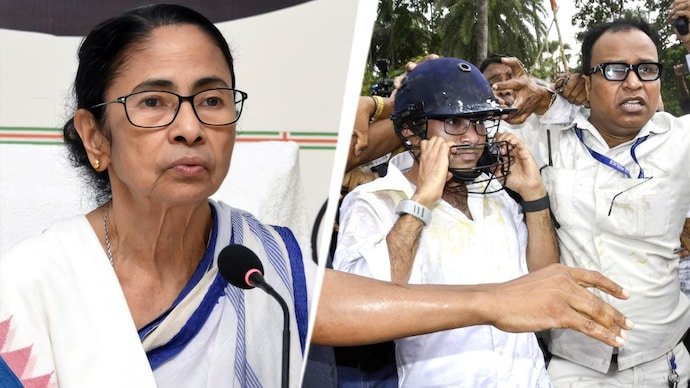
West Bengal politics witnessed another dramatic twist after a leaked audio clip allegedly featuring former Chief Minister Mamata Banerjee surfaced online, triggering a fresh Political Controversy. The recording, which emerged shortly after Trinamool congress (TMC) leader Abhishek Banerjee was attacked during a visit to Sonarpur, appears to capture Mamata Banerjee criticizing and warning a senior hospital executive over the treatment and discharge of her nephew.
The controversy comes at a particularly sensitive time for West Bengal. The state is navigating a major political transition following the recent Assembly election results, which ended the TMC’s 15-year rule and brought the Bharatiya Janata Party (BJP) to power for the first time.
Against this backdrop, the alleged assault on Abhishek Banerjee, the subsequent hospital treatment, and the leaked audio have evolved into a wider debate about political violence, institutional independence, and the future of opposition politics in the state.
What Is the Mamata Banerjee Audio Controversy?
The political row centers around a viral audio recording allegedly featuring Mamata Banerjee in a conversation with Pradip Tandon, the Chief Executive Officer of Belle Vue Hospital, one of Kolkata’s best-known private healthcare institutions.
In the recording, Mamata is purportedly heard expressing anger over what she viewed as inappropriate handling of Abhishek Banerjee’s medical treatment following the attack in Sonarpur.
The leaked clip includes remarks in which she allegedly accuses the hospital executive of wrongdoing and warns that political circumstances could change in the future.
The authenticity of the recording and the full context surrounding the conversation remain matters of public debate. However, its circulation has immediately drawn reactions from political parties, healthcare professionals, and observers across the state.
The episode has transformed what was initially a security and law-and-order issue into a broader controversy involving healthcare institutions and political influence.
The Attack on Abhishek Banerjee: What Happened?
The controversy cannot be understood without examining the incident that triggered it.
Abhishek Banerjee, a Member of Parliament and one of the most influential leaders in the Trinamool Congress, visited Sonarpur in South 24 Parganas to meet families allegedly affected by post-election violence.
During the visit, a crowd confronted him, leading to chaotic scenes that quickly went viral on social media.
According to reports and visual evidence from the location, stones and eggs were thrown at the TMC leader while slogans were raised against him. Security personnel and party workers formed a protective cordon around Banerjee as they attempted to move him away from the crowd.
Perhaps the most striking image from the incident was Banerjee wearing a Cricket helmet for protection while navigating through the hostile environment.
Visuals also appeared to show torn clothing and physical jostling during the confrontation.
Why the Sonarpur Incident Matters Politically
In ordinary circumstances, an attack on a senior opposition leader would already generate significant attention.
However, the political importance of this incident is magnified because of Abhishek Banerjee’s position within the Trinamool Congress.
Often regarded as the party’s second most influential figure after Mamata Banerjee, he plays a central role in shaping the organization’s strategy and future Leadership.
Any attack targeting him inevitably becomes a major political event with implications extending beyond a single confrontation.
The incident also occurred during a period of heightened tensions following a fiercely contested election that significantly altered West Bengal’s political balance.
The Post-Poll Violence Debate Returns
The Sonarpur confrontation has reignited a long-running debate over political violence in West Bengal.
For decades, the state has experienced periodic accusations of politically motivated clashes following elections.
Different parties have, at various times, alleged intimidation, retaliation, and violence directed at supporters and opponents.
The recent election results have once again brought these concerns into focus.
Abhishek Banerjee’s visit itself was reportedly connected to claims that families associated with the Trinamool Congress had faced difficulties after the change in government.
Meanwhile, political opponents have argued that concerns regarding post-election violence should be viewed within the broader context of the state’s historical political culture.
| Key Event | Significance |
|---|---|
| West Bengal Election Result | BJP forms government after ending TMC’s 15-year rule |
| Abhishek Banerjee Visit | Meeting families allegedly affected by post-poll violence |
| Sonarpur Attack | Senior TMC leader confronted by hostile crowd |
| Hospital Treatment | Medical evaluation following the incident |
| Leaked Audio Emerges | Political controversy expands beyond security concerns |
Mamata Banerjee’s Allegations Against Political Opponents
Following the attack, Mamata Banerjee strongly criticized the BJP and accused political rivals of creating an environment that enabled such incidents.
She also alleged that pressure had been exerted on medical institutions regarding Abhishek Banerjee’s treatment.
According to her statements, concerns existed about attempts to minimize the seriousness of his condition despite medical evaluations that included advanced diagnostic procedures.
The allegations added another layer to the controversy by introducing questions about the interaction between politics, law enforcement, and healthcare administration.
Such claims are particularly sensitive because hospitals are generally expected to operate independently of political influence.
The Hospital at the Center of the Controversy
Belle Vue Hospital’s unexpected involvement has placed healthcare governance under public scrutiny.
Private hospitals often find themselves managing high-profile political patients, but they typically avoid becoming part of political disputes.
The leaked audio has thrust the institution into the spotlight and sparked discussions about how hospitals navigate politically charged situations.
Healthcare administrators frequently face the challenge of balancing patient privacy, medical judgment, public communication, and political sensitivities.
When prominent political figures are involved, those challenges become significantly more complex.
The Bigger Issue: Independence of Institutions
Beyond the immediate controversy, the incident raises broader questions about institutional independence in democratic societies.
Whether the focus is hospitals, police forces, courts, universities, or regulatory bodies, public trust depends heavily on perceptions of neutrality.
Political controversies involving independent institutions often generate intense reactions because they touch on fundamental questions of governance.
Supporters of different political parties may interpret the same event in completely different ways, but the long-term health of democratic systems depends on maintaining confidence in professional decision-making processes.
This is one reason why the leaked audio has attracted attention beyond West Bengal’s immediate political landscape.
How Social Media Amplified the Controversy
The role of social media has been crucial in shaping public perceptions of the episode.
Within hours of appearing online, the audio recording spread rapidly across platforms, generating intense debate among political supporters and critics alike.
The speed with which political controversies now evolve has transformed modern politics.
Incidents that once might have remained confined to traditional media cycles now become nationwide discussions within minutes.
This creates both opportunities and challenges.
- Information spreads faster.
- Political accountability increases.
- Public engagement expands.
- Context can be lost.
- Verification becomes more difficult.
- Polarization often intensifies.
The Mamata Banerjee audio controversy demonstrates how digital platforms have become central battlegrounds in contemporary political communication.
The BJP-TMC Rivalry Enters a New Phase
The controversy also reflects the evolving relationship between the BJP and the Trinamool Congress following the historic change in power.
For years, the BJP positioned itself as the principal challenger to TMC dominance in West Bengal.
Now, the political dynamics have shifted dramatically.
The BJP must transition from opposition politics to governance, while the TMC faces the challenge of redefining itself as the state’s primary opposition force.
This transition is likely to produce frequent political confrontations as both parties compete to shape public narratives and define the next phase of Bengal politics.
A Unique Angle: The Challenge of Opposition Politics After Long-Term Rule
One aspect often overlooked in coverage of this controversy is how difficult it can be for a party to transition from government to opposition after many years in power.
For over a decade, the Trinamool Congress operated as the governing party, controlling administrative mechanisms and shaping policy decisions.
Opposition politics requires a fundamentally different approach.
Leaders must adapt to new realities, build fresh political strategies, and respond to challenges from a position outside government.
The intense reactions surrounding incidents like the Sonarpur attack partly reflect this adjustment period.
Both the TMC and BJP are navigating unfamiliar political terrain as their roles within West Bengal’s political system evolve.
Potential Impact on West Bengal Politics
The long-term significance of the controversy will depend on several factors.
These include:
- Whether the audio recording’s authenticity is formally established.
- How the public interprets the Sonarpur incident.
- Future developments regarding post-poll violence allegations.
- The ability of political parties to shape public perception.
- Responses from institutions involved in the controversy.
Political narratives often matter as much as facts in determining public opinion, making the coming weeks particularly important.
Conclusion
The leaked audio allegedly involving Mamata Banerjee and a leading Kolkata hospital executive has transformed an already serious political incident into a wider controversy touching on healthcare administration, institutional independence, opposition politics, and post-election tensions in West Bengal.
At the center of the storm is the attack on Abhishek Banerjee, an event that has become symbolic of the state’s increasingly polarized political environment following a historic transfer of power. While competing narratives continue to emerge, the episode highlights how quickly political disputes can expand beyond their original context in the age of social media and round-the-clock news coverage.
As West Bengal enters a new political era, controversies such as this are likely to shape the relationship between the ruling BJP and the opposition Trinamool Congress. The ultimate impact of the audio row will depend not only on the facts surrounding the incident but also on how voters interpret the broader questions of accountability, governance, and democratic conduct that it has brought into focus.
For breaking news and live news updates, like us on Facebook or follow us on Twitter and Instagram. Read more on Latest India on thefoxdaily.com.






COMMENTS 0