BJP general secretary Smriti Irani has challenged Congress leader Rahul Gandhi to turn his recent remarks on women’s empowerment into concrete political action, asking him to support the implementation of the law providing 33 per cent reservation for women in legislatures.
Irani also issued a separate challenge to the Congress over Vande Mataram, calling on the party to organise a full rendition of the national song, including the verses that refer to Goddess Durga, at its headquarters.
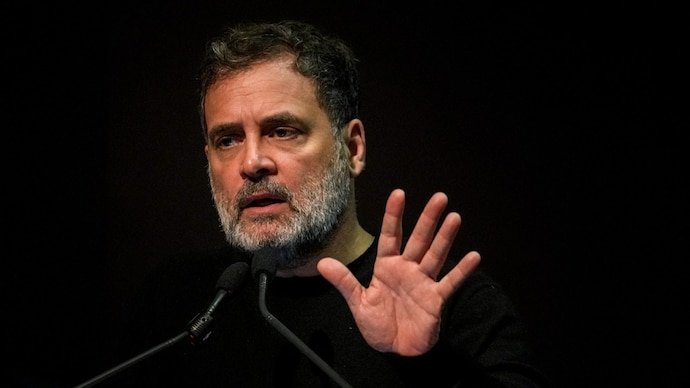
The remarks came a day after Gandhi interacted with girl students in Pune as part of his ‘Chhatron Ki Goonj’ outreach programme. During the interaction, Gandhi urged the students to challenge what he described as patriarchal attitudes and criticised what he called a “Manusmriti mindset” that keeps women subordinate to male relatives.
Irani used those comments to frame a direct political challenge, arguing that support for women’s rights should also translate into backing legislative measures aimed at increasing women’s representation in elected institutions.
Smriti Irani challenges Rahul Gandhi over women’s reservation
Speaking to reporters on Sunday, Irani said Gandhi’s comments in support of women and women’s leadership should be followed by support for the implementation of the women’s reservation law.
She asked the Congress leader to support Prime Minister Narendra Modi‘s initiative for implementing the legislation that provides for 33 per cent reservation for women in Parliament and state legislative assemblies.
The challenge places the issue of women’s political representation at the centre of the latest exchange between the BJP and Congress.
Rather than responding only to Gandhi’s criticism of patriarchy, Irani sought to move the debate toward institutional representation. Her argument was essentially that political parties should demonstrate their commitment to women’s empowerment through support for measures that increase women’s presence in legislatures.
What the women’s reservation law seeks to do
The women’s reservation legislation provides for reserving one-third of seats for women in the Lok Sabha and state legislative assemblies. It also provides for reservation among seats reserved for members of Scheduled Castes and Scheduled Tribes.
The legislation became law after Parliament passed the Constitution (One Hundred and Sixth Amendment) Act, 2023, commonly known as the Women’s Reservation Act or Nari Shakti Vandan Adhiniyam.
However, the law is linked to the completion of a future census and subsequent delimitation exercise before the reservation provisions can take effect. This makes implementation a separate issue from the passage of the legislation itself.
That distinction is important in understanding Irani’s challenge. The political argument is not simply about whether Parliament has approved women’s reservation. It is also about when the constitutional mechanism will become operational and how parties position themselves on its implementation.
Why women’s representation has become a major political issue
Women’s representation has long been a significant issue in Indian Politics. The debate concerns not only the number of women elected to legislatures but also whether political institutions adequately reflect the country’s population.
Reservation at the legislative level is intended to address this representation gap by creating a guaranteed share of seats for women.
Supporters of the measure argue that reserved representation can provide more women with an opportunity to enter political institutions and build political careers. Critics and political opponents have raised questions about the timing of implementation and the mechanisms through which seats will be identified and rotated.
Regardless of those disagreements, the legislation has made women’s representation a central part of the national political conversation.
Irani’s remarks demonstrate how the issue can quickly become a point of political contest between the BJP and Congress, particularly when senior opposition leaders publicly discuss women’s empowerment.
Rahul Gandhi’s Pune outreach focused on patriarchy
Gandhi’s comments came during his interaction with girl students in Pune. The outreach programme was aimed at engaging young people and giving them a platform to discuss social and political issues.
During the event, Gandhi urged the students to “smash patriarchy” and criticised a social mindset that, in his view, places women under the authority of male relatives.
He referred to what he described as the “Manusmriti mindset”, arguing that such thinking has historically been used to restrict women’s independence.
Gandhi also alleged that violence is used to prevent women from advancing and claimed that 80 per cent of women faced harassment.
His comments were framed around the broader question of gender equality and the social barriers faced by women.
From social reform to political representation
The contrast between the two leaders’ messages is revealing.
Gandhi’s remarks focused primarily on social attitudes, patriarchy and the treatment of women, while Irani responded by focusing on political representation and legislative action.
That allowed the BJP leader to shift the conversation from a broad discussion of gender equality to a specific policy demand: support for the implementation of women’s reservation.
It is a familiar feature of political debate. When one party raises a broad principle, its opponent often responds by pointing to a specific policy or legislative position as a test of whether that principle is being applied in practice.
In this case, the women’s reservation law became that test.
Irani brings Vande Mataram into the political debate
Irani’s second challenge involved Vande Mataram, India‘s national song.
She asked the Congress to organise a full rendition of the song at its headquarters, including verses that contain references to Goddess Durga.
The issue has previously been raised by the BJP in criticism of Congress programmes where only the opening portion of Vande Mataram was sung.
Irani connected the issue to Gandhi’s remarks about women and religion. She argued that Hindu traditions contain a strong cultural emphasis on the worship of female deities, citing Lakshmi, Saraswati and Durga as examples.
She specifically described Durga as an embodiment of “Shakti”, or divine power, and used that cultural reference to make her political argument about the treatment of women.
Why the full version of Vande Mataram is politically sensitive
Vande Mataram occupies a distinctive place in India’s history and political culture. Written by Bankim Chandra Chattopadhyay, the song became an important symbol during the Indian freedom movement.
The song also has a complex history in independent India because of debates surrounding its religious imagery and the use of particular verses.
India’s Constituent Assembly accorded Vande Mataram an important status alongside Jana Gana Mana. The national song is therefore deeply embedded in India’s national and political history.
At the same time, political parties have differed over how much of the song should be performed at official or organisational events.
Irani’s latest remarks revive that debate in a partisan context by directly connecting the song’s references to Goddess Durga with the larger political argument over women’s empowerment.
The BJP-Congress contest over women’s issues
The exchange is part of a larger political contest over WHO can claim the strongest credentials on women’s issues.
For the BJP, women’s representation has increasingly been presented as part of a broader political narrative around women-led development and greater participation of women in public life.
The passage of the women’s reservation legislation was a major part of that narrative. The BJP has frequently highlighted the law as evidence of its commitment to increasing women’s representation in political institutions.
For the Congress, women’s empowerment has also been a prominent theme in political messaging, including discussions about economic independence, safety, social equality and representation.
This creates political space for both parties to challenge the other over whether its rhetoric is matched by policy and organisational action.
The implementation question remains central
One of the most important details in the current debate is the difference between passing a law and implementing it.
The constitutional amendment creating women’s reservation was approved by Parliament and became law in 2023. However, its implementation is connected to the census and delimitation process.
That means the political dispute over women’s reservation is likely to continue even after the legislation’s passage.
The eventual implementation will require the relevant constitutional and electoral processes to be completed. The delimitation exercise will determine the constituencies affected by the reservation mechanism.
As a result, calls for immediate implementation involve a question about the timetable and sequence of those processes rather than simply another vote in Parliament.
Why the argument matters beyond BJP and Congress
The political exchange has implications beyond the two parties because women’s representation affects the composition of India’s legislatures and potentially the nature of electoral politics.
A larger presence of women in Parliament and state assemblies could change the profile of political candidates and encourage parties to develop deeper organisational networks among women voters.
It could also influence the political ambitions of women who currently have limited access to electoral opportunities.
At the same time, reservation alone does not determine whether women will exercise political influence. Candidate selection, campaign resources, party structures, leadership opportunities and the ability to operate independently within political organisations can all shape the effectiveness of representation.
That is why the implementation of the law is likely to be only one part of a broader debate about women’s participation in Indian politics.
From slogans to policy: the real political test
The latest exchange highlights a recurring problem in political debates over social issues: broad statements of principle are easy to make, while translating them into institutional change is considerably more complicated.
Gandhi’s appeal to young women to challenge patriarchy speaks to the social and cultural dimension of gender inequality. Irani’s response points toward political representation as a measurable policy outcome.
Both dimensions can coexist. Increasing women’s representation in legislatures does not automatically eliminate social discrimination, while challenging patriarchal attitudes does not by itself change the composition of elected institutions.
The more substantive question is therefore how political parties approach both issues simultaneously.
What could happen next in the political debate
The immediate dispute is likely to remain political rather than legislative, with the BJP using the women’s reservation law and Vande Mataram issue to challenge Congress’s messaging on gender and cultural identity.
For Congress, the response will determine whether the party engages directly with the implementation question or keeps the focus on the broader social issues raised by Gandhi.
The women’s reservation issue is likely to remain particularly important because its implementation depends on constitutional processes that extend beyond a single political statement.
Meanwhile, Vande Mataram will continue to carry both national and political significance, making disagreements over its rendition especially sensitive.
A political battle over what women’s empowerment should mean
Smriti Irani’s challenge to Rahul Gandhi has turned a discussion about patriarchy and women’s rights into a broader political contest over representation, legislation and cultural symbolism.
Her demand that Gandhi support the implementation of the 33 per cent women’s reservation law gives the BJP a concrete policy issue with which to test Congress’s position on political empowerment.
Her separate call for the full rendition of Vande Mataram adds a cultural dimension to the confrontation.
The deeper issue, however, is larger than the latest exchange between two political camps. India’s debate over women’s empowerment increasingly involves three connected questions: how women are treated in society, how many women participate in political institutions, and how effectively laws designed to improve representation are implemented.
As the women’s reservation framework moves toward the constitutional processes required for implementation, those questions are likely to remain central to India’s political debate.
For breaking news and live news updates, like us on Facebook or follow us on Twitter and Instagram. Read more on Latest India on thefoxdaily.com.






COMMENTS 0