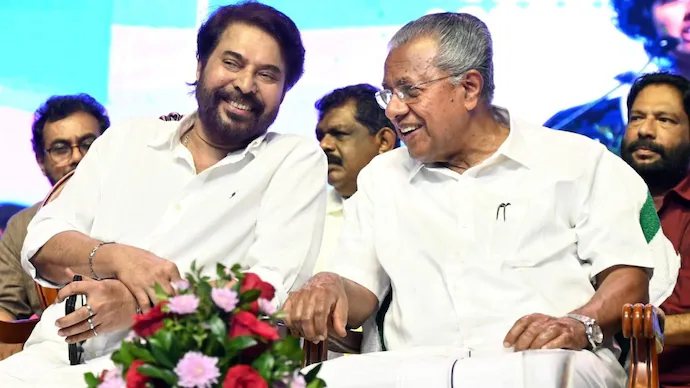
Veteran Malayalam actor Mammootty, who has maintained a long-standing association with Left-leaning politics in Kerala, is facing criticism from sections of the Left’s online supporters following a series of personal interactions that have been interpreted through a political lens. The latest controversy erupted after the actor visited the home of BJP state vice-president B Gopalakrishnan to meet his family and newly married daughter.
The backlash has exposed tensions between the actor’s personal relationships and the political expectations placed on celebrities who are perceived to share ideological affiliations with a particular party. While some social media users accused Mammootty of compromising his secular and Left-leaning credentials, several CPI(M) leaders have defended his right to maintain personal relationships across political boundaries.
The controversy also reflects a wider debate in Kerala over political polarisation, online trolling and the growing tendency to treat celebrities’ private interactions as public political statements.
Why Is Mammootty Facing Criticism From Left-Leaning Social Media Users?
The immediate trigger was Mammootty’s visit to the residence of BJP leader B Gopalakrishnan on November 7, 2026. The actor had initially promised to attend Gopalakrishnan’s daughter’s wedding, held at Guruvayur on November 1, but could not attend the ceremony.
He later visited the BJP leader’s home to meet the newlyweds and their family, fulfilling his earlier commitment. Gopalakrishnan shared photographs and videos of the interaction on social media, showing the actor spending time with the family.
The posts prompted criticism from several Left-leaning social media accounts. Some users portrayed the visit as a political endorsement or a sign of ideological inconsistency, questioning why an actor associated with Left politics would publicly interact with a prominent BJP leader.
Critics also argued that such interactions could provide social legitimacy to political figures whose previous statements have been controversial. Some accused Mammootty of hypocrisy, while others questioned whether his personal associations were consistent with the secular values he has historically been associated with.
Gopalakrishnan responded to the backlash by appealing to people not to politicise his daughter’s wedding or personal relationships. The BJP leader’s intervention highlighted how a family occasion had become part of a wider political argument.
Why B Gopalakrishnan’s Past Remarks Became Part of the Debate
The criticism of Mammootty was not limited to his decision to visit a BJP leader. Some observers argued that the actor’s association with Gopalakrishnan deserved scrutiny because of the BJP leader’s previous remarks about religious and political issues.
Gopalakrishnan has faced criticism in the past for comments concerning Muslims and religious representation. During an Assembly election campaign, he questioned why Guruvayur, the temple town from where he contested, did not have a Hindu MLA.
Before the Lok Sabha elections, he also made claims concerning Vavar Swamy, the Muslim saint associated with the Sabarimala pilgrimage tradition, suggesting that the land associated with the temple could eventually be claimed as Waqf property.
Last year, following the announcement of the Kerala State Film Awards, Gopalakrishnan shared a post selectively naming Muslim award winners, including Mammootty. He described the development as a “massive wonder” during the election season. The post has since been deleted.
These earlier remarks have become central to the criticism from some Left-leaning commentators, who argue that Mammootty’s visit could help normalise the public image of leaders they consider communal or politically divisive.
However, the controversy also raises a separate question: whether attending a family function or visiting newlyweds should automatically be interpreted as support for the political views of the host.
Why Was Mammootty Singled Out Despite Other Political Leaders Attending the Wedding?
The criticism also attracted attention because Mammootty was not the only prominent public figure associated with a different political camp to attend the wedding. CPI(M) leader and Leader of the Opposition Pinarayi Vijayan and Congress leader and Chief Minister VD Satheesan were also among those who attended the ceremony, according to the report.
The presence of leaders from different political backgrounds suggests that the wedding itself was not exclusively a political gathering. Nevertheless, Mammootty’s visit to Gopalakrishnan’s home became a particular focus of online criticism.
One explanation lies in the actor’s public image. Mammootty has long been regarded by many supporters of the Left as a prominent cultural figure sympathetic to its ideological positions. His association with CPI(M) leaders and Kairali TV has reinforced that perception over several decades.
Consequently, some online supporters appear to hold him to a different standard from politicians or other guests. His interaction with a BJP leader was interpreted not simply as a social gesture but as a potential political signal.
That interpretation, however, remains contested. The visit itself does not establish that Mammootty endorsed Gopalakrishnan’s political positions or changed his ideological beliefs.
How the Wayanad Landslide Visit Started the Online Dispute
The latest controversy is not the first time sections of the Left’s online ecosystem have criticised Mammootty. The actor had already faced a backlash in March 2026 following a private visit to the Elstone Estate in Wayanad to meet survivors of a landslide.
During the visit, CPI(M) Wayanad district secretary K Rafeeq accompanied Mammootty. At one point, Rafeeq appeared to stand close to the actor while helping manage the crowd.
A short video from the interaction showed Mammootty expressing discomfort about the politician remaining beside him. The actor reportedly told Rafeeq:
“Why are you always standing next to me? People will think I came here for you. Please move aside”.
The comment appeared to reflect Mammootty’s concern that the visit should remain focused on the landslide survivors rather than become associated with a political leader.
However, the clip triggered criticism from some Left-leaning social media users. Trolls described the actor as arrogant and accused him of disrespecting a local CPI(M) leader. Some demanded that he show greater deference to the party’s representatives.
The reaction exposed a difference in how the interaction was interpreted. While Mammootty’s reported remarks appeared directed at keeping the visit from becoming a political event, critics viewed them as a personal slight against Rafeeq.
Rafeeq later clarified that Mammootty had not intended to insult him, helping ease the controversy at the time.
Meeting With SFI and DYFI Leaders Triggered Another Wave of Criticism
The disagreement resurfaced in October 2026, when Mammootty hosted a group of Left-affiliated youth and student leaders at his residence.
The visitors belonged to the Students’ Federation of India (SFI) and the Democratic Youth Federation of India (DYFI), organisations associated with the CPI(M). The meeting was initially seen as another indication of the actor’s continuing personal connections with Left supporters.
However, some social media users brought up the earlier Wayanad incident and questioned Mammootty’s interactions with party representatives. Critics argued that he appeared uncomfortable with political associations when they involved the Left but was willing to meet a BJP leader publicly.
The argument centred on what critics viewed as inconsistent treatment of political relationships. Supporters of the actor, meanwhile, could distinguish between attending a family occasion and allowing political figures to dominate a humanitarian visit.
The October meeting therefore did not end the earlier dispute. Instead, it became another episode in an increasingly public debate over how Mammootty’s personal interactions should be interpreted.
Mammootty’s Visit to the Statue of Unity Also Attracted Criticism
Mammootty had faced sporadic criticism from sections of Left-leaning social media users earlier in 2026 after visiting the Statue of Unity in Gujarat and sharing photographs from the location.
The actor had travelled to Gujarat to receive his fourth National Film Award for Best Actor. His photographs from the monument nevertheless attracted political reactions from some online accounts.
The episode indicated that criticism of Mammootty’s public activities was not limited to his meetings with individual political leaders. Even visits to prominent national landmarks could attract ideological interpretations because of the political associations attached to those locations.
Understanding Mammootty’s Long Association With the Left
Mammootty is an actor rather than a politician, but his association with Left-leaning politics in Kerala has been visible for decades. He has maintained a close relationship with several CPI(M) leaders, including Pinarayi Vijayan, and has been associated with Kairali TV, a television network promoted by the CPI(M).
He has served as chairman of Malayalam Communications Limited, which operates Kairali TV, since the organisation’s inception in the mid-1990s.
His public statements have also reflected support for causes associated with the Left. At a conference organised by the DYFI, Mammootty spoke about the 2002 Gujarat riots and said that if organisations such as the DYFI had been present and active in Gujarat, the communal violence and atrocities committed in the name of religion would not have occurred.
The remarks triggered a major controversy at the time. Protests were reported, film shoots were disrupted and the state provided special police protection at his residence amid the hostility he faced.
For years, many Left supporters defended Mammootty against criticism from right-wing groups, viewing him as a prominent cultural personality who had spoken openly against communal violence.
In an earlier media interview, he was described as someone who considered himself a “liberal Leftist”. That description reflects the political identity often associated with him, although he has not held an elected political position or formally represented the CPI(M) in public office.
His relationship with the Left has therefore been shaped by personal friendships, cultural associations and public statements rather than a conventional political career.
Why Mammootty Has Maintained Distance From Direct Political Messaging
Despite his long association with Left leaders and organisations, Mammootty has generally maintained a distinction between his personal beliefs and his professional identity as an actor.
His public appearances with political figures have often attracted attention, but he has not consistently used every interaction to communicate a political message. This has allowed him to maintain relationships across different sections of Kerala’s political and cultural landscape.
That approach has become increasingly difficult in an environment where photographs, short video clips and social media posts can quickly become political talking points.
For celebrities with a recognisable ideological identity, even routine social interactions can be interpreted as statements of support or opposition. The Mammootty controversy illustrates how online political communities can create expectations about whom public figures should meet and how they should behave.
It also highlights the difficulty of separating personal relationships from political symbolism in Kerala, where cinema and politics have historically shared a close relationship.
CPI(M) Leaders Defend Mammootty and Distance the Party From Online Trolls
The online criticism prompted senior CPI(M) figures to defend Mammootty and clarify that attacks by individual social media users should not be treated as the official position of the party.
Former Kerala Finance Minister and senior CPI(M) leader Thomas Isaac argued that attending weddings and maintaining personal relationships should not be judged according to political differences.
Isaac specifically criticised the online attacks and said that the people responsible did not represent the party’s official position.
“The cyber followers are the main players behind this. They are not the CPI(M). The CPI(M) wants to maintain such a relationship with him. Those associated with the party, whether on social media or otherwise, should act keeping this perspective in mind. Those who do not follow this approach do not represent the CPI(M).”
His comments reflected concern that the online backlash could damage the relationship between the party and a prominent cultural figure who has been associated with its political and media activities for years.
Similar efforts to calm tensions had taken place after the earlier Wayanad incident and the October meeting with student leaders.
CPI(M) state secretary MV Govindan publicly rejected the online bullying following the October episode. Rafeeq had also clarified after the Wayanad visit that Mammootty had not intended to insult him.
Pinarayi Vijayan Apologises for Distress Caused to Mammootty
Kerala’s senior Left leader Pinarayi Vijayan also publicly expressed regret over the distress caused to Mammootty by the social media campaign, particularly if people associated with the CPI(M) had participated in the attacks.
Vijayan questioned why people claiming to represent the party’s online ecosystem were targeting an actor who had maintained a long relationship with the Left.
“Could they not recognise Mammootty? Do they not know who Mammootty is?”
The remarks highlighted the gap between the public position of senior party leaders and the behaviour of some supporters on social media.
While party leaders have sought to preserve their relationship with Mammootty, the repeated controversies show how difficult it can be to control online political reactions, even when those reactions conflict with the party leadership’s stated position.
What the Controversy Reveals About Politics and Celebrity Culture in Kerala
The backlash against Mammootty goes beyond a single visit to a BJP leader’s home. It reflects the pressure faced by public figures whose perceived political identities become part of their public image.
For some Left supporters, Mammootty’s past statements and associations have made him an important cultural ally. They therefore expect his public conduct to remain consistent with the political values they associate with him.
Others argue that ideological agreement does not require a person to avoid social relationships with people from opposing political parties. Attending a wedding, meeting a family or visiting newlyweds does not automatically amount to endorsing the host’s political views.
The distinction is particularly relevant in Mammootty’s case because the actor has maintained relationships with political figures while continuing to work primarily as an artist.
The controversy also raises questions about the influence of online political groups. Short clips and photographs can become the basis for intense criticism, often without the full context of an interaction. In the Wayanad episode, for example, the actor’s reported concern about keeping attention on landslide survivors became a dispute over his treatment of a local party leader.
For Mammootty, the challenge is likely to remain the same: preserving his independence as a cultural personality while navigating expectations created by decades of political associations.
The latest episode demonstrates that even a personal visit can become a major political controversy when public figures are viewed through the lens of party loyalty. The responses from senior CPI(M) leaders also suggest that the party leadership does not want online attacks to define its relationship with the actor.
For breaking news and live news updates, like us on Facebook or follow us on Twitter and Instagram. Read more on Latest India on thefoxdaily.com.


COMMENTS 0