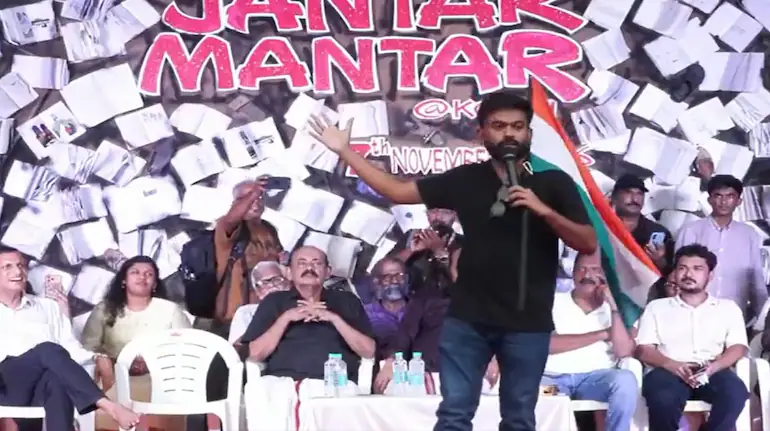
Cockroach Janata Party (CJP) founder Abhijeet Dipke has predicted that the Bharatiya Janata Party (BJP) will lose power in the 2029 Lok Sabha elections, urging supporters and protesters to prepare for a change of government. Speaking at a political gathering in Kochi, Kerala, on Saturday, November 7, he also demanded the resignation of Chief Election Commissioner Gyanesh Kumar over the Election Commission‘s Special Intensive Revision (SIR) of electoral rolls.
Dipke made the remarks during the CJP’s ‘Jantar Mantar at Kochi’ campaign, which has been organised to oppose the voter-list revision exercise. He argued that political change must come through elections and called for an electoral system that is independent and impartial.
Predicting the outcome of the next general election, Dipke told the gathering, “Be prepared for 2029. He will definitely go,” referring to Prime Minister Narendra Modi. He repeatedly asked protesters whether Modi would lose power in the next Lok Sabha elections, drawing an enthusiastic response from the audience.
His comments add to the political criticism surrounding the SIR exercise, which has become a contentious issue between the opposition and the BJP-led Centre. The controversy involves questions about voter-list accuracy, the verification of eligibility and concerns raised by opposition parties about the potential exclusion of legitimate voters.
Dipke Demands CEC Gyanesh Kumar’s Resignation Over SIR
A central part of Dipke’s speech was his demand for the resignation of Chief Election Commissioner Gyanesh Kumar. He linked the demand to his criticism of the electoral-roll revision process and accused the government of protecting the election chief while taking action against young protesters.
“Gyanesh Kumar has to go. If he goes, Narendra Modi will also go,” Dipke said.
He alleged that the SIR exercise was being used to influence electoral outcomes rather than simply update voter records. The CJP founder argued that electoral transparency was essential to maintaining public confidence in democratic institutions.
The Special Intensive Revision is an Election Commission exercise intended to verify and update electoral rolls. Such revisions can involve checking voter eligibility, identifying duplicate or shifted entries, correcting errors and removing names of people who are no longer eligible under election laws.
However, the exercise has faced political criticism in several states. Opposition parties have questioned the timing, implementation and possible consequences of large-scale verification drives, particularly where voters may face difficulties producing documents or completing the required procedures.
These concerns have made the SIR a significant political issue. At the same time, allegations that the exercise is deliberately designed to manipulate election results require evidence and cannot be treated as established merely because political leaders have made them.
Why the Election Commission’s Independence Is Central to the Debate
The Election Commission of India is a constitutional body responsible for conducting elections to Parliament, state legislatures and the offices of the President and Vice-President. Its independence is essential because political parties competing in elections must have confidence that the process is administered fairly.
The Chief Election Commissioner heads the Commission and works with the other Election Commissioners on election-related responsibilities. The institution oversees electoral rolls, election schedules, polling arrangements, counting procedures and the implementation of the Model Code of Conduct.
Dipke’s demand for Kumar’s resignation reflects a wider opposition argument that the Election Commission must demonstrate impartiality in politically sensitive decisions. His remarks also connect the SIR controversy with the broader question of how electoral institutions maintain public trust.
However, a demand for the resignation of an election official is a political position, not proof of wrongdoing. Any allegation of bias or procedural misconduct needs to be assessed against the Commission’s decisions, applicable election laws and verifiable evidence.
Dipke Accuses Modi Government of Compromising India’s Interests
Dipke also criticised the Modi government’s relationship with US President Donald Trump, alleging that India had compromised its national interests in dealings with Washington. He questioned reports and claims concerning India’s Russian oil purchases, tariffs on Indian goods and trade arrangements with the United States.
He referred to an alleged commitment to stop purchasing Russian oil, the reported 18% tariff on Indian goods and what he described as a zero-tariff arrangement for American products. He used these issues to argue that the government was making concessions to protect the Prime Minister’s political image and avoid embarrassment in its dealings with Trump.
“Who is selling the interests of this nation? It is you, not the CJP and not the cockroaches,” he said.
Dipke’s remarks were political allegations made at the rally and were not independently substantiated by the material provided. Trade agreements, tariff arrangements and energy-purchasing decisions involve separate negotiations and policy considerations. Their actual terms need to be examined before drawing conclusions about their impact on India’s economic or strategic interests.
India’s purchase of Russian crude oil has been shaped by energy-security requirements, international market conditions and the country’s diplomatic relationships. Similarly, tariff announcements and trade negotiations with the United States need to be distinguished from final, legally operative trade agreements.
CJP Founder Recalls Arrest During Delhi Protest
Dipke also spoke about his earlier arrest in Delhi alongside CJP leaders Saurav Das and Ashutosh Ranka. According to his account, the three were detained after entering the Jantar Mantar area carrying the national flag during a protest.
He said the experience had strengthened his determination to continue participating in demonstrations across the country with the Tricolour.
“I was sent behind bars for raising this Tricolour. Saurav and Ashu, my two brothers, were also sent behind bars for raising it,” Dipke said.
He compared the incident with restrictions during British rule, alleging that citizens’ freedom to protest and express political opinions was being curtailed. He also said he was prepared to face arrest in other states but would not stop carrying the national flag at public demonstrations.
The comparison was part of Dipke’s political speech. Whether the arrest and the circumstances surrounding it amount to an infringement of constitutional rights would depend on the specific legal grounds, police action and subsequent proceedings.
He Accuses BJP of Dividing People Along Religious Lines
Another major theme of Dipke’s speech was his criticism of the BJP’s political and ideological approach. He accused the ruling party of dividing people along religious lines and alleged that communal tensions and riots were being triggered for political gain.
These were serious allegations made by the CJP founder at the Kochi gathering. He did not establish them through evidence in the statements provided, and they should be understood as his political accusations rather than independently verified findings.
Dipke also criticised what he described as government interference in personal choices and electoral freedom. He argued that political control had expanded from questions about food and relationships to the freedom to decide whom to vote for.
“They first wanted to control what you eat, then whom you can marry and love, and now they have come to a point where they want to control whom you vote for,” he said.
His comments connected the SIR controversy with broader concerns about personal liberty, religious polarisation and democratic participation. The speech sought to present the voter-list revision campaign as part of a larger struggle over citizens’ rights and the functioning of democratic institutions.
Dipke Invokes Gandhi, Ambedkar and Nehru
Dipke invoked Mahatma Gandhi, Dr BR Ambedkar and Jawaharlal Nehru while criticising the Prime Minister and the BJP’s ideological position. He described Gandhi as the soul of India, Ambedkar as its backbone and Nehru as its mind.
He argued that Modi could not surpass the contributions of these three leaders even if he remained in office for 120 years. The comparison was intended to emphasise their historical influence on India’s freedom movement, constitutional development and early years as an independent democracy.
Gandhi played a central role in the mass mobilisation against British colonial rule. Ambedkar chaired the Drafting Committee of the Constituent Assembly and became one of the most influential figures in the making of India’s Constitution. Nehru served as India’s first Prime Minister and shaped the country’s early political, economic and international policies.
By invoking these figures, Dipke positioned his criticism within a broader argument about India’s democratic and constitutional traditions. He also targeted the Rashtriya Swayamsevak Sangh (RSS), the organisation from which Modi’s political ideological background emerged, making allegations about its role during the freedom struggle.
Historical claims about political organisations and their role in the independence movement remain subjects of public and scholarly debate. Dipke’s remarks represented his political interpretation rather than a complete account of that history.
‘We Are Ambedkarites, We Are Gandhians’: Dipke Defends Young Protesters
The CJP founder rejected the description of young demonstrators as anarchists. He portrayed them instead as citizens drawing inspiration from India’s freedom movement and constitutional values.
“We are Ambedkarites, we are Gandhians. Don’t you dare call us anarchists,” he told the gathering.
Dipke alleged that the government was using its power against young people who questioned its decisions. He argued that political dissent and peaceful protest should be recognised as legitimate parts of democracy rather than treated as threats to public order.
His comments also reflected the CJP’s effort to present its campaign as a youth-led movement focused on electoral transparency and civil liberties. The Kochi event attracted people from different age groups, along with representatives of youth and socio-cultural organisations.
Dipke Compares the Current Political Climate With Manmohan Singh’s Tenure
Dipke compared the current political environment with the period when Manmohan Singh was Prime Minister, arguing that people had greater freedom to criticise the government at that time.
He referred to speeches made by Modi against Singh and suggested that similar criticism directed at the present Prime Minister could attract action under the Unlawful Activities (Prevention) Act, commonly known as UAPA.
“I am not saying that government was perfect. But that India was more democratic, where you were allowed to criticise the prime minister. And that is how democracy should be,” he said.
The comparison was based on Dipke’s assessment of political freedoms during the two periods. The UAPA is an anti-terrorism law that provides for action against specified unlawful and terrorist activities; whether it applies in a particular case depends on the facts and legal provisions involved. Criticism of a Prime Minister, by itself, does not automatically constitute an offence under the law.
Dipke also alleged that India had lost its voice over the preceding 10 to 12 years but said protests organised under the Jantar Mantar campaign had encouraged people to speak openly again.
Prakash Raj Leads Protest March in Kochi
The Kochi gathering was part of the CJP’s wider campaign against the SIR exercise. The main meeting took place at Rajendra Maidan, where participants attended speeches and cultural programmes.
Earlier, actor Prakash Raj led a protest march from Marine Drive to Rajendra Maidan. Dipke said he had travelled to Kochi at the invitation of local organisers and Prakash Raj to participate in the campaign.
Prakash Raj has previously spoken on political and social issues, and his participation brought additional public attention to the protest. The march and the meeting brought together people from different backgrounds around the campaign’s demands concerning electoral-roll revision and the Election Commission.
Can the BJP Be Defeated in the 2029 Lok Sabha Elections?
Dipke’s prediction that the BJP-led government will lose power in 2029 is a political forecast, not an established electoral outcome. The next Lok Sabha election will depend on voter preferences, alliances, candidate selection, campaign strategies, economic conditions and developments during the remainder of the current parliamentary term.
The BJP’s national electoral position will also be shaped by its performance in state elections and its ability to maintain support among different social and regional groups. Opposition parties, meanwhile, will need to build effective alliances, agree on seat-sharing arrangements and present an alternative political programme if they hope to challenge the ruling party nationally.
The controversy surrounding SIR could remain an important issue if concerns about voter inclusion, verification procedures and the transparency of electoral rolls continue. However, the political impact of the debate will depend on the evidence presented, the Election Commission’s response and how voters assess the issue.
For now, the Kochi protest reflects the CJP’s attempt to connect opposition to electoral-roll revision with a wider campaign around civil liberties, constitutional values and political accountability. Dipke’s call to prepare for 2029 signals the party’s intention to keep challenging the BJP, while the final verdict on the government’s future will rest with voters at the ballot box.
For breaking news and live news updates, like us on Facebook or follow us on Twitter and Instagram. Read more on Latest India on thefoxdaily.com.




COMMENTS 0