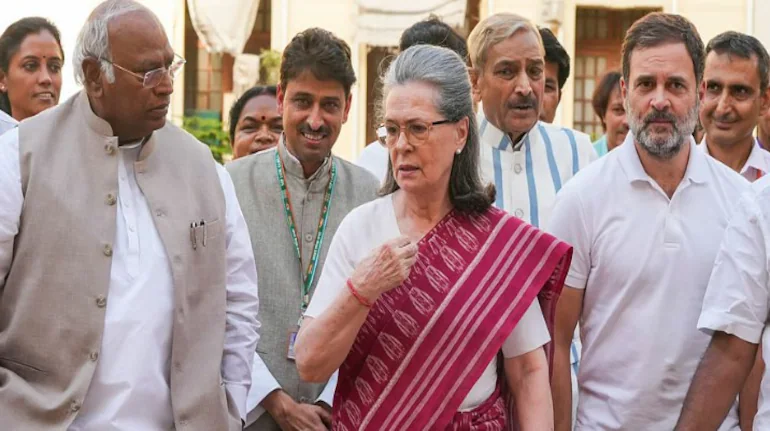
Congress president Mallikarjun Kharge and senior party leader Sonia Gandhi are preparing to meet Tamil Nadu Chief Minister MK Stalin and NCP (SP) chief Sharad Pawar as the opposition steps up efforts to coordinate its response to the Centre’s proposed delimitation legislation. The meetings, expected to take place in Chennai and Mumbai respectively, come a day before the special sitting of Parliament begins on November 30, 2026.
According to news agency ANI, the Congress leaders intend to urge Stalin and Pawar to reconsider their parties’ support for the proposed legislation. The outreach reflects growing concern within the opposition INDIA bloc over differences among its constituents, particularly after the Dravida Munnetra Kazhagam (DMK) announced that it would back the revised Delimitation Bill following assurances from the Centre on Tamil Nadu’s parliamentary representation.
The political discussions are taking place against a wider debate about how delimitation could reshape India’s electoral constituencies, parliamentary representation and the balance of power between states. Congress is attempting to bring its partners onto a common position before lawmakers take up the legislation in Parliament.
Why Kharge and Sonia Gandhi are reaching out to Stalin and Pawar
The proposed meetings with Stalin and Pawar are part of Congress’s effort to prevent differences over delimitation from weakening opposition coordination ahead of the special parliamentary sitting.
Stalin’s DMK has announced its decision to support the revised legislation, while the Congress and several other opposition parties have raised objections over the potential consequences of increasing the number of parliamentary seats and conducting a delimitation exercise.
The Congress leadership is concerned that support from important INDIA bloc partners could complicate the opposition’s attempt to challenge the government’s proposals. The party’s outreach is intended to explain its concerns and persuade its allies to reconsider their positions before the bills are taken up.
The proposed meeting with Pawar is also significant because the NCP (Sharadchandra Pawar) has emerged as another important political voice in the debate. Differences over the legislation have created questions about whether opposition parties can maintain a coordinated position when their individual assessments of the government’s revised proposal differ.
Why the DMK agreed to support the revised Delimitation Bill
The DMK’s decision followed discussions between its members of Parliament and Union Home Minister Amit Shah. The party said its principal concerns had been addressed through assurances concerning Tamil Nadu’s share of seats in the Lok Sabha and the protection of the existing balance of parliamentary representation among states.
DMK MP Kanimozhi said the party had secured assurances that Tamil Nadu’s Lok Sabha representation would increase from the existing 39 seats to 59 under the proposed expansion, using the 1971 population figures as the basis. She also said the revised arrangement would remain frozen for 25 years.
According to Kanimozhi, the party’s demands had been raised earlier in Parliament and through a resolution adopted by the Tamil Nadu government in 2024. The DMK believes that the assurances incorporated into the revised proposal address its concerns about the possibility of states losing their relative political influence because of differences in population growth.
The party’s position marks a change from its earlier opposition to the government’s delimitation proposal. All 22 DMK Lok Sabha MPs had voted against the previous constitutional amendment in April. The revised proposal and the assurances communicated by the Centre have now led the party to take a different position.
Why southern states are concerned about delimitation
Delimitation involves redrawing electoral constituency boundaries and determining the distribution of seats based on the applicable constitutional and legal framework. The exercise is important because it determines how voters are represented in Parliament and state legislative assemblies.
The central concern raised by several southern states is that a population-based redistribution could alter the balance of representation between regions. States such as Tamil Nadu have argued that they should not be disadvantaged in parliamentary representation because they achieved lower population growth through sustained investments in education, healthcare and family planning.
Southern political leaders have therefore demanded safeguards to protect their relative share of seats. Their concern is not simply about the total number of Lok Sabha members but also about whether the political influence of individual states could change significantly after delimitation.
The DMK has said that the proposed 25-year freeze on the distribution of seats addresses this concern. However, other opposition parties continue to question the legislation and the broader process through which constituency boundaries and representation will be determined.
What the Congress wants to achieve before November 30
The timing of the proposed meetings is important because Parliament is scheduled to reconvene on November 30 for a special sitting during which the government is expected to take up the revised legislation.
Congress wants to discuss the political and constitutional implications with its partners before the parliamentary proceedings begin. The meetings could help clarify whether the DMK and NCP (SP) are prepared to reconsider their positions or whether the opposition will enter the session with differing approaches to the bill.
The party’s challenge is to balance its opposition to the proposed delimitation framework with the concerns of regional parties that believe they have secured protections for their states through negotiations with the Centre.
For Stalin, the DMK’s stated position is based on the assurances regarding Tamil Nadu’s representation. For Congress, the wider question is whether those assurances adequately address the implications of the proposed constitutional changes for the federal balance and the representation of all states.
Why the meetings matter for the INDIA bloc
The INDIA bloc was formed to coordinate opposition parties against the BJP-led National Democratic Alliance, but its members have frequently differed over regional priorities, political strategies and legislative positions.
The delimitation debate has exposed another area of disagreement. While Congress is seeking a common opposition response, the DMK has indicated that it is willing to support the revised proposal after receiving assurances on Tamil Nadu’s seat share. The position of Pawar’s party is also important as the opposition attempts to establish how its MPs will approach the legislation.
Kharge and Sonia Gandhi’s proposed outreach is therefore more than a series of meetings with individual political leaders. It is an attempt to preserve coordination among parties whose interests do not always align on major national policy questions.
The outcome of the discussions could influence the opposition’s parliamentary strategy when the special sitting begins. However, whether the meetings produce a common position remains to be seen.
What happens next in Parliament?
The Lok Sabha is scheduled to reconvene on November 30, when the government is expected to move forward with the revised delimitation-related legislation and its proposed constitutional changes linked to women’s reservation.
The bills have major implications for the composition of Parliament, the distribution of seats among states and the implementation of the one-third reservation for women in legislative bodies. Their passage will require the necessary parliamentary majorities and, where constitutionally required, ratification by at least half of the state legislatures.
For the government, support from regional parties could be important in securing the numbers required for the constitutional amendment. For the opposition, the immediate task is to decide whether it can present a coordinated challenge despite the DMK’s decision to support the revised proposal.
The planned meetings between Kharge, Sonia Gandhi, Stalin and Pawar could offer an indication of how much common ground remains within the INDIA bloc. With Parliament’s special sitting approaching, the discussions are likely to be closely watched as political parties prepare for a consequential debate over India’s future electoral representation.
For breaking news and live news updates, like us on Facebook or follow us on Twitter and Instagram. Read more on Latest India on thefoxdaily.com.




COMMENTS 0