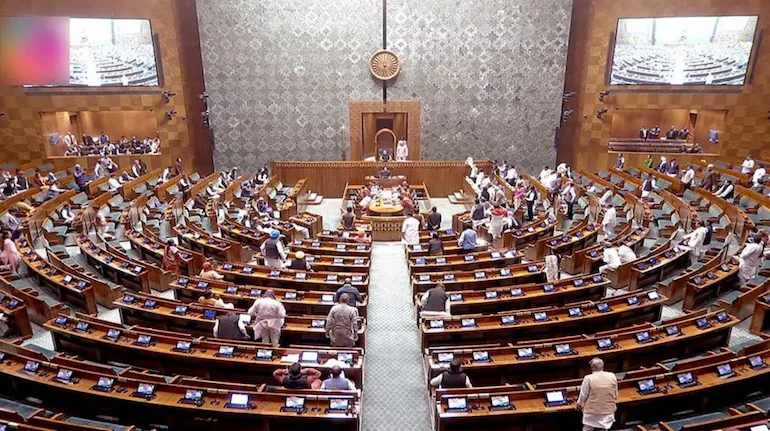
The Lok Sabha has revised the seating arrangements of 97 Members of Parliament after the Dravida Munnetra Kazhagam (DMK) announced its decision to support the Centre’s proposed Delimitation and Women’s Reservation Bills. The change followed a meeting of DMK MPs convened by party president MK Stalin, after which the party formally conveyed its position to Union Home Minister Amit Shah.
DMK deputy general secretary and Lok Sabha MP Kanimozhi said the party decided to support the legislation because the Centre had incorporated its long-standing demands, including retaining the existing basis of parliamentary representation for another 25 years and using the 1971 population figures for increasing seats.
According to Kanimozhi, the proposed arrangement would increase Tamil Nadu’s Lok Sabha representation from 39 to 59 seats while protecting the state’s share in Parliament. The party’s announcement marks a significant shift in the political debate over delimitation, which has generated concerns among several southern states about the possible impact of population-based seat redistribution.
Why Were the Seating Arrangements of 97 MPs Changed?
The change in seating arrangements came after the DMK announced its support for the Centre’s revised legislative proposals. The Lok Sabha Secretariat revised the seating plan for 97 MPs, including members of the DMK, following the party’s decision.
The change reflects the parliamentary adjustments made after the party’s position on the legislation became clear. However, the revised seating arrangements should not be confused with the proposed delimitation exercise itself. The seating change concerns where MPs sit inside the House, while delimitation would determine the number and boundaries of electoral constituencies.
The immediate political development was the DMK’s decision to back the Bills after concluding that its demands had been included in the revised proposal. The party’s MPs met Amit Shah to communicate the decision to the Centre.
Kanimozhi Says Centre Accepted DMK’s Key Demands
Explaining the party’s position, Kanimozhi said the DMK had repeatedly raised concerns about delimitation in Parliament and through a resolution adopted by the Tamil Nadu government in 2024. She said the revised legislation incorporated the safeguards the party had sought.
“We have decided to support the Delimitation Bill because whatever the DMK had wanted in that bill, like last time when we spoke in Parliament, or even before that when the DMK government had passed a resolution in 2024, whatever we had asked for, today they have made it part of the bill. Whatever the DMK had insisted on is in the bill today. We had also insisted that there will be a freeze for the next 25 years. So all that is in the bill…Whatever we wanted, we’ve got,” Kanimozhi said.
She said the party had specifically demanded that the increase in parliamentary seats be calculated using the 1971 population figures rather than allowing population changes to alter the relative representation of states.
“When the government said that they will be increasing the number of seats, we wanted it to be done on the 1971 basis, and they have agreed to that, and a freeze on that for 25 years has also been accepted,” she said.
Kanimozhi added that the proposed increase would take Tamil Nadu’s Lok Sabha representation from 39 to 59 seats. She also said the Women’s Reservation Bill would be implemented after the delimitation legislation was passed.
Tamil Nadu’s Lok Sabha Seats to Increase from 39 to 59
The proposed increase in Tamil Nadu’s representation is central to the DMK’s explanation for supporting the revised framework. The party had argued that states which successfully controlled population growth should not lose their relative influence in Parliament during a delimitation exercise.
By seeking to retain the 1971 population basis and freeze the distribution for another 25 years, the DMK aimed to secure an arrangement under which Tamil Nadu could gain additional constituencies without a reduction in its proportion of Lok Sabha representation.
The distinction is important because delimitation involves more than simply increasing the total number of MPs. It can also change how seats are distributed among states and how electoral boundaries are drawn within each state.
The DMK has presented the revised proposal as an acceptance of its demand to protect the state’s parliamentary position. The precise implementation of the proposed changes, however, will depend on the legislation being passed and the subsequent delimitation process.
MK Stalin Says DMK Took a Long-Term View
Earlier on Saturday, Stalin addressed a meeting of DMK MPs at Anna Arivalayam, the party headquarters in Chennai, and explained the reasoning behind the decision. He said the party had approached the issue with a long-term perspective rather than allowing immediate political reactions to determine its position.
Stalin also said the DMK had been among the first political parties to raise concerns about the possible consequences of delimitation for Tamil Nadu and other southern states.
“For the past few months, the entire country has been discussing what stand the DMK would take when the Delimitation Bill was reintroduced. Yesterday, we gave a clear answer to that question,” he said.
The party’s position had attracted attention because it had opposed an earlier version of the constitutional amendment and related legislation. Its support for the revised proposal followed the Centre’s acceptance of the safeguards that the DMK says it had consistently demanded.
Rahul Gandhi Says INDIA Bloc Partners Can Maintain Their Positions
The DMK’s announcement also prompted questions about the unity of the opposition INDIA bloc, particularly because several parties within the alliance have taken different positions on the proposed delimitation legislation.
Lok Sabha Leader of Opposition Rahul Gandhi said the position of an alliance partner within the INDIA bloc would not automatically change if it decided to support the Bill. His remarks came amid questions about the DMK and the Sharad Pawar-led Nationalist Congress Party (Sharadchandra Pawar), or NCP (SP).
Asked whether the NCP (SP)’s position in the opposition alliance would change if it supported the legislation, Gandhi said: “In the INDIA bloc, their position is what their position is. Their position is not going to change in the INDIA bloc if they support the bill.”
Responding to another question about the DMK’s decision, Gandhi described the broader issue as a “fight for democracy”. He also appealed to parties in the National Democratic Alliance (NDA), including the Telugu Desam Party (TDP), to consider the implications of the proposed legislation.
Delimitation and Women’s Reservation Bills at the Centre of Debate
The Centre’s proposed legislative package links the delimitation exercise with the implementation of one-third reservation for women in the Lok Sabha and state legislative assemblies. The Constitution (132nd Amendment) Bill, 2026, is intended to make the constitutional changes required for the proposed framework, while the Delimitation (Second) Bill, 2026, provides for the readjustment of seats and constituencies.
The government has proposed increasing the number of seats in legislative bodies by 50 per cent. The revised framework also seeks to preserve the relative distribution of parliamentary representation among states for the specified period.
Supporters of the proposal argue that increasing legislative strength can create additional representation while enabling the women’s quota to be implemented. Critics have questioned whether delimitation needs to be linked to the reservation framework and have called for safeguards over how states’ representation will be calculated.
Why DMK MPs Will Sit Away from Congress in Lok Sabha
The seating reshuffle also reflects the political changes that followed the breakdown of the DMK’s alliance with the Congress in Tamil Nadu. The DMK’s 22 Lok Sabha MPs have been moved towards the Treasury Benches, placing them alongside members of the ruling alliance rather than their former Congress partners.
Kanimozhi had earlier written to Lok Sabha Speaker Om Birla requesting a change in the party’s seating arrangements. In her communication, she referred to the end of the DMK’s alliance with the Congress and argued that it was no longer appropriate for the party’s MPs to continue sitting alongside their former allies.
The Congress had subsequently joined hands with actor-politician Vijay’s Tamilaga Vettri Kazhagam (TVK) in Tamil Nadu, further widening the political divide between the two former allies.
The latest reshuffle affects MPs from several parties, including the DMK, Congress, Samajwadi Party, NCP (SP) and Shiv Sena (UBT). NCP (SP) MP Supriya Sule is also among those whose seating arrangements have changed and is set to sit alongside DMK MPs Kanimozhi and Dayanidhi Maran.
Although the DMK MPs are moving to the Treasury side of the House, the seating change does not automatically mean that the party has joined the BJP-led National Democratic Alliance (NDA). The DMK has announced support for the revised Bills, but its parliamentary position and formal alliance status are separate political questions.
DMK’s 22 MPs Could Influence the Delimitation Bill’s Passage
The DMK has 22 members in the Lok Sabha, making its support relevant to the government’s efforts to secure the required numbers for the constitutional amendment. All 22 DMK MPs had voted against the earlier constitutional amendment linked to delimitation in April.
The revised proposal has changed the party’s position. By announcing support, the DMK has added its parliamentary strength to the group of parties backing the government’s latest legislative package.
A constitutional amendment under Article 368 requires a majority of the total membership of each House and at least two-thirds of the members present and voting. Depending on the provisions being amended, ratification by at least half of the state legislatures may also be required.
The government’s ability to secure the necessary support will therefore depend on the final voting numbers in both Houses, rather than simply the number of parties publicly expressing support.
What Happens Next in Parliament?
The government is scheduled to take up the revised delimitation and women’s reservation proposals during the special parliamentary session beginning November 30. The Constitution (132nd Amendment) Bill, 2026, and the Delimitation (Second) Bill, 2026, are expected to be among the central items of legislative business.
The proposed framework seeks to increase the strength of the Lok Sabha and state assemblies by 50 per cent, while protecting the relative distribution of seats among states for the specified period. It is also intended to provide the constitutional and legal framework for implementing one-third reservation for women in elected legislatures.
The DMK’s support has changed the parliamentary arithmetic and created a new political dynamic within the INDIA bloc. At the same time, the seating reshuffle has given a visible form to the changing relationships between parties inside the Lok Sabha.
For the DMK, the decision is being presented as an outcome of securing safeguards for Tamil Nadu rather than abandoning its demand for fair delimitation. Whether those safeguards are implemented as the party expects will depend on the final legislation and the delimitation process that follows.
The change involving 97 MPs is therefore more than an administrative adjustment inside the Lok Sabha. It comes at a moment when parliamentary alignments are shifting ahead of a major debate over women’s representation, the size of legislatures and the distribution of political power among India’s states.
For breaking news and live news updates, like us on Facebook or follow us on Twitter and Instagram. Read more on Latest India on thefoxdaily.com.



COMMENTS 0