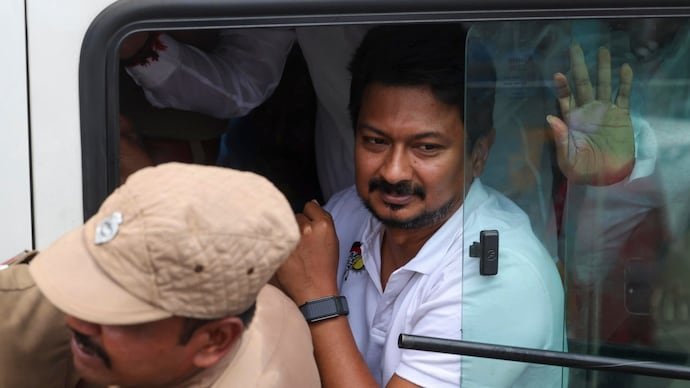
The Madras High Court ordered that Tamil Nadu Leader of the Opposition Udhayanidhi Stalin be released on station bail after questioning, hours after his arrest over remarks made during a speech on the Cauvery water dispute that sparked political and legal Controversy.
The Madras High Court on Tuesday directed Tamil Nadu Police to release Assembly Leader of the Opposition Udhayanidhi Stalin on station bail the same day after questioning him, bringing immediate judicial oversight to a politically charged case that has triggered widespread debate across the state.
The court’s intervention came only hours after Udhayanidhi was arrested in connection with remarks delivered during a public speech on the Cauvery water-sharing dispute. The comments have been widely interpreted by critics as an indirect sexual innuendo referring to actor Trisha, although Udhayanidhi has denied mentioning anyone other than Chief Minister Vijay and has maintained that the courts should decide the matter.
The episode has quickly evolved into one of Tamil Nadu’s most closely watched political controversies, combining questions of free speech, criminal law, political rivalry and allegations of insulting a woman’s dignity.
High Court Orders Same-Day Release
During the hearing, Tamil Nadu Advocate General Vijay Narayan informed the Madras High Court that Udhayanidhi Stalin had already been arrested by Thanjavur Police and taken to Thanjavur for questioning.
However, the state clarified that investigators did not intend to seek judicial remand.
“The police do not intend to remand him to judicial custody but only to question Udhayanidhi.”
After considering the state’s submission, the High Court directed that he be released on station bail after the questioning process was completed on Tuesday itself.
The order effectively ensured that the arrest would not immediately lead to judicial custody while allowing investigators to continue their inquiry.
Why Was Udhayanidhi Stalin Arrested?
The controversy stems from a speech delivered during a protest over the long-running Cauvery water-sharing dispute on August 3 in Thanjavur.
According to the complaint filed with police, members of the audience repeatedly chanted actor Trisha’s name during the speech. The complainant alleged that Udhayanidhi responded with an obscene double-meaning remark that was interpreted as referring to the actor.
The remarks attracted widespread criticism from the ruling Tamilaga Vettri Kazhagam (TVK) and several political leaders, who argued that they were offensive and inappropriate.
Police subsequently registered a criminal case before taking Udhayanidhi into custody on Tuesday.
The Complaint That Led to the Case
The First Information Report originated from a complaint submitted at the Thanjavur East Police Station by S. Bairavi, the Central District Women’s Wing Organiser of TVK in Thanjavur.
The complaint alleged that Udhayanidhi’s response during the public gathering amounted to an obscene remark that degraded women.
It further alleged that a 2-minute and 39-second video of the speech was deliberately circulated on the Social Media platform X by DMK IT wing office-bearers to provoke public unrest and amplify the controversial comments.
The complainant also argued that the remarks caused mental agony to actor Trisha and women more broadly.
Legal Provisions Invoked
Police booked Udhayanidhi Stalin under several legal provisions covering allegations ranging from obscenity to criminal intimidation.
| Category | Allegation |
|---|---|
| Obscenity | Use of allegedly obscene words during a public speech |
| Women’s dignity | Insulting the modesty of a woman |
| Public order | Provocation with intent to cause a riot |
| Public harmony | Promoting enmity between groups |
| Criminal law | Criminal intimidation and other related provisions |
The registration of these offences allows police to investigate the allegations. It does not amount to a judicial finding that the accused has committed the offences.
Anticipatory Bail Petition Filed
As police arrived at Udhayanidhi Stalin’s residence in Neelankarai, his legal team immediately moved the Madras High Court by filing an anticipatory bail petition.
During the hearing, however, the state informed the court that the arrest had already taken place but emphasized that judicial remand was not being sought.
This clarification became central to the High Court’s decision directing that he be released on station bail after questioning.
Udhayanidhi Stalin’s Response
Before being escorted away by police officers, Udhayanidhi briefly addressed reporters outside his residence.
“Court will decide.”
He also questioned the basis of the allegations.
“Did I mention anyone’s name except the CM’s? Then why do you think this is happening? Let the court decide.”
His remarks indicate that he disputes the interpretation advanced by the complainants and maintains that the legal process should determine whether any offence has been committed.
Political Fallout Across Tamil Nadu
The arrest quickly triggered political demonstrations across the state.
DMK workers organised flash Protests and road blockades in several districts, accusing the ruling government of targeting the Opposition through police action.
The demonstrations underscored the political significance of the controversy, particularly as the state prepares for the upcoming Assembly session.
Meanwhile, DMK president M.K. Stalin chaired a meeting at the party headquarters to discuss the party’s response before the Assembly convenes on August 5.
TVK Expands Its Protest
While the police Investigation continued, Tamilaga Vettri Kazhagam intensified its campaign over the alleged remarks.
In addition to filing complaints with local police, the party approached the National Commission for Women (NCW).
TVK national spokesperson Pazha Selvakumar submitted a formal complaint in New Delhi requesting that the Commission seek an explanation from Udhayanidhi Stalin and call upon him to issue an unconditional public apology.
The NCW complaint represents a parallel avenue separate from the ongoing criminal investigation.
Why the High Court’s Order Is Significant
The High Court’s direction does not address the merits of the allegations or determine whether any criminal offence occurred.
Instead, it focuses on the immediate question of personal liberty during the investigation.
By directing police to release Udhayanidhi on station bail after questioning, the court balanced the investigative powers of Law Enforcement with the state’s representation that custodial detention was not considered necessary.
Such orders are not uncommon where investigators indicate that further custody is unnecessary for the purposes of questioning.
Understanding Station Bail
Station bail allows an accused person to be released directly by the investigating police instead of being produced for judicial custody when the applicable legal provisions permit such release.
It enables the investigation to continue while avoiding unnecessary detention, subject to any conditions imposed under law.
The grant of station bail should not be interpreted as a finding on the merits of the allegations. The criminal investigation continues independently of the release.
What Happens Next?
Following questioning, investigators are expected to continue examining the speech, the complaint, video recordings and other evidence relevant to the case.
If police conclude that sufficient material exists, they may proceed with the next stages of the criminal process in accordance with law. Conversely, the investigation could also narrow or modify the allegations depending on the evidence collected.
Any future legal proceedings will ultimately depend on the evidence presented before the courts, where both the prosecution and the defence will have the opportunity to present their arguments.
Timeline of Key Events
| Event | Development |
|---|---|
| August 3 | Udhayanidhi Stalin addresses a protest on the Cauvery water-sharing dispute in Thanjavur. |
| After the speech | TVK alleges that his remarks indirectly referred to actor Trisha and files a police complaint. |
| Tuesday morning | Police arrive at Udhayanidhi’s residence and arrest him. |
| During High Court hearing | The Advocate General informs the court that police seek only to question him and not judicial remand. |
| Tuesday | The Madras High Court directs police to release him on station bail after questioning. |
| Later Tuesday | DMK protests continue while TVK approaches the National Commission for Women. |
The Bigger Picture
The controversy has become more than a dispute over a single political speech. It now encompasses questions about political accountability, the legal limits of public expression, allegations involving the dignity of women, and the role of the courts in balancing criminal investigations with individual liberty.
For now, the High Court’s order has ensured that Udhayanidhi Stalin will not remain in custody after questioning, while the investigation into the allegations continues. The eventual outcome will depend on the evidence collected by investigators and the legal findings of the courts rather than the competing political narratives surrounding the case.
For breaking news and live news updates, like us on Facebook or follow us on Twitter and Instagram. Read more on Latest India on thefoxdaily.com.






COMMENTS 0