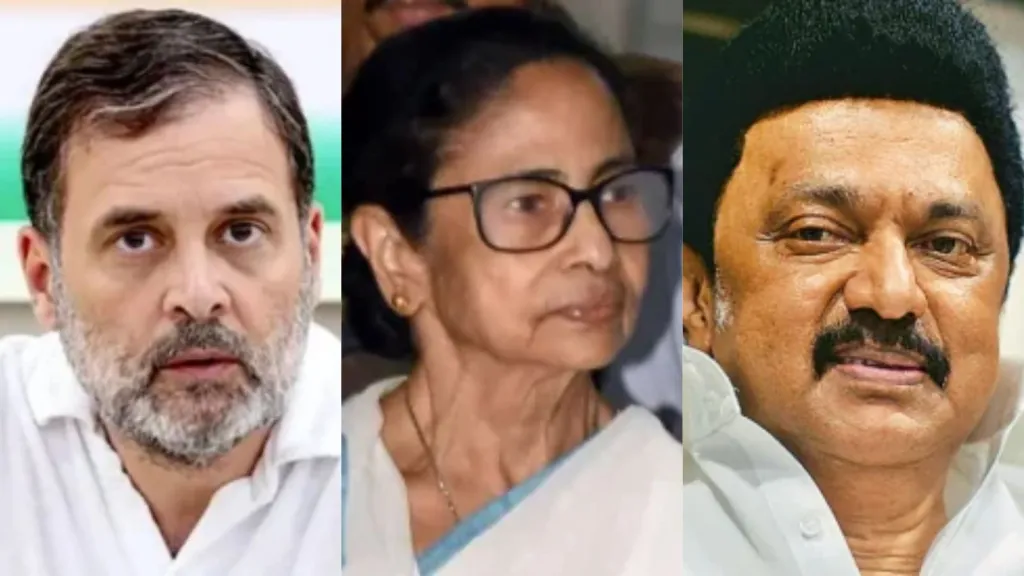
Six months after its political break-up with the Dravida Munnetra Kazhagam (DMK) in Tamil Nadu, the Congress is attempting to rebuild ties with its former ally as Opposition parties prepare to challenge the Centre’s proposed delimitation-linked women’s reservation legislation in Parliament. In an effort to bring the DMK back into a common Opposition position, Congress leaders are using channels involving Trinamool Congress (TMC) chief Mamata Banerjee, who is understood to have a good working relationship with DMK president MK Stalin.
The renewed outreach comes ahead of a special parliamentary sitting scheduled to begin on November 30, 2026. The proposed constitutional amendment has become a major political flashpoint because of concerns among several Opposition parties, particularly those from southern states, over how delimitation could affect their representation in the Lok Sabha.
Stalin has maintained that the DMK will not compromise on Tamil Nadu’s interests. The party’s central demand is that the state’s existing 7.18 per cent share of Lok Sabha seats must not be reduced under any circumstances. While the DMK has indicated that it could support delimitation if its representation is protected, it has not abandoned its objections to the proposed arrangement.
For the Congress, rebuilding communication with the DMK is politically important. The two parties were previously allies in Tamil Nadu, but their relationship broke down after the Congress joined hands with actor-turned-politician C Joseph Vijay’s Tamilaga Vettri Kazhagam (TVK) to enter the state government. The latest parliamentary confrontation has created a fresh reason for the Opposition parties to reconsider their coordination.
Why Congress Is Trying to Win Back the DMK
The Congress-DMK relationship deteriorated after the Congress ended its alliance with the DMK and joined hands with Vijay’s TVK to become part of the Tamil Nadu government. The political shift created a major divide between two parties that had previously worked together in the state and at the national level.
Now, with the delimitation-linked constitutional amendment returning to Parliament, the Congress is seeking to bring the DMK closer to the wider Opposition strategy. The issue has implications for the balance of political representation between states and could influence the distribution of Lok Sabha seats.
Congress leaders believe that the DMK’s position on constitutional principles and regional representation could provide common ground for cooperation, despite the breakdown of their Tamil Nadu alliance.
Congress General Secretary (Organisation) KC Venugopal said the party was reaching out to all Opposition groups, including the DMK, to coordinate its response.
“We are approaching everybody because I think the DMK has always stood by the Constitution of India. I think whoever loves the Constitution of India cannot support these kinds of divisive agendas. So, we will approach all other opposition parties, as we did earlier,” Venugopal told the media.
The statement reflects the Congress’s attempt to frame the dispute as a broader constitutional issue rather than simply a disagreement between political parties. However, repairing the relationship with Stalin’s party may require more than parliamentary coordination, given the recent breakdown of their state-level alliance.
Mamata Banerjee Takes the Lead in Outreach to Stalin
According to Congress leaders, Mamata Banerjee has emerged as an important intermediary in efforts to reconnect with the DMK. Her seniority within the INDIA bloc and her reported equation with Stalin have made her a suitable channel for communication.
A Trinamool Congress source confirmed that discussions with the DMK were taking place regularly through Banerjee. The outreach suggests that the Opposition is attempting to maintain communication across party lines despite differences over state-level alliances and political ambitions.
Banerjee’s involvement is significant because the Congress and TMC have also had disagreements over political strategy in the past. Nevertheless, the possibility of a common position on delimitation has created an incentive for Opposition leaders to work together on the immediate parliamentary challenge.
Congress leaders are also exploring other channels to reach the DMK, indicating that the effort is not dependent on a single intermediary. The immediate objective is to prevent divisions within the Opposition from weakening its position during the special parliamentary sitting.
For Banerjee, the mediation effort also places her in a potentially influential role within Opposition coordination at a time when the delimitation issue has become a test of the INDIA bloc’s ability to act collectively.
Stalin Rules Out Compromise on Tamil Nadu’s Share of Lok Sabha Seats
Despite the renewed outreach, Stalin has made it clear that the DMK’s position on the delimitation issue remains unchanged. He has insisted that Tamil Nadu’s existing 7.18 per cent share of Lok Sabha seats must not be reduced, arguing that the state’s political representation should be protected.
Stalin said the DMK would not compromise on the interests of Tamil Nadu or move away from its principles. His remarks underline the party’s concern that a new delimitation exercise could alter the balance of parliamentary representation between states.
“No change in position, no compromise, the DMK will never compromise on Tamil Nadu’s interests; nor will it depart from its principles,” Stalin said.
He also appeared to criticise the Congress over its decision to leave the DMK alliance and join hands with TVK in Tamil Nadu.
“The shameless and ungrateful lot who abandoned their principles for positions of power must realise this,” Stalin said.
The remarks show that the political disagreement between the two parties has not disappeared. Although Congress leaders are attempting to rebuild ties, Stalin’s criticism suggests that the DMK remains unhappy with the circumstances surrounding the alliance break-up.
At the same time, the DMK’s position leaves room for a possible parliamentary understanding if its key demand is addressed. The party has indicated that it could support delimitation provided Tamil Nadu’s share of Lok Sabha seats is protected.
Congress Issues Three-Line Whip Ahead of Special Parliament Sitting
As part of its preparations, the Congress on Friday issued a three-line whip to its Lok Sabha MPs, directing them to be present in Delhi on November 29, a day before Parliament reconvenes.
The message was issued by Kodikunnil Suresh, Congress MP and Chief Whip of the Congress Parliamentary Party in the Lok Sabha. It instructed all party MPs to reach Delhi before 10 am on Sunday.
The communication stated: “The House is recommencing on November 30, 2026. Therefore, all Lok Sabha MPs of INC are requested to be present in Delhi on November 29, 2026, positively, before 10:00 A.M.”
The party is also holding a meeting of its parliamentary strategy group at the residence of Congress Parliamentary Party chairperson Sonia Gandhi at 10 Janpath. The meeting is expected to be followed by discussions involving INDIA bloc allies.
A senior Congress MP involved in the parliamentary strategy group said the party’s immediate priority was to ensure that its own MPs remained united and that other Opposition parties maintained discipline during the vote.
The leader said the Congress did not believe the BJP had the required numbers but warned that the party needed to remain cautious about possible attempts to influence Opposition MPs.
The preparations indicate that the Congress views the special sitting as a high-stakes parliamentary contest in which attendance and voting discipline could be as important as political arguments.
Samajwadi Party Also Moves to Keep Its MPs Together
The Samajwadi Party, the second-largest Opposition party in the Lok Sabha, is also monitoring its MPs ahead of the proposed vote. The party has indicated that it intends to oppose the constitutional amendment in its current form and is preparing to issue a whip.
A senior Samajwadi Party leader alleged that the BJP had been approaching its MPs over several weeks with offers in an attempt to influence their position.
“They (BJP) have been reaching out to our MPs for weeks, making them all kinds of offers. We are confident about our people, but we are still watching them. We will issue a whip and all our MPs will vote against this unconstitutional Bill,” the leader said.
The allegation reflects the level of political tension ahead of the special sitting. However, the claim about attempts to influence MPs remains an allegation made by the Samajwadi Party leader.
For the Opposition, maintaining unity is particularly important because the constitutional amendment requires a two-thirds majority in the Lok Sabha. Even a relatively small number of votes could affect the outcome if the final division is close.
How the Numbers Stand for the Delimitation Bill
The proposed constitutional amendment requires a two-thirds majority of members present and voting in the Lok Sabha. According to the figures cited in the political debate, the NDA government needs 360 votes in favour to secure passage in the House.
During an earlier attempt in April, 528 MPs voted, and the government reportedly fell short of the required threshold by 54 votes. The political calculations have since become more complicated because of changes in alliances and the possibility that some regional parties could support the legislation under specific conditions.
The DMK has 24 Lok Sabha MPs, making its position important to the numbers game. Its willingness to consider supporting delimitation if Tamil Nadu’s representation is protected could influence the government’s efforts to secure the necessary majority.
The Nationalist Congress Party (Sharadchandra Pawar) has eight MPs, while the YSR Congress Party has four. Together, the DMK, NCP-SP and YSRCP account for 36 MPs. Their positions could therefore have a substantial impact on the parliamentary arithmetic.
The source material also indicates that BJP leaders are attempting to secure support from the NCP-SP and other regional groups. However, even if the 22 MPs from the NCP-SP and YSRCP were to support the Bill, the NDA would still face a shortfall under the calculations cited in the report.
BJP sources have also claimed that the party could receive support from 20 rebel Trinamool Congress MPs who have reportedly switched to the Nationalist Citizens Party of India. Their voting rights, however, have become a separate point of dispute because disqualification petitions against them remain pending.
Trinamool Questions Voting Rights of 20 Rebel MPs
The status of the 20 MPs who reportedly left the Trinamool Congress has emerged as another potential complication for the government’s parliamentary strategy.
Trinamool Congress Deputy Leader in the Rajya Sabha Sagarika Ghose questioned whether these MPs should be allowed to vote on the delimitation Bill while disqualification petitions against them remain unresolved.
Ghose alleged that the Lok Sabha Speaker had not ruled on the petitions for six months, despite directions from the Supreme Court. She argued that the legal status of the MPs needed to be clarified before their votes could be counted in a major constitutional amendment.
“For six months, the Lok Sabha Speaker has not ruled on the 20 traitor Trinamool MPs against whom disqualification petitions are pending. Even Supreme Court directives have gone unheeded. Will these traitors now be allowed to vote on the delimitation Bill in the Lok Sabha? Are their votes legal? How can they vote when they should have been disqualified by now?” Ghose told The Indian Express.
Her remarks represent the Trinamool Congress’s position on the dispute. The final question of whether the MPs are eligible to participate in the vote depends on the relevant parliamentary and legal proceedings, rather than the political allegations made by either side.
Why Southern States Are Concerned About Delimitation
Delimitation involves redrawing the boundaries of electoral constituencies and determining the distribution of seats among different regions. Any major exercise can affect the political representation of states in the Lok Sabha, making the issue particularly sensitive for states with different population trends.
Southern states have raised concerns that a delimitation exercise based heavily on population could reduce their relative share of parliamentary seats. States such as Tamil Nadu have argued that they should not lose political influence after implementing population-control policies and achieving significant progress in areas such as education and public health.
The concern is not simply about the total number of seats in Parliament. It is also about the relative weight of different states in national decision-making and whether states that have experienced slower population growth could see their representation weakened compared with more populous regions.
For the DMK, protecting Tamil Nadu’s 7.18 per cent share has therefore become a central condition in its position on the proposed legislation. Stalin’s repeated insistence on this figure indicates that the party wants a clear assurance rather than relying on general political commitments.
Can the INDIA Bloc Rebuild Unity Before the Vote?
The delimitation debate has created an immediate reason for Opposition parties to coordinate, but it has also exposed the political divisions within their broader alliance. The Congress is trying to regain the DMK’s cooperation after the Tamil Nadu split, while Mamata Banerjee is helping facilitate communication between the parties.
The Samajwadi Party is preparing to oppose the Bill, and the Trinamool Congress is challenging the voting status of its rebel MPs. These positions show that the Opposition’s strategy involves both resisting the proposed legislation and managing internal disagreements over parliamentary procedure.
The Congress’s outreach to Stalin will be an important test of whether the INDIA bloc can put aside recent political disputes when faced with a common national issue. However, the DMK has made clear that cooperation cannot come at the cost of Tamil Nadu’s representation.
The special parliamentary sitting beginning on November 30 will therefore involve more than a debate over women’s reservation. The proposed constitutional amendment has brought questions of federal representation, state interests, party alliances and parliamentary numbers into the same political contest.
Whether Mamata Banerjee’s mediation can help restore trust between the Congress and DMK remains uncertain. The immediate outcome will depend on the government’s ability to secure the required votes, the position taken by regional parties and the extent to which the Opposition can maintain unity during the crucial parliamentary proceedings.
For breaking news and live news updates, like us on Facebook or follow us on Twitter and Instagram. Read more on Latest India on thefoxdaily.com.






COMMENTS 0