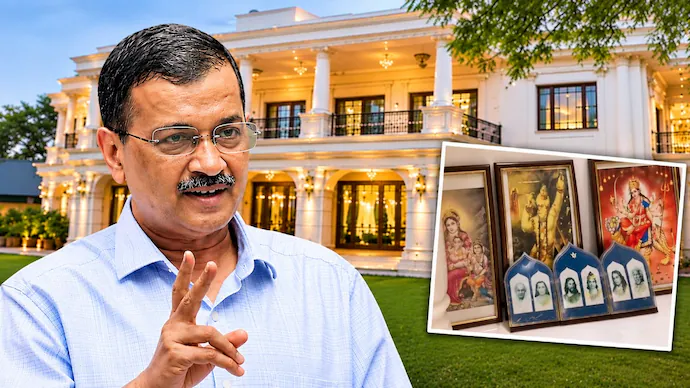
Images of a framed picture of Jesus Christ displayed alongside Hindu deities inside a temple at Arvind Kejriwal’s former official residence have sparked a fresh controversy after the BJP-led Delhi government opened the property to journalists. The shrine, its reported cost and the presence of religious images have become another talking point in the political dispute over the bungalow popularly known as ‘Sheesh Mahal’.
The media walkthrough at 6, Flagstaff Road on Friday, November 27, brought renewed attention to the interiors of the residence, which Kejriwal occupied while serving as Delhi Chief Minister. Alongside furniture, appliances and decorative fittings, journalists were shown a white marble mandir containing images of Jesus Christ, Lord Shiva and Goddess Durga. A price tag displayed during the tour put the reported cost of the shrine at Rs 6.71 lakh.
The religious imagery quickly became a subject of discussion on social media, where BJP supporters and other accounts questioned why a picture of Jesus was displayed alongside Hindu deities in the temple. The debate has added a new layer to an existing political controversy centred on the alleged expenditure incurred during the renovation and refurbishment of Kejriwal’s former official residence.
However, the presence of different religious images in a private shrine does not, by itself, establish anything about a person’s religious beliefs. The political criticism surrounding the visuals has largely focused on Kejriwal’s public image and his outreach to Hindu voters, particularly in Punjab.
Jesus Christ Picture in Kejriwal’s Mandir Triggers Social Media Debate
The picture of Jesus Christ inside the white marble shrine attracted attention after photographs and videos from the government-organised walkthrough circulated online. The images showed Jesus alongside Hindu religious figures, including Lord Shiva and Goddess Durga.
Panchjanya, a Hindi magazine widely associated with the Rashtriya Swayamsevak Sangh (RSS), questioned the arrangement in a post on X. It wrote: “What is Jesus Christ doing in a temple with Mother Durga and Lord Mahadev in Kejriwal’s glass palace?”
Other social media users also used the visuals to criticise the former Delhi Chief Minister. An account operating under the handle Indrajit posted a sarcastic comment in Hindi, saying that Jesus was also placed beside Lord Ram in the temple at Kejriwal’s Sheesh Mahal.
Another account, named Lala, questioned the presence of Jesus Christ’s image alongside Hindu deities. The post also accused Kejriwal of presenting himself as a Sanatani in Punjab, turning the shrine into a point of political criticism against the Aam Aadmi Party (AAP) leader.
These reactions reflect the political interpretation of the images rather than any established explanation of why the picture was placed in the shrine. The material presented during the walkthrough did not provide further details about the selection of the religious images or the circumstances in which they were installed.
Delhi Government Displays Rs 58.83 Crore Expenditure at Sheesh Mahal
While the mandir attracted attention online, the main purpose of the media tour was to showcase the reported expenditure on the former Chief Minister’s residence. The Delhi government placed a large board at the entrance carrying the message, “Welcome to Sheesh Mahal, built at a cost of Rs 58 crore.”
The expenditure figure displayed on the board was Rs 58,83,66,314. Inside the property, furniture, electrical appliances, decorative features and other fittings were accompanied by price tags and corresponding bill or invoice numbers. The presentation was intended to show journalists the individual costs associated with the renovation and furnishing of the bungalow.
The government has proposed charging visitors Rs 20 for a guided tour of the property. Public visits are expected to begin next month, although the walkthrough for journalists offered an early look at the rooms, facilities and items that the government wants visitors to examine.
The displayed figures cover a range of expensive fittings and furnishings. Among the items highlighted during the tour were:
- Chandelier: Rs 11.56 lakh.
- Two-seater sofa: Rs 5.47 lakh.
- Dining tables and chairs: Rs 5.58 lakh.
- Curtains: Rs 5.69 lakh.
- Central table: Rs 6.79 lakh.
- Round side tables: Rs 10 lakh.
- Television unit: Rs 30 lakh.
- Another television: Rs 3.43 lakh.
- Mandir: Rs 6.71 lakh.
The individual price tags were part of the government’s attempt to make the reported expenditure more visible than a single overall project figure. By displaying the cost of specific items, the administration has sought to keep attention on the scale and nature of the spending at the residence.
Luxury Interiors, Automated Fittings and Wellness Facilities
The walkthrough also highlighted the bungalow’s elaborate interior design and specialised facilities. Several areas were accompanied by separate expenditure figures, including a meeting space, lobby and powder room.
A ‘baithak’ featuring a sliding door was listed at Rs 41.16 lakh, while the lobby area was valued at Rs 7.58 lakh. The powder room fittings were displayed at Rs 5.8 lakh. A kitchen dumbwaiter, a small lift used to transport food or other items between floors, was listed at Rs 7 lakh.
The property reportedly covers 1,905 square metres and includes eight bedrooms and 13 bathrooms. It also has a wellness room equipped with a sauna and jacuzzi. Automated doors and windows, along with other high-end fittings, were among the features highlighted during the media visit.
The combination of specialised facilities, expensive furnishings and extensive renovation work has kept the bungalow at the centre of a political argument about the use of public money for official residences. The BJP has repeatedly used the term ‘Sheesh Mahal’ to question the spending associated with the property.
Delhi Public Works Department Minister Parvesh Verma told India Today TV that the walkthrough was organised to demonstrate how public money had been spent. He said the project began with an initial budget of Rs 8 crore but eventually crossed Rs 56 crore.
The figures displayed during the latest walkthrough put the total expenditure at Rs 58.83 crore. The difference between the initial budget and the final amount has been a central part of the BJP’s criticism of the renovation.
Why Sheesh Mahal Became a Political Flashpoint
The controversy over the bungalow has been part of the political rivalry between the BJP and the AAP. Kejriwal occupied the official residence at 6, Flagstaff Road from 2015 until October 2024, when he vacated it after stepping down as Chief Minister.
The BJP popularised the label ‘Sheesh Mahal’ to portray the residence as an example of alleged extravagance. The party has questioned the scale of renovation and the money spent on furnishings and facilities, arguing that the expenditure deserves public scrutiny because the property was an official residence.
For the AAP, the controversy has been politically motivated. The party has accused the BJP government of using the bungalow to divert attention from other issues facing Delhi, including pollution in the Yamuna. It has described the publicity surrounding the property as a political exercise rather than a meaningful response to governance concerns.
The dispute has therefore developed beyond a disagreement over the cost of a government residence. It has become a wider political argument over public accountability, the conduct of elected representatives and the use of official properties.
AAP and BJP Clash Over the Political Meaning of the Shrine
The latest focus on the mandir has introduced a religious element into the Sheesh Mahal debate. Until now, much of the criticism had centred on the reported cost of construction, renovation, furniture and luxury fittings. The images of Jesus Christ alongside Hindu deities have shifted part of the online discussion towards Kejriwal’s religious identity and political messaging.
The criticism has particular political significance because the AAP has sought to build support among voters in different states, including Punjab, where religious identity and cultural issues frequently feature in political discourse. Social media users critical of Kejriwal have used the shrine’s visuals to question the consistency of his public image.
At the same time, the available visuals do not establish the political purpose behind the shrine’s arrangement. The presence of Jesus Christ alongside Hindu deities can be described as an observable feature of the mandir, but claims about what it says about Kejriwal’s beliefs or political intentions remain interpretations made by commentators.
The AAP’s response to the wider Sheesh Mahal controversy has focused on accusing the BJP of selective political targeting. The party has argued that the government is using the former residence to generate publicity instead of addressing pressing issues in the capital. The latest religious angle is likely to keep the dispute in public discussion, but it does not resolve the underlying disagreement over the renovation expenditure.
What the Public Tour Could Mean for the Sheesh Mahal Controversy
The proposed public tour is likely to give the BJP government another platform to present its account of the expenditure at the residence. Visitors will be able to see the interiors and the price tags displayed on selected items, turning the bungalow into a physical showcase for the administration’s criticism of the previous AAP government.
The Rs 20 proposed entry fee also suggests that the property may be presented as a public attraction as well as a political exhibit. Its unusual architecture, extensive facilities and the controversy surrounding its renovation could draw visitors interested in seeing the former Chief Minister’s residence firsthand.
For the BJP, the walkthrough provides an opportunity to keep questions about public spending in the political conversation. For the AAP, the government’s focus on the bungalow reinforces its allegation that the controversy is being used to target Kejriwal rather than address Delhi’s current problems.
The mandir’s images have added another subject for political debate, but the central issue remains the reported expenditure on the official residence. The displayed bills, item-wise price tags and overall project cost are likely to remain the focus of scrutiny as the government prepares to open the property to visitors.
What began as a dispute over the renovation of a Chief Minister’s residence has now expanded into a debate involving public expenditure, political image and religious symbolism. The Jesus Christ picture may have become the latest viral talking point, but the larger Sheesh Mahal controversy continues to revolve around how much was spent, what the money was used for and whether the expenditure was justified.
For breaking news and live news updates, like us on Facebook or follow us on Twitter and Instagram. Read more on Latest India on thefoxdaily.com.





COMMENTS 0