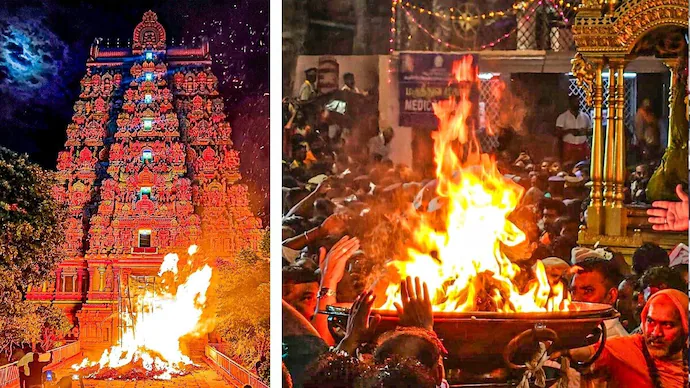
The Supreme Court on Friday directed that the Karthigai Deepam lamp be lit at the disputed Deepathoon stone pillar on Thiruparankundram hill in Madurai on November 28, after the ceremonial lighting did not take place at the designated spot despite the court’s November 20 order. The bench also issued contempt notices to Tamil Nadu Chief Secretary, Director General of Police (DGP) and other officials, asking them to explain why proceedings should not be initiated for alleged wilful disobedience.
In a series of strong observations, the court questioned the state administration’s failure to implement its earlier direction. It also suspended the temple’s board of trustees, appointed retired judges as receivers to oversee the temple trust and directed the Central Reserve Police Force (CRPF) to take charge of security across the temple and the hill.
The order brings fresh urgency to the dispute over the location of the Karthigai Deepam ritual, which has become a legal and administrative flashpoint involving devotees, temple authorities, the Tamil Nadu government and the nearby dargah. The Supreme Court said the immediate proceedings concerned compliance with its earlier order, rather than the wider dispute over the hill.
Why Did the Supreme Court Order the Deepam to Be Lit on November 28?
The latest direction follows the failure to light the ceremonial lamp at Deepathoon on November 24, the day of the Karthigai Deepam observance. In its November 20 order, the Supreme Court had permitted the lamp to be lit at the stone pillar on Thiruparankundram hill as a one-time measure.
However, on November 24, the annual lamp was lit at the customary Deepa Mandapam near the Uchipillaiyar temple instead of the disputed Deepathoon. The hilltop pillar is located close to the Hazrat Sultan Sikandar Badusha Dargah, making the proposed ritual a sensitive issue involving competing religious claims and the administration of the hill.
After the November 24 ceremony passed without the lamp being lit at the pillar, devotees and petitioners approached the Supreme Court seeking enforcement of its direction. They argued that the passage of the festival date should not make the court’s order ineffective and requested permission to conduct the lighting on another day.
Supreme Court Issues Contempt Notices to Chief Secretary, DGP and 13 Others
The Supreme Court issued contempt notices to the Tamil Nadu Chief Secretary, the Director General of Police and 13 other officials and temple functionaries. They have been asked to explain why contempt proceedings should not be initiated against them for the alleged wilful disobedience of the November 20 order.
The list of officials and authorities receiving notices includes:
- Tamil Nadu Chief Secretary.
- Director General of Police (DGP).
- Secretary and Commissioner of the Hindu Religious and Charitable Endowments Department.
- Madurai District Collector.
- Madurai Commissioner of Police.
- Madurai Superintendent of Police.
- Officials and representatives associated with the temple administration.
The court directed the Chief Secretary to ensure that the notices are personally served on all 15 respondents within three days. The Chief Secretary must also submit a personal affidavit confirming that the notices have been delivered.
The proceedings concern the alleged failure of the authorities to implement the Supreme Court’s direction. Issuing contempt notices does not mean that the officials have already been found guilty. They will have an opportunity to respond to the allegations before the court decides whether contempt proceedings should be pursued further.
Why Did the Supreme Court Rebuke the Tamil Nadu Government?
The bench of Justices Aravind Kumar and Vipul M Pancholi expressed strong displeasure over the sequence of events that followed its November 20 order. The court indicated that government authorities cannot disregard judicial directions and stressed the importance of the rule of law.
During the hearing, the bench observed that attempts to undermine the court’s constitutional authority could lead to serious consequences. It also questioned whether the actions of executive officials had been influenced by directions from political authorities.
The court’s criticism came after the Madurai District Collector, Nishant Krishna, submitted a report explaining why the lamp had not been lit at Deepathoon. The Collector had earlier apologised to the court and maintained that he had made repeated efforts to obtain authorisation from the temple administration to carry out the ritual.
The administration’s position was that the temple’s board of trustees had not authorised a team to light the lamp at the disputed pillar. The petitioners, however, argued that the authorities had failed to take the necessary steps to implement the Supreme Court’s order.
The Solicitor General, Tushar Mehta, appearing for the Archaeological Survey of India, also argued that the failure to comply with the direction amounted to serious contempt. The petitioners questioned why the administration had not ensured implementation despite being aware of the court’s order.
The Supreme Court made clear that its Friday hearing was limited to the alleged non-compliance with the November 20 direction. It was not reopening the larger dispute over the religious and legal status of the hill.
Temple Board of Trustees Suspended, Retired Judges Appointed as Receivers
In another significant part of its order, the Supreme Court suspended the board of trustees responsible for overseeing the temple administration. The decision follows the dispute over the board’s role in preventing or failing to authorise the lighting of the lamp at Deepathoon.
The court appointed retired judges Vaidyanathan and Parthiban as receivers to oversee the temple trust. Their appointment is intended to ensure supervision of the trust’s affairs and facilitate implementation of the court’s directions.
The move changes the immediate administrative arrangement at the temple while the legal proceedings continue. The receivers will be responsible for overseeing the trust in accordance with the Supreme Court’s directions.
The suspension of the board is a significant intervention because the dispute has involved not only the state administration but also the temple authorities responsible for managing religious activities at the site.
CRPF to Take Over Security of Temple and Entire Thiruparankundram Hill
The Supreme Court also directed the Central Reserve Police Force to take charge of security at the temple and across the entire Thiruparankundram hill. The decision followed the court’s concerns over the failure of the local police administration to ensure implementation of its earlier order.
By assigning security responsibilities to a central force, the court has sought to establish an arrangement that allows the temple and the nearby religious site to function without disruption.
The CRPF has been directed to ensure that both the temple and the dargah operate peacefully. The force must also facilitate devotees in performing their respective religious rituals.
This aspect of the order is important because Thiruparankundram hill is a religiously sensitive location. The Deepathoon pillar is situated close to the Hazrat Sultan Sikandar Badusha Dargah, and the dispute over the lamp’s location has generated competing claims and tensions.
The Supreme Court’s direction does not authorise disruption of religious activities at either site. Instead, it places responsibility on the central force to maintain security and ensure that both places of worship can function peacefully.
What Is the Thiruparankundram Deepathoon Dispute?
The controversy centres on the location where the Karthigai Deepam lamp should be lit on Thiruparankundram hill in Madurai district, Tamil Nadu.
The traditional ceremony has been conducted at the Deepa Mandapam near the Uchipillaiyar temple. However, Hindu devotees and petitioners sought permission to light an additional ceremonial lamp at Deepathoon, a stone pillar located higher up the hill.
The pillar is situated around 50 metres from the Hazrat Sultan Sikandar Badusha Dargah. The proximity of the two religious sites has made the question of conducting the ritual at the hilltop a sensitive issue.
Petitioners approached the courts seeking permission to light the Karthigai Deepam at the pillar, arguing that the ritual should be allowed at the location. The Tamil Nadu government and temple administration raised objections, with the authorities maintaining that the customary ceremony should continue at its established location.
The state government also sought a review of the Supreme Court’s November 20 direction. One of its concerns was that allowing the ritual at the pillar, even once, could affect the existing status quo at the site.
The Supreme Court’s November 20 order permitted the lighting at Deepathoon as a one-time measure. The subsequent failure to carry out that direction led to the fresh applications and contempt petitions now being considered by the court.
What Happened on November 24 During the Karthigai Deepam Festival?
November 24 was the date on which the annual Karthigai Deepam ceremony was observed. Despite the Supreme Court’s November 20 direction, the ceremonial lamp was lit at the customary Deepa Mandapam near the Uchipillaiyar temple rather than at Deepathoon.
The decision triggered protests and criticism from devotees and groups supporting the lighting of the lamp at the hilltop pillar. The petitioners argued that the authorities had failed to comply with the court’s order and sought legal action against those responsible.
The Madurai administration subsequently explained that it had approached the temple authorities and requested authorisation to carry out the exercise. The Collector’s report described efforts to coordinate with the temple administration, while also stating that the required permission had not been granted in time.
The petitioners disputed this explanation, arguing that the administration had a responsibility to ensure that the judicial direction was implemented. Their contempt applications asked the Supreme Court to examine the conduct of the officials and direct the lighting to take place despite the festival date having passed.
The court’s latest order addresses both issues: it has directed that the lamp be lit on November 28 and initiated proceedings to examine why the earlier direction was not implemented.
What Happens Next in the Deepathoon Case?
The immediate priority is implementation of the Supreme Court’s direction to light the Karthigai Deepam at Deepathoon on November 28. The newly appointed receivers have been tasked with ensuring that the ritual takes place at the designated pillar.
The CRPF’s deployment will also be important in maintaining security across the hill and ensuring that devotees at the temple and dargah can carry out their religious activities peacefully.
Separately, the 15 officials and functionaries who received contempt notices must respond to the allegations. The Chief Secretary has been directed to personally ensure service of the notices within three days and submit an affidavit confirming compliance.
The court will then have to consider the explanations submitted by the respondents and determine whether the failure to implement its November 20 order amounts to wilful disobedience warranting contempt action.
The broader dispute over the Deepathoon, the customary location of the Karthigai Deepam ceremony and the competing claims surrounding Thiruparankundram hill remains a separate issue. The Supreme Court has expressly confined the current contempt hearing to compliance with its earlier direction.
The November 28 ceremony will therefore be a crucial next step in the case. Beyond the ritual itself, the episode has raised wider questions about the responsibility of government officials and public institutions to implement court orders, particularly when a dispute involves religious sensitivities and public order.
For breaking news and live news updates, like us on Facebook or follow us on Twitter and Instagram. Read more on Latest India on thefoxdaily.com.



COMMENTS 0