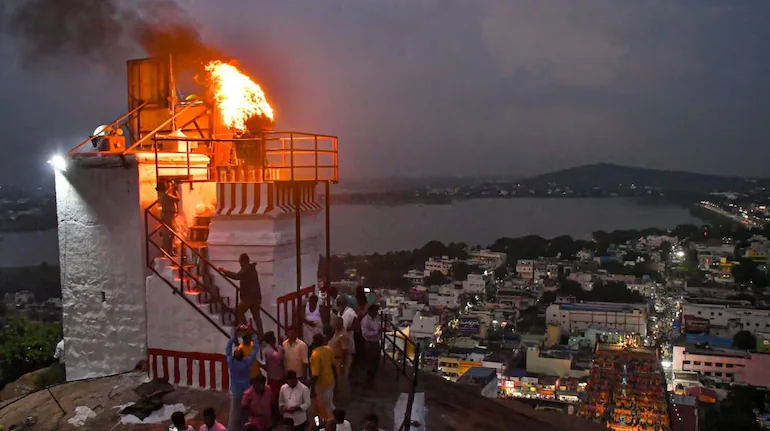
The Karthigai Deepam dispute at Thiruparankundram Hill in Madurai has escalated into a political confrontation between the Bharatiya Janata Party (BJP) and the Tamil Nadu government led by actor-turned-politician Vijay’s Tamilaga Vettri Kazhagam (TVK). The controversy intensified on November 24, 2026, after the ceremonial lamp was lit at the customary Uchipillayar Mandapam rather than at the disputed Deepathoon stone pillar, the location covered by an interim order of the Supreme Court.
Tamil Nadu BJP president Nainar Nagendran accused the state government of hurting Hindu sentiments by challenging the Supreme Court’s decision through a review petition. BJP national spokesperson C.R. Kesavan also criticised the government, alleging that it had betrayed devotees of Lord Muruga and disregarded their religious sentiments.
The dispute has become a significant test of the relationship between religious practices, constitutional protections, public order and judicial authority in Tamil Nadu. However, the Supreme Court’s interim order did not settle the underlying question of whether an established religious custom exists at the Deepathoon. It permitted the lamp-lighting ceremony at that location for one occasion, subject to strict conditions.
Why the BJP Is Criticising Vijay’s TVK Government
The BJP’s criticism centres on the Tamil Nadu government’s decision to seek a review of the Supreme Court’s November 20 order. The apex court had permitted the ceremonial Karthigai Deepam lamp to be lit at the Deepathoon on November 24 as a one-time arrangement. The state government subsequently approached the court seeking reconsideration and an immediate stay of the direction.
Speaking to news agency ANI, Nagendran accused Chief Minister Vijay’s administration of opposing a religious activity despite the Supreme Court’s intervention. He also alleged that thousands of police personnel had been deployed across Tamil Nadu to arrest BJP members and Hindu activists involved in the dispute.
Nagendran argued that the controversy reflected broader concerns about religious freedom and the treatment of Hindu devotees in the state. Referring to Articles 25 and 26 of the Constitution, he said citizens should be able to practise their religion and participate in religious activities in accordance with their faith.
He questioned why restrictions were being imposed on the ceremonial lamp-lighting and prayers at Thiruparankundram despite the Supreme Court’s directions. His remarks reflected the BJP’s position that the state administration should have facilitated the limited ritual authorised by the court rather than opposing the arrangement.
These allegations represent the BJP’s political position. The government’s objections have been linked to its arguments over the customary location of the ritual, the management of the temple and concerns about maintaining communal harmony around a religiously sensitive site.
C.R. Kesavan Accuses TVK-Congress Government of Betraying Devotees
BJP national spokesperson C.R. Kesavan also targeted the Tamil Nadu government in a post on X on November 25. He accused the TVK-Congress government of preventing the sacred Karthigai Deepam from being lit at the Deepathoon and described the decision as a betrayal of devotees of Lord Muruga.
Kesavan alleged that the government had adopted a discriminatory approach and gravely insulted the religious sentiments of Hindu devotees. His remarks added to the BJP’s attempt to frame the dispute as a question of religious rights and the implementation of a Supreme Court order.
The political criticism has placed the state government under pressure to explain why the lamp was not lit at the location identified in the Supreme Court’s interim direction. It has also intensified scrutiny of the administration’s handling of the event, particularly after the Madurai Bench of the Madras High Court directed officials to comply with the apex court’s order.
What Did the Supreme Court Order on November 20?
The Supreme Court intervened in the dispute on November 20, 2026, while hearing proceedings connected to the Madras High Court’s earlier decisions on the Deepathoon ritual. A bench comprising Justices Aravind Kumar and Vipul M. Pancholi permitted the ceremonial lamp to be lit at the disputed stone pillar on November 24, the day of the Karthigai Deepam festival.
However, the permission came with important limitations. The court described the arrangement as a one-time measure and made clear that it should not be interpreted as recognition of an established religious custom at the Deepathoon.
The order also did not determine ownership of the disputed location, the legal character of the pillar or whether any individual, institution or religious denomination had an enforceable right to conduct the ceremony there in future years. The broader legal questions were left open for consideration in subsequent proceedings.
The court imposed several safeguards to prevent the ritual from turning into a larger public gathering or creating a confrontation between groups using the hill.
- Restricted participation: Only an authorised team representing the temple administration and relevant government officials could access the Deepathoon to light the lamp.
- No public gathering: Members of the general public were not permitted to accompany the team to the disputed location.
- No demonstrations: Processions, public congregations, slogan-raising and demonstrations were prohibited during the ceremony.
- Security arrangements: The district administration and police were responsible for ensuring adequate protection and regulating access.
- No permanent changes: The order did not permit construction, excavation or structural alterations at the site.
- Protection of other worship: The court made clear that worship at the Dargah and mosque, and lawful access to those places, must not be disturbed.
The Supreme Court’s approach was intended to allow the festival ritual to take place on the specified date without deciding the larger dispute prematurely. It also recognised that the opportunity to perform the ceremony on that particular festival day could not be restored through a later judgment.
Madras High Court Directed Officials to Follow the Supreme Court Order
The dispute returned to the Madurai Bench of the Madras High Court on November 24, after concerns were raised that the Supreme Court’s interim direction might not be implemented. The petitions challenged restrictions imposed by the district administration and sought action to ensure that the authorised lamp-lighting could take place.
A bench comprising Justice G.R. Swaminathan and Justice M.D. Sumathi directed the Madurai district administration and other officials to comply with the Supreme Court’s order. The proceedings took place amid heightened security arrangements and the detention of several people in connection with the dispute.
The High Court observed that the pending review petition could not, by itself, be treated as a reason to disregard the Supreme Court’s direction. It also referred to Article 144 of the Constitution, which requires civil and judicial authorities across India to act in aid of the Supreme Court.
The court directed the release of people detained under the prohibitory orders challenged in the proceedings. It also examined the district administration’s restrictions on movement around the hill and the arrangements required to implement the apex court’s decision.
The proceedings highlighted the distinction between maintaining public order and implementing a judicial direction. The district administration had argued that restrictions were necessary to prevent unauthorised access and manage the security situation. The High Court, however, emphasised that those restrictions could not be used to defeat the specific arrangement authorised by the Supreme Court.
Why Was the Lamp Lit at Uchipillayar Mandapam Instead?
Despite the Supreme Court’s one-time permission and the Madras High Court’s directions, the Karthigai Deepam lamp was lit at the customary Uchipillayar Mandapam rather than at the disputed Deepathoon on November 24, according to reports on the event.
The difference between the two locations is central to the dispute. The Uchipillayar Mandapam is associated with the established temple arrangements for the ceremonial lamp, while Hindu organisations and devotees have argued that the Deepathoon on the upper reaches of Thiruparankundram Hill should also be used for the annual ritual.
The Supreme Court order specifically concerned the Deepathoon, a stone pillar situated on the hilltop approximately 50 metres from the Hazrat Sultan Sikandar Badusha Auliya Dargah. The court had authorised a restricted team to conduct the ceremony there, rather than permitting a public procession or unrestricted access to the area.
The lamp being lit at the customary mandapam therefore did not amount to the ceremony taking place at the location specified in the Supreme Court’s interim order. This distinction is at the heart of the latest political confrontation and raises questions about whether the court’s direction was fully implemented.
The immediate disagreement is not simply about whether the Karthigai Deepam lamp was lit. It concerns the precise location of the ritual, the authority responsible for arranging it and the extent to which the state administration complied with the court’s instructions.
What Is the Thiruparankundram Deepathoon Dispute?
Thiruparankundram Hill, located in Madurai district, is an important religious site associated with the Arulmigu Subramaniya Swamy Temple, one of the major temples dedicated to Lord Muruga in Tamil Nadu. The hill also contains the Hazrat Sultan Sikandar Badusha Auliya Dargah, making the surrounding area a place of religious significance for different communities.
The Deepathoon dispute concerns a stone pillar on the upper reaches of the hill. Hindu organisations and several devotees have demanded that the Karthigai Deepam lamp be lit at this pillar as part of the annual festival. They argue that the location should be recognised as an appropriate place for the ceremonial observance.
The Tamil Nadu government and the temple administration have disputed the claim that lighting the lamp at the Deepathoon is an established custom. Their position has included the argument that the traditional lamp-lighting takes place at a mandapam near the Uchipillaiyar temple, rather than at the disputed pillar.
The government has also raised concerns about the proximity of the pillar to the Dargah and the potential for tensions if a large gathering or procession takes place around the location. It has argued that maintaining communal harmony and public order must be considered while deciding how the festival is conducted.
The dispute has consequently moved beyond the physical act of lighting a lamp. It involves competing claims about religious tradition, the authority of temple institutions, access to the hill and the responsibilities of the state in managing a sensitive public space.
How the Legal Dispute Reached the Supreme Court
The current controversy follows earlier proceedings before the Madras High Court. In December 2025, a single-judge order allowed the lamp to be lit at the Deepathoon. The matter subsequently reached a division bench, which issued its judgment on January 6, 2026.
The state administration challenged the directions relating to the disputed location, maintaining that the claimed custom had not been established and that the customary ritual was conducted elsewhere. The proceedings also involved questions about the nature of the pillar and the rights of the temple administration.
As the dispute continued, disagreements over implementation led to further court proceedings. The Supreme Court eventually took up the matter and issued its November 20 interim order, allowing the lamp to be lit at the Deepathoon for the 2026 festival under strict conditions.
Importantly, the apex court stayed relevant findings from the Madras High Court’s January 6 judgment while the challenge remained pending. It did not finally endorse the High Court’s reasoning or accept either side’s wider claims about the disputed site.
The Supreme Court’s decision to permit the ceremony for one day was therefore a limited interim arrangement, not a final judgment on the religious or property-related questions. The matter is expected to require further judicial consideration.
Why Articles 25 and 26 Are Important in the Dispute
The BJP has invoked Articles 25 and 26 of the Indian Constitution to argue that devotees should be able to practise their religion without unjustified restrictions.
Article 25 protects freedom of conscience and the right to freely profess, practise and propagate religion, subject to public order, morality, health and other constitutional provisions. Article 26 provides religious denominations with certain rights to manage their religious affairs, also subject to constitutional limitations.
These provisions are relevant because the Thiruparankundram dispute involves questions about the conduct of a religious ceremony, the role of temple authorities and the limits of government intervention.
However, invoking constitutional religious freedom does not automatically resolve every disagreement about the location or historical status of a religious practice. Courts may need to examine whether a claimed custom exists, who has the authority to conduct the ritual and whether restrictions are justified by other legal considerations.
The Supreme Court deliberately left these broader questions open in its November 20 order. Its interim permission should therefore not be treated as a final ruling on the interpretation of Articles 25 and 26 in this particular dispute.
Political Fallout for Vijay’s TVK Government
The controversy has created a politically sensitive situation for the TVK-led administration. The BJP has used the dispute to question the government’s handling of religious issues and its response to judicial directions. Its leaders have portrayed the decision to seek a review and the failure to conduct the ceremony at the Deepathoon as evidence that the government has disregarded devotees’ concerns.
For the government, the central challenge is to explain its position on the customary location of the ritual while demonstrating that it respects judicial orders and can maintain public order. Its arguments have focused on the absence of an established custom at the Deepathoon, the role of the temple administration and the need to avoid tensions near the Dargah.
The dispute also places the administration’s law-and-order decisions under scrutiny. Police deployment, restrictions on movement and the detention of activists have become part of the political debate, alongside the original question of where the lamp should be lit.
Although the BJP’s criticism has been particularly sharp, the final legal position will depend on the proceedings before the courts rather than political statements from either side. The Supreme Court has not yet determined whether the Deepathoon is an established customary location for the Karthigai Deepam ritual.
What Happens Next in the Karthigai Deepam Case?
The immediate issue is whether the events of November 24 will lead to further legal proceedings over compliance with the Supreme Court’s order. The fact that the lamp was lit at the customary Uchipillayar Mandapam rather than at the Deepathoon has raised questions about the implementation of the interim direction.
The Supreme Court had also directed the Madurai district collector to submit a compliance report within three days after the festival. That report could become important in determining what arrangements were made, whether the authorised team was able to access the pillar and why the ceremony did not take place at the location specified in the order.
The state’s review petition is another important part of the legal process. The government is seeking reconsideration of the November 20 decision, but the filing of a review petition does not automatically cancel or suspend an existing judicial direction.
The larger dispute remains unresolved. Future proceedings will need to examine the claimed religious custom, the legal status of the Deepathoon, the authority of the temple administration and the competing arguments raised by the state and petitioners.
For now, the Thiruparankundram controversy has become both a legal dispute over the implementation of an interim Supreme Court order and a political confrontation over religious rights and public administration. The next developments in court, particularly the consideration of the state’s review petition and the compliance report, will be crucial in determining how the dispute progresses.
For breaking news and live news updates, like us on Facebook or follow us on Twitter and Instagram. Read more on Latest India on thefoxdaily.com.



COMMENTS 0