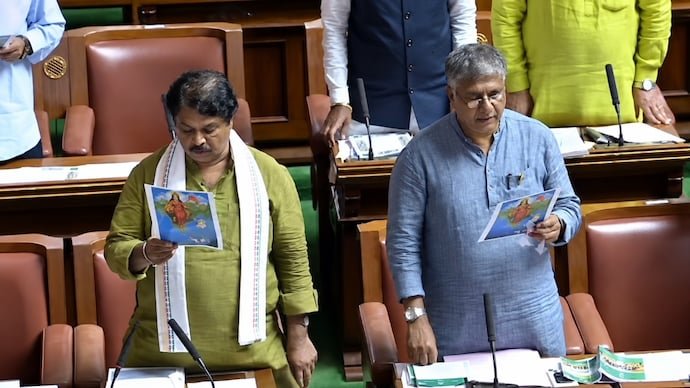
The Karnataka Legislative Assembly witnessed a political confrontation over Vande Mataram on Monday after BJP legislators began reciting the full version of the national song when the official rendition played at the start of the House proceedings ended after two stanzas.
The BJP members continued singing the remaining stanzas and raised slogans against the Congress-led Karnataka government, objecting to its decision to restrict the rendition of Vande Mataram at state government programmes to its first two stanzas in most circumstances.
The dispute unfolded as the Karnataka legislature began a three-day special session called to discuss the severe drought affecting the state and the implications of the Kasturirangan report on the Western Ghats. Instead of remaining limited to those policy issues, the opening moments of the session were dominated by a renewed political dispute over the national song.
BJP members recite full Vande Mataram
The proceedings in the Legislative Assembly began with Vande Mataram being played or rendered officially. The version used in the House ended after the first two stanzas.
After the rendition concluded, BJP legislators objected and began reciting the remaining portions of the song themselves. They also raised slogans criticising the state government for not playing the complete version.
The protest took place before the House moved on with its scheduled Business. Speaker GS Patil subsequently allowed condolences to be offered for prominent people who had died, after which Chief Minister DK Shivakumar began paying tribute to former MLA RB Shiriyannavar, who died on August 27.
The BJP members’ protest, however, kept the Vande Mataram issue at the centre of attention at the beginning of the special session.
Similar protest in Karnataka Legislative Council
The confrontation was not limited to the Legislative Assembly. BJP members in the Karnataka Legislative Council also continued reciting the remaining stanzas of Vande Mataram.
The protest took place while Council Chairman Saleem Ahmed began reading the Preamble to the Constitution, following the usual practice at the start of proceedings.
BJP members continued with the remaining portions of Vande Mataram and raised slogans against the government over the decision to limit the official rendition to two stanzas.
The simultaneous protests in both Houses highlighted the extent to which the issue has become a political flashpoint between the BJP and Congress in Karnataka.
Why Karnataka limited the rendition to two stanzas
The Karnataka government’s decision is part of a wider political dispute over how Vande Mataram should be performed at public and party functions.
The state government has ordered that only the first two stanzas be sung at its programmes, except when the President, Vice-President, Prime Minister or Governor is present. The decision has been challenged in the Karnataka High Court, with a petitioner arguing that the state government cannot restrict the rendition in a manner that conflicts with directions issued by the Union government.
The dispute has therefore moved beyond political criticism and into the legal arena. The challenge questions the scope of the state government’s executive authority and its ability to determine how the national song should be rendered at official functions.
The controversy is also connected to a broader national debate that has intensified in recent months over whether Vande Mataram should be performed in its complete form or whether the first two stanzas should remain the standard for public occasions.
The historical reason behind the two-stanza practice
The practice of singing only the first two stanzas has historical roots that go back to the freedom movement. In 1937, the Congress Working Committee decided that only the first two stanzas should be sung at national gatherings.
The decision reflected concerns about references and religious imagery in the later portions of the poem and the possibility that those passages could cause discomfort among members of different religious communities.
Vande Mataram was written by Bankim Chandra Chattopadhyay and became closely associated with India‘s freedom struggle. It was adopted as the national song after Independence, while Jana Gana Mana was designated as the national anthem.
On January 24, 1950, President of the Constituent Assembly Rajendra Prasad stated that Jana Gana Mana would be the national anthem and that Vande Mataram, which had played an important role in the freedom struggle, would be honoured equally.
The historical debate over the song has therefore never been simply about its length. It has involved questions of nationalism, religious imagery, historical interpretation and the manner in which a national symbol should be used at public gatherings.
Why the later stanzas are politically sensitive
The six-stanza version of Vande Mataram contains imagery that differs from the portions most commonly performed at official and public gatherings.
The first two stanzas praise the motherland through imagery associated with its natural beauty and prosperity. The later portions contain stronger martial and religious imagery, including references to Hindu deities.
Those references have historically generated objections among some Muslim scholars and political groups, who have argued that the imagery can conflict with Islamic beliefs concerning worship and the representation of the divine.
The 1937 Congress decision was influenced by these concerns. Supporters of the two-stanza practice argue that the shortened version allows the national song to be honoured while avoiding elements that have historically generated religious objections.
Those who support singing the complete song take a different position, emphasising its role in the freedom struggle and arguing that its full historical composition should be preserved and respected.
BJP and Congress take opposing positions
The Karnataka dispute reflects a much larger disagreement between the BJP and Congress over Vande Mataram.
The BJP has in recent months pushed for the complete version of the national song to receive greater prominence. The party has criticised the Congress decision to restrict its own programmes to the first two stanzas and has argued that the full song represents an important part of India’s national heritage.
Congress has defended its position by pointing to the 1937 resolution and the historical views of leaders of the freedom movement. The party has argued that limiting the public rendition to the first two stanzas has precedent and was intended to accommodate India’s religious diversity.
The disagreement has become particularly sharp because both parties attach broader political meaning to the issue. For the BJP, the complete song is associated with national identity and the history of the freedom movement. For Congress, the historical decision to use the first two stanzas is linked to concerns about inclusiveness at mixed public gatherings.
New legal framework adds to the dispute
The controversy has also developed alongside changes in the legal treatment of Vande Mataram.
Parliament recently passed the Prevention of Insults to National Honour (Amendment) Act, 2026, extending legal protection to Vande Mataram under the relevant national-honour law. The amendment makes intentionally preventing the singing or playing of the national song, or causing a disturbance to an assembly engaged in its singing, an offence.
The legal change has added another dimension to the political debate, although the Karnataka dispute concerns which version should be rendered at state functions rather than a straightforward refusal to allow the song to be performed.
A separate petition before the Karnataka High Court challenges the state government’s two-stanza policy. The petitioner argues that the Union government’s directions regarding the official version should apply when the song is performed at state functions.
What the Karnataka court challenge is about
The legal challenge does not seek to compel individuals to sing Vande Mataram. Instead, it questions the Karnataka government’s authority to prescribe a version that differs from the version directed by the Union government for official occasions.
The petition argues that the subject of the national song does not fall within the areas in which state legislatures have specific legislative competence under the Constitution. It therefore challenges the state’s ability to issue its own restriction through executive action.
The outcome of the legal proceedings could have implications for how Vande Mataram is handled at official functions in Karnataka, particularly if the court is asked to reconcile the state government’s order with Union-level instructions.
Special session was called for drought and Western Ghats issues
The Vande Mataram confrontation came at the beginning of a special session whose primary agenda is focused on major policy and environmental concerns.
Karnataka is facing severe drought conditions, making water availability and agricultural distress important issues for the state government and legislators. A special session provides an opportunity for elected representatives to debate the government’s response and examine the consequences for communities affected by water shortages.
The session is also expected to address the implications of the Kasturirangan report concerning the Western Ghats. The report has long been part of a contentious discussion over environmental protection, development restrictions and the interests of communities living in ecologically sensitive areas.
These issues have direct consequences for Karnataka’s agriculture, infrastructure and rural Economy, making them central to the legislative agenda of the special sitting.
Political symbolism overshadows the opening
The opening dispute demonstrates how symbolic national issues can quickly become politically prominent inside state legislatures.
Vande Mataram has a long association with India’s independence movement, which gives the song considerable emotional and political significance. Differences over its rendition can therefore become proxies for much wider disagreements about nationalism, secularism, historical memory and the role of religious imagery in public life.
In Karnataka, the disagreement has also become an example of the broader political competition between the BJP and Congress. The BJP’s decision to recite the remaining stanzas inside the House transformed the issue from a government protocol into a visible legislative protest.
At the same time, the government’s two-stanza policy reflects a position that has historical precedent within the Congress movement. The controversy cannot therefore be understood solely as a dispute that began with the latest Assembly session; it is part of a debate that has existed for decades.
The wider national debate over Vande Mataram
The Karnataka episode comes at a time when Vande Mataram has returned to the centre of national political debate.
The BJP has called for greater recognition of the complete composition, while Congress has maintained its position on the first two stanzas at party programmes. Other political organisations have taken different positions, demonstrating that the issue does not divide Indian Politics along a single simple line.
The debate has also revived discussion about the distinction between a song’s historical composition and the version that has traditionally been used at official gatherings. Vande Mataram contains six stanzas in its complete form, but the first two have historically been the portions most widely performed in public settings.
That history is now being reconsidered amid new government protocols and legislation, giving the issue renewed political importance.
What happens next in Karnataka
The immediate political confrontation is likely to continue beyond the opening moments of the special session. BJP legislators have made clear that they object to the Karnataka government’s decision to limit the rendition, while the Congress-led government has maintained its policy.
The pending court challenge could provide an institutional route for resolving at least part of the dispute. Until then, the issue is likely to remain a point of confrontation between the ruling Congress and opposition BJP in the Karnataka legislature.
The special session itself, however, is expected to focus on the drought situation and the Kasturirangan report, two issues with substantial implications for the state’s population and economy.
The Vande Mataram confrontation has nevertheless ensured that the opening of the Karnataka Assembly session was dominated by a national-symbol dispute. BJP members’ decision to recite the full version after the official rendition ended after two stanzas turned the beginning of the proceedings into a visible political protest, reflecting the continuing national debate over how India’s national song should be performed and understood in public life.
For breaking news and live news updates, like us on Facebook or follow us on Twitter and Instagram. Read more on Latest India on thefoxdaily.com.





COMMENTS 0