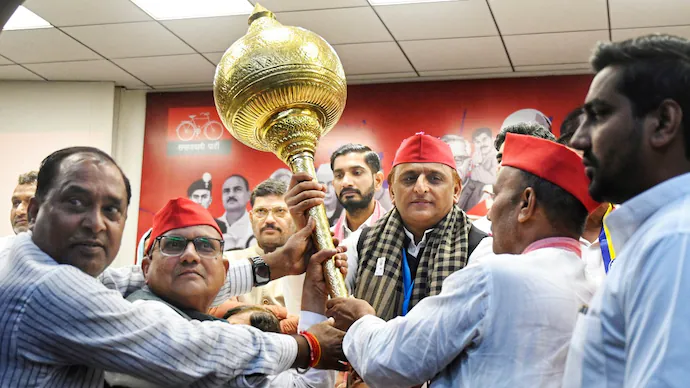
The latest Uttar Pradesh Legislative Council election results have created a new political talking point ahead of the 2027 Assembly elections. Although the Bharatiya Janata Party (BJP) retained its overall position by winning six of the 11 seats, the Samajwadi Party (SP) secured five, improving its previous tally and demonstrating an ability to challenge the ruling party in constituencies where the BJP had expected stronger performances.
For SP president Akhilesh Yadav, the most politically significant victories came from Lucknow and Varanasi. The party’s success in both Varanasi constituencies is particularly noteworthy because the city is represented in the Lok Sabha by Prime Minister Narendra Modi, who has won the parliamentary seat since 2014. Winning again in this politically important region gives the SP an opportunity to question the BJP’s organisational strength ahead of the next state election.
Polling for the 11 Legislative Council constituencies, comprising five graduates’ and six teachers’ seats, took place on October 23, 2026. The final results were declared on October 29 after counting in several constituencies continued for an extended period.
The outcome does not establish that the BJP is losing control of Uttar Pradesh. However, it provides the opposition with an important political opportunity. With the 2027 Assembly elections approaching, the results could influence campaign strategies, candidate selection and the way both parties approach different sections of the electorate.
UP MLC Election Results 2026: BJP Finishes Ahead but SP Records Important Gains
The final tally gave the BJP six seats and the Samajwadi Party five. Although the ruling party remained ahead numerically, the distribution of victories revealed a more competitive contest than the overall score might suggest.
The SP performed particularly well in graduates’ constituencies, winning three of the five seats. The BJP secured the remaining two. In teachers’ constituencies, however, the BJP maintained a stronger position, winning four of the six seats against the SP’s two.
The results also represented an improvement for the Samajwadi Party compared with the 2020 Legislative Council Elections, when the BJP had won six seats, the SP three and Independents two.
This time, the BJP retained six seats, while the SP increased its tally to five. The opposition party retained its existing representation and brought two additional constituencies into its tally, including the Lucknow Graduates’ seat previously held by the BJP and the Agra Teachers’ seat contested by Akash Agrawal after he joined the SP.
The constituency-wise results were as follows:
- Allahabad-Jhansi Graduates: Maan Singh Yadav (SP)
- Lucknow Graduates: Kanti Singh (SP)
- Varanasi Graduates: Ashutosh Sinha (SP)
- Meerut Graduates: Dinesh Kumar Goyal (BJP)
- Agra Graduates: Manvendra Pratap Singh (BJP)
- Varanasi Teachers: Lal Bihari Yadav (SP)
- Agra Teachers: Akash Agrawal (SP)
- Lucknow Teachers: Umesh Dwivedi (BJP)
- Meerut Teachers: Shrichand Sharma (BJP)
- Bareilly-Moradabad Teachers: Hari Singh Dhillon (BJP)
- Gorakhpur-Faizabad Teachers: Dhruv Kumar Tripathi (BJP)
The geographical distribution of these victories is important. The BJP maintained its advantage in several teachers’ constituencies and retained both seats in Meerut. However, the SP’s performance in Lucknow and Varanasi gave the opposition a result it can use to challenge the ruling party’s political narrative.
Why the Varanasi Results Matter for the BJP
Among all the constituencies, Varanasi carries particular political significance. The city is not simply another electoral location. It is Prime Minister Narendra Modi’s parliamentary constituency and one of the most recognisable political centres associated with the BJP’s national leadership.
The Samajwadi Party retained both the Varanasi Graduates’ and Varanasi Teachers’ constituencies, preventing the BJP from making an electoral breakthrough in the region.
In the graduates’ constituency, SP candidate Ashutosh Sinha defeated BJP candidate Kedarnath Singh by 19,932 votes. Sinha secured 55,046 votes against Singh’s 35,114. The victory was particularly important because Sinha had also won the constituency in 2020.
The teachers’ constituency produced another victory for the opposition. Lal Bihari Yadav retained his seat by securing 11,612 votes against BJP candidate Pramod Kumar Mishra, who received 6,597 votes.
Together, the two victories allowed the SP to demonstrate that the BJP’s political influence in Varanasi does not automatically translate into victories across every electoral category.
Understanding the political importance of the Varanasi region
The Varanasi division’s two MLC constituencies cover eight districts and 47 Assembly segments. In the 2022 Uttar Pradesh Assembly elections, the BJP-led National Democratic Alliance won 28 of these 47 seats. The Samajwadi Party secured 14, the Suheldev Bharatiya Samaj Party won four and the Bahujan Samaj Party secured one.
This background gives the MLC results an additional political dimension. The SP can point to its victories as evidence that it remains competitive in a region where the BJP-led alliance previously enjoyed a substantial advantage in Assembly representation.
However, the comparison must be treated carefully. The 2022 Assembly elections involved a much broader electorate, while the Legislative Council graduates’ and teachers’ constituencies represent specific voter groups. Their results cannot independently establish a shift in voting preferences across all 47 Assembly segments.
Nevertheless, retaining both Varanasi seats gives Akhilesh Yadav a useful opportunity to challenge the BJP’s claim of organisational dominance in an important political region.
Lucknow Graduates’ Victory Raises Questions About BJP’s Candidate Selection
The SP’s victory in Lucknow Graduates’ is another significant development because it involved defeating a sitting BJP representative.
SP candidate Kanti Singh defeated BJP incumbent Avneesh Kumar Singh by 17,127 votes. She secured 56,905 votes, compared with 39,778 for the BJP candidate.
The result is particularly relevant because Lucknow is the state capital and the centre of the Uttar Pradesh government’s political and administrative operations.
For the BJP, losing the graduates’ constituency in the state capital creates questions about its ability to maintain support among voters who participate in the Legislative Council’s graduate electorate. For the SP, the victory provides an opportunity to demonstrate that it can compete successfully in an area closely associated with the ruling establishment.
The result also places the BJP’s candidate-selection strategy under scrutiny. A sitting representative losing by a substantial margin suggests that the party needs to examine local electoral feedback rather than relying entirely on its broader organisational position.
That does not necessarily mean the BJP’s entire support base in Lucknow has weakened. The party retained the Lucknow Teachers’ constituency through Umesh Dwivedi, who defeated SP candidate Sushil Kumar. The contrasting outcomes indicate that the two voter categories responded differently to the candidates and parties.
Candidate Selection Becomes a Challenge for the BJP
One of the important lessons emerging from the 2026 MLC elections concerns the relationship between candidate selection and local political networks.
In Agra, Akash Agrawal won the teachers’ constituency on an SP ticket after previously seeking a BJP nomination. The BJP selected Hari Kishore Tiwari instead, following which Agrawal joined the opposition party and contested against the ruling party’s candidate.
Agrawal secured 14,046 votes, defeating Tiwari, who received 9,783. The outcome allowed the SP to bring the constituency into its tally after it had previously been represented by an Independent.
The development illustrates how disagreements over nominations can create opportunities for rival parties. A candidate who already has local connections and an established voter network may become a formidable opponent if denied a ticket by one party and subsequently supported by another.
A similar question has emerged in Varanasi Graduates’. The BJP again fielded Kedarnath Singh, who had lost to Ashutosh Sinha in the 2020 election. Sinha’s repeat victory has raised questions about whether the BJP adequately considered local feedback before finalising its candidate.
These outcomes do not establish that candidate selection alone caused the BJP’s defeats. Electoral performance is influenced by several factors, including voter satisfaction, organisational activity, candidate popularity and local issues. Nevertheless, the results give the BJP a reason to examine whether its nomination decisions are aligned with ground-level expectations.
What the Victory Margins Reveal About the Contest
The final vote margins provide another useful perspective on the election. Several SP candidates won by substantial differences, particularly in graduates’ constituencies.
Maan Singh Yadav recorded the largest victory margin of the entire election. He defeated BJP candidate Ashok Kumar Rathore in Allahabad-Jhansi Graduates’ by 27,663 votes, securing 60,358 votes against his opponent’s 32,695.
Ashutosh Sinha recorded the second-largest margin, defeating Kedarnath Singh by 19,932 votes in Varanasi Graduates’. Kanti Singh followed with a 17,127-vote victory in Lucknow Graduates’.
The results indicate that the SP’s performance was not limited to narrowly contested victories. Its candidates established substantial leads in several important graduates’ constituencies.
However, the BJP also demonstrated considerable electoral strength. Hari Singh Dhillon won Bareilly-Moradabad Teachers’ by 17,676 votes, while Shrichand Sharma secured Meerut Teachers’ by 13,241 votes.
The closest contest took place in Gorakhpur-Faizabad Teachers’, where BJP candidate Dhruv Kumar Tripathi defeated Independent candidate Rajiv Yadav by 2,210 votes.
The difference between these outcomes highlights the varied nature of the election. Some constituencies produced decisive victories, while others remained competitive until the final stages of counting.
Why Graduates’ and Teachers’ Constituencies Require a Different Political Reading
One reason the MLC results have attracted attention is that they provide a different perspective on Uttar Pradesh’s political environment. Unlike Assembly elections, graduates’ and teachers’ constituencies do not involve voting by the entire electorate.
These constituencies represent specific categories of voters who meet the eligibility requirements for the respective electoral rolls. Graduate constituencies involve eligible registered graduates, while teachers’ constituencies represent eligible registered teachers.
This distinction matters because the concerns of these voters can differ from those dominating a general election campaign.
For graduate voters, issues such as employment opportunities, recruitment processes, educational qualifications and career prospects may influence political preferences. Teachers may place greater importance on service conditions, salaries, pension-related concerns, institutional administration and education policies.
These are relevant areas of political discussion, although the election results alone cannot establish which individual issue determined a particular vote.
Samajwadi Party leaders have sought to connect their victories with dissatisfaction among teachers, students and unemployed graduates. Akhilesh Yadav has argued that the BJP has alienated sections of these communities and presented the results as a rejection of the government’s policies.
For the opposition, this interpretation offers a campaign opportunity. Rather than presenting the results merely as five victories, the SP can use them to highlight issues that it believes deserve greater attention before the Assembly elections.
Akhilesh Yadav Uses the Results to Strengthen the PDA Narrative
Following the announcement of the results, Akhilesh Yadav described the outcome as a double defeat for the BJP’s double-engine government.
His political messaging has focused on the party’s PDA coalition, which stands for Pichhda, Dalit and Alpsankhyak, referring to backward classes, Dalits and minorities.
The SP chief claimed that the coalition’s support base was expanding and asserted that it had reached 95 per cent. This figure represents his political claim rather than an independently established measurement of the electorate’s voting preferences.
The PDA strategy is important to understanding the SP’s broader electoral approach. The party is attempting to build a coalition that extends beyond its traditional support base by bringing different social groups into a common political framework.
The MLC results give the SP an opportunity to present its strategy as electorally effective. However, converting victories in graduates’ and teachers’ constituencies into broader social support will require the party to demonstrate that its message connects with voters across rural and urban areas, different communities and economic groups.
The party has also used the results to energise its organisation. Hoardings appeared near the SP headquarters and at prominent intersections in Lucknow, celebrating the victories and projecting Akhilesh Yadav as a potential chief minister after the 2027 elections.
Such messaging is part of the political contest that begins well before formal Assembly campaigning. Electoral victories can provide opposition workers with renewed confidence and help leadership communicate a narrative of momentum.
BJP Retains Six Seats: Why the Result Is Not a Complete Rejection
Despite the SP’s gains, the BJP has reasons to view the results as a mixed performance rather than a comprehensive electoral setback.
The party retained six seats, the same number it had secured in the 2020 elections. It won both graduates’ constituencies in Meerut and Agra, along with teachers’ constituencies in Lucknow, Meerut, Bareilly-Moradabad and Gorakhpur-Faizabad.
Its performance in teachers’ constituencies was particularly strong. Winning four of the six seats demonstrates that the party maintained significant support among this category of voters in several regions.
Uttar Pradesh Deputy Chief Minister Keshav Prasad Maurya indicated that the party would review its performance and examine how the SP managed to win constituencies where the BJP had expected a stronger showing.
The review will be important because the party faces two different electoral challenges. It must understand the reasons behind its defeats in Lucknow and Varanasi while preserving the organisational strengths that helped it retain seats elsewhere.
Uttar Pradesh minister and Suheldev Bharatiya Samaj Party chief Om Prakash Rajbhar also played down the broader significance of the results, arguing that graduates and teachers represent a comparatively more educated section of the electorate rather than the population as a whole.
His observation highlights a central limitation of using MLC elections to predict Assembly outcomes. The BJP’s performance among graduates and teachers cannot automatically be treated as a measurement of its support among all voters.
Can the MLC Results Change the Political Equation Before the 2027 UP Elections?
The immediate advantage for the Samajwadi Party is political momentum. Five victories provide Akhilesh Yadav with an opportunity to strengthen the party’s campaign narrative and motivate its organisational network before the next Assembly election.
The party can highlight three particularly important developments:
- Success in Varanasi: Retaining both constituencies allows the SP to challenge the BJP in a region closely associated with Narendra Modi.
- Victory in Lucknow Graduates’: Defeating a sitting BJP representative gives the opposition a significant result in the state capital.
- Improved overall tally: Increasing its representation from three to five seats strengthens the SP’s position in the Legislative Council and provides a political boost.
Akhilesh Yadav has also asked party workers to work towards increasing the SP’s vote count by at least 27,000 in every Assembly constituency during the 2027 elections.
The target reflects the leadership’s emphasis on converting the latest electoral momentum into a wider organisational effort. However, the MLC results do not provide a direct numerical formula for Assembly campaigning. The electorates, constituencies and voting dynamics are different.
For the BJP, the challenge is to prevent the opposition from turning these results into a broader narrative of declining support. Its review of candidate selection, local organisational performance and voter dissatisfaction could become important in determining how it responds before 2027.
What Happens Next in Uttar Pradesh’s Political Contest?
The MLC election results are unlikely to settle the political debate over which party holds the advantage in Uttar Pradesh. Instead, they have introduced another set of questions that both the BJP and SP will need to address before the Assembly elections.
For the SP, the central challenge will be expanding its support beyond the specific voter groups represented in graduates’ and teachers’ constituencies. The party will need to demonstrate that its PDA strategy, employment messaging and criticism of the government can translate into support across the much larger Assembly electorate.
For the BJP, the priority will be understanding why it lost constituencies such as Lucknow Graduates’ and failed to make gains in Varanasi despite its strong political presence. Candidate selection and local dissatisfaction are issues the party will have to examine, particularly where opposition candidates secured substantial victory margins.
The broader political environment will also matter. Assembly elections involve multiple issues, including employment, development, law and order, welfare schemes, infrastructure, social coalitions and the performance of the state government. The importance voters assign to these issues may differ considerably from the priorities influencing MLC elections.
Ultimately, the 2026 Legislative Council results offer the Samajwadi Party a valuable opportunity to challenge the BJP’s political confidence. The victories in Varanasi and Lucknow make that opportunity particularly significant.
But the BJP remains ahead in the overall tally, and its victories across several teachers’ and graduates’ constituencies demonstrate that its electoral network remains competitive. Whether the SP can convert its latest success into a larger political shift will become clearer as both parties intensify their preparations for Uttar Pradesh’s 2027 Assembly elections.
For now, the most important message from the MLC results is not that the BJP has lost Uttar Pradesh, but that the Samajwadi Party has found new ground from which to challenge it. And by winning both Varanasi seats, Akhilesh Yadav has ensured that the BJP will have to answer uncomfortable questions even in one of its most politically prominent strongholds.
Tighten the article’s repeated analysis Separate confirmed results from interpretation Soften unsupported campaign inferences
For breaking news and live news updates, like us on Facebook or follow us on Twitter and Instagram. Read more on Latest India on thefoxdaily.com.






COMMENTS 0