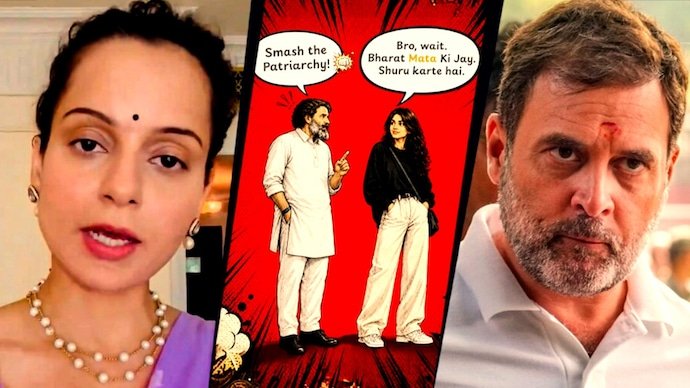
Actor and BJP MP Kangana Ranaut has taken a fresh swipe at Congress leader Rahul Gandhi after he used the phrase “smash the patriarchy” while defending actor Kriti Sanon amid a controversy over her outfit in a Raksha Bandhan advertisement.
Ranaut reshared a post from the BJP’s official Instagram account and added her own pointed message: “Bro, wait. Bharat Mata ki Jay. Shuru karte hain.” Her response turned what began as a dispute over a celebrity advertisement into a broader political argument over Women’s Rights, cultural identity, political representation and the competing approaches of the BJP and Congress.
The exchange followed Gandhi’s intervention in the controversy on August 25. Sharing Sanon’s response to criticism of her advertisement, Gandhi said that what a woman wears, does and where she goes is her choice. He also urged people to stop trolling women for exercising their freedom and used the hashtag “smash the patriarchy.”
Ranaut’s response was not simply about Sanon’s outfit. By amplifying the BJP’s graphic, she shifted the conversation toward the Congress’ historical record on issues involving Muslim women, women’s political representation and the treatment of women in political institutions.
Why Kangana Ranaut targeted Rahul Gandhi
Ranaut’s latest post came after an increasingly political exchange that began with a fashion and advertising controversy.
Sanon appears in a jewellery brand’s Raksha Bandhan campaign wearing an Indo-Western outfit featuring a bralette-style blouse, cape and draped skirt. The advertisement shows her celebrating the festival by tying a rakhi to her brother and also to her pet dog.
The campaign divided social Media users. Some criticised the styling and argued that the presentation did not fit their understanding of a traditional Indian festival. Others defended Sanon, saying that a woman’s clothing should not determine whether she respects Indian culture or family traditions.
Ranaut entered the debate by questioning Sanon’s decision to wear what she described as a bikini or undergarments while tying a Rakhi to her brother. She argued that modern women have many choices in clothing and questioned why a more traditional outfit was not selected for a festival advertisement.
Sanon subsequently pushed back against the criticism, arguing that culture and traditions are rooted in a person’s values and emotions rather than in a neckline. Her response also questioned why women continue to be told what they should wear.
Gandhi then publicly backed Sanon’s position. That intervention gave the dispute a political dimension and provided the opening for Ranaut and the BJP to respond.
What Rahul Gandhi said about women’s choice
Gandhi’s intervention was brief but directly addressed the central issue in the controversy.
He said that what a woman wears, what she does and where she goes is her choice. He also said women should not be trolled for exercising their freedom and added the phrase “smash the patriarchy.”
The statement was consistent with a broader set of comments Gandhi had made days earlier about patriarchy and the social expectations placed on women.
At his “Chhatron Ki Goonj” outreach programme, Gandhi criticised what he described as a “Manusmriti mindset” and spoke to girl students about women having control over their own lives. He argued against the idea that women should be regarded as being under the authority of fathers, husbands or sons.
That broader context is important because his “smash the patriarchy” phrase was not created specifically for the Sanon controversy. It was already part of his recent political messaging on gender equality.
The BJP graphic behind Kangana’s response
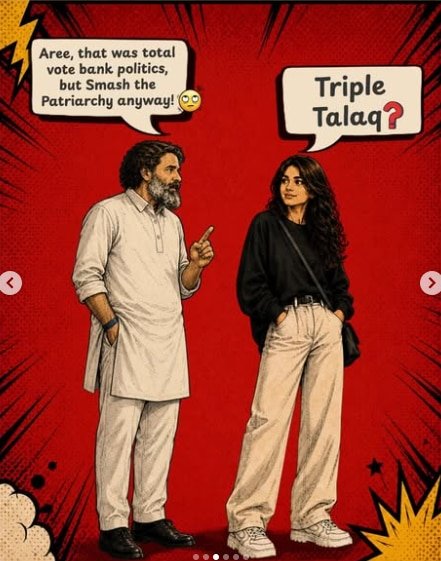
Ranaut’s Instagram post amplified a BJP graphic designed as a fictional exchange between Gandhi and a woman.
The graphic begins with Gandhi saying, “Smash the Patriarchy!” The woman responds, “Bro, wait. Bharat Mata ki Jay. Shuru karte hain.” It then moves through several political questions concerning the Congress’ record and positions on women-related issues.
One panel raises the subject of triple talaq. Another questions the Congress’ position during the long political history of the Women’s Reservation Bill. A third invokes the Shah Bano case.
The final panel turns to contemporary Politics, asking why the Karnataka Cabinet has no woman minister despite having 33 ministers. Gandhi is depicted responding with hesitation.
The graphic is clearly a partisan political argument rather than an independent assessment of the Congress’ record. Its purpose is to challenge Gandhi’s current language on patriarchy by pointing to decisions and political positions associated with the Congress over different periods.
That distinction matters because the issues referenced in the graphic span decades, different governments and changing political circumstances. They cannot all be treated as a single policy record belonging to one leader or one administration.
The Women’s Reservation Bill claim needs historical context
The BJP graphic raises the Women’s Reservation Bill as part of its criticism of the Congress. But the history of the legislation is more complicated than a simple claim that one party supported or opposed it.
Proposals to reserve seats for women in Parliament and state legislatures have been introduced repeatedly since the 1990s. The 2010 version of the Women’s Reservation Bill was passed by the Rajya Sabha but never received a vote in the Lok Sabha before the House was dissolved.
The legislation was therefore not defeated through a final Lok Sabha vote during that period. It lapsed after remaining pending.
In September 2023, Parliament passed a new constitutional amendment providing for one-third reservation for women in the Lok Sabha and state legislative assemblies, subject to the implementation framework specified by the law.
The history shows why the issue has remained politically contentious for decades. Different parties have supported the principle at various stages while disagreements over implementation, representation and the inclusion of sub-quotas have complicated attempts to secure consensus.
Consequently, the BJP’s current criticism is best understood as a political argument about the Congress’ historical handling of women’s representation rather than as evidence that Congress as a whole simply opposed women’s reservation.
Why Shah Bano and triple talaq were brought into the debate
The BJP graphic also invokes the Shah Bano case and triple talaq, two separate chapters in the political and legal debate over Muslim women’s rights in India.
The Shah Bano case dates back to the 1980s. In 1985, the Supreme Court ruled in favour of Shah Bano on the issue of maintenance following divorce. The Rajiv Gandhi government subsequently enacted the Muslim Women (Protection of Rights on Divorce) Act, 1986.
The legislation became controversial because critics argued that it diluted the practical effect of the Supreme Court judgment, while supporters presented it as legislation addressing the rights of divorced Muslim women within the framework of Muslim personal law.
Decades later, the political debate over triple talaq produced another major shift. The Supreme Court declared instant triple talaq legally invalid in 2017, and Parliament later enacted legislation criminalising the practice.
The two issues are often discussed together in political arguments about Muslim women, but they arose in very different legal and political circumstances. The BJP’s graphic uses them to question the Congress’ present-day claims on gender equality.
Karnataka Cabinet becomes a key talking point
The reference to the Karnataka Cabinet in the BJP graphic has a more immediate political basis.
After the Karnataka Cabinet expansion in August 2026, the council of ministers reached a strength of 33, with one position vacant, but no woman was included among the ministers.
That absence has itself become a subject of political discussion because Congress has historically made women’s welfare and empowerment important elements of its political messaging in Karnataka.
The BJP graphic uses the lack of women ministers as a direct challenge to Gandhi’s call to “smash the patriarchy.” The argument is straightforward: if women’s political representation is a core principle, critics ask why the state Cabinet does not reflect that principle.
But Cabinet composition is also shaped by political calculations involving regions, communities, factions, seniority and the availability of ministerial positions. The absence of women can therefore be criticised as a representation issue without automatically proving that a particular leader’s broader position on patriarchy is insincere.
Kriti Sanon’s response changed the tone of the original controversy
Before Gandhi entered the debate, Sanon had already responded directly to the criticism.
She argued that the meaning of a festival should not be reduced to clothing and said the essence of festivals lies in the emotions and significance attached to traditions. She described Raksha Bandhan as a bond of protection and explained that she and her sister also tie rakhi to each other.
Sanon additionally defended the presence of her dog in the campaign, saying that her family extends its prayers and affection to its pets as well.
Her statement moved the discussion beyond whether her outfit was appropriate. It raised a larger question about WHO gets to define cultural authenticity and whether women are disproportionately judged through their clothing when participating in traditional celebrations.
That question is partly why Gandhi’s intervention resonated beyond the advertisement itself. His argument was that criticism of Sanon’s clothing crossed into policing a woman’s personal choices.
Where Kangana Ranaut and Rahul Gandhi disagree
The disagreement between Ranaut and Gandhi is ultimately about two different ways of framing the same controversy.
Gandhi’s position focuses on individual freedom. His argument is that a woman should not be subjected to public trolling simply because of what she wears or how she presents herself.
Ranaut’s criticism focuses more heavily on context and cultural expectations. Her earlier comments questioned the appropriateness of the advertisement’s styling for Raksha Bandhan, while her latest post expands that argument into a broader criticism of the Congress.
The two positions are not necessarily answering exactly the same question. One asks whether a woman has the right to choose her clothing. The other asks whether a commercial representation of a religious or cultural festival can be criticised for its creative choices.
That distinction is central to understanding why the dispute has continued. Freedom of personal choice and criticism of commercial content can coexist. A person can defend an individual’s right to choose clothing while disagreeing with the way a brand uses that clothing to represent a festival.
The political stakes behind the social media exchange
Ranaut’s intervention also reflects the increasingly blurred boundary between celebrity culture and electoral politics in India.
Both Ranaut and Gandhi have substantial public visibility, and statements made on Instagram can quickly become political talking points. In this case, a jewellery advertisement became the starting point for a debate involving patriarchy, cultural identity, women’s representation and the historical records of two major political parties.
For the BJP, Gandhi’s “smash the patriarchy” messaging creates an opportunity to question whether Congress governments and leaders have consistently matched that rhetoric with representation and policy choices.
For the Congress, the controversy allows Gandhi to present himself as defending a woman’s autonomy against online moral policing.
For Sanon, however, the dispute began with something considerably less political: an advertisement that attempted to give a traditional festival a contemporary fashion treatment.
What the controversy says about women, clothing and politics
The most significant part of the debate may be the question that has been overshadowed by the political sparring: why does a woman’s clothing become such a powerful proxy for arguments about culture?
Traditional festivals naturally carry expectations about rituals, symbolism and presentation. Advertisers also routinely modernise traditional themes to appeal to contemporary audiences. When those two approaches collide, disagreements are almost inevitable.
But the Sanon controversy shows how quickly a debate about an advertisement can become a judgment about a woman herself.
At the same time, political leaders are entitled to criticise advertising choices and discuss cultural representation. The difficult line is between criticism of a commercial campaign and criticism directed at a woman for exercising personal choice.
That distinction will likely remain at the centre of the debate as the controversy moves from Entertainment coverage into partisan political discourse.
What happens next in the Kangana Ranaut-Rahul Gandhi row
There is no indication that the exchange will end with Ranaut’s latest Instagram post. The BJP has already framed Gandhi’s remarks as an opportunity to challenge Congress on its record on women’s issues, while the Congress can use the controversy to reinforce its message on personal freedom and gender equality.
The Sanon advertisement itself may eventually fade from the political conversation, but the arguments it triggered are likely to persist. Questions over women’s clothing, cultural identity, representation in politics and the meaning of patriarchy have deep roots in India’s public debate.
For now, Ranaut’s “Bro, wait” response has transformed a celebrity advertisement dispute into another political clash between the BJP and Congress. Gandhi’s defence of Sanon was framed around a woman’s freedom to make personal choices. Ranaut’s response, amplified through the BJP’s graphic, asks whether that principle is consistently reflected in the political record of the party he represents.
The answer to that larger question cannot be settled by an Instagram exchange. It depends on the record of legislation, political representation and government decisions over time. What the latest controversy does show is how quickly questions about women’s autonomy can become a battleground for competing visions of culture and politics.
For breaking news and live news updates, like us on Facebook or follow us on Twitter and Instagram. Read more on Latest India on thefoxdaily.com.





COMMENTS 0