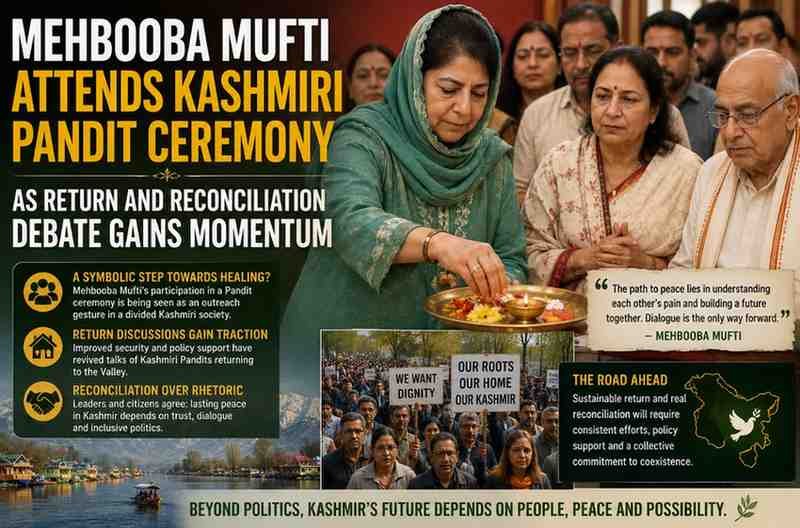
In a region where Politics and history are deeply intertwined, symbolic gestures often carry significance beyond the event itself. The decision by Mehbooba Mufti to attend a ceremony organized by the Kashmiri Pandit community comes at a time when conversations around reconciliation, rehabilitation, and the possible return of displaced families have once again entered public discourse.
The visit has drawn attention because it coincides with reports of improving security conditions in Jammu and Kashmir and a decline in militant recruitment, developments that some displaced Pandit groups view as creating a more favorable environment to reconsider returning to their ancestral homeland.
While one public appearance cannot erase decades of pain, displacement, and mistrust, it has reopened an important conversation about whether confidence-building measures between communities can contribute to lasting peace.
Why the Event Matters
Kashmir has witnessed decades of political conflict, violence, and displacement that profoundly affected both Kashmiri Pandits and Kashmiri Muslims. The migration of a large section of the Pandit community from the Valley in the late 1980s and early 1990s remains one of the region’s most significant humanitarian and social challenges.
Since then, successive governments, civil society groups, and community leaders have explored different approaches to facilitate rehabilitation while ensuring security, dignity, and sustainable livelihoods.
Against this backdrop, interactions between political leaders and displaced communities often receive considerable public attention because they touch upon sensitive issues of trust and reconciliation.
The Long Journey of Displacement
The displacement of Kashmiri Pandits reshaped the Valley’s social fabric. Families left behind homes, businesses, places of worship, schools, and generations of shared memories.
Many rebuilt their lives elsewhere in India, while continuing to maintain emotional and cultural ties with Kashmir.
For numerous families, the question of return has remained deeply personal, involving not only physical security but also employment opportunities, housing, education, healthcare, and community acceptance.
Why Security Conditions Matter
Security remains one of the most important considerations for displaced families contemplating a return. Reports indicating improvements in the overall security environment and reduced militant recruitment have encouraged renewed discussion about whether conditions are gradually becoming more conducive.
However, experts emphasize that perceptions of safety vary among individuals and communities, and long-term confidence depends on sustained stability rather than short-term trends.
Successful rehabilitation requires both physical security and a lasting sense of belonging.
Can Symbolic Gestures Build Confidence?
Public acts of outreach, such as attending community events or participating in shared cultural gatherings, cannot by themselves resolve complex historical issues. Nevertheless, they may contribute to rebuilding communication between communities that have experienced decades of separation.
Symbolic gestures often serve three important purposes:
- They acknowledge shared history.
- They encourage dialogue.
- They signal willingness to engage across community lines.
While symbolism alone is insufficient, it can create opportunities for broader conversations about reconciliation.
Kashmir’s Shared Cultural Heritage
Long before conflict shaped modern narratives, Kashmir was known for its rich tradition of cultural coexistence. Literature, music, crafts, language, philosophy, and spiritual traditions developed through centuries of interaction among different communities.
Many scholars describe this shared heritage as an important foundation for rebuilding trust in the future.
Preserving this legacy requires recognizing both historical diversity and the experiences of all communities affected by conflict.
| Area of Reconciliation | Why It Matters |
|---|---|
| Community Dialogue | Builds mutual understanding |
| Security | Essential for confidence in return |
| Housing & Infrastructure | Supports long-term rehabilitation |
| Employment Opportunities | Encourages sustainable resettlement |
| Cultural Preservation | Strengthens shared identity |
The Challenges of Return
Returning to one’s ancestral home involves far more than relocating. Families must consider access to employment, education, healthcare, property issues, infrastructure, and community integration.
Many younger generations have spent most or all of their lives outside Kashmir, creating additional social and economic considerations.
Experts therefore argue that any rehabilitation effort must address both emotional and practical dimensions of resettlement.
Trust Takes Time to Rebuild
Trust is among the most difficult aspects of post-conflict recovery. Decades of separation, trauma, and political divisions cannot be overcome through isolated initiatives.
Meaningful reconciliation typically requires sustained dialogue, consistent policy implementation, security assurances, and participation from community leaders, civil society organizations, and governments.
Confidence grows gradually through repeated positive experiences rather than single events.
The Role of Political Leadership
Political leaders often play an important symbolic role during periods of reconciliation. Public engagement with different communities can help foster dialogue and encourage broader conversations about coexistence.
However, lasting progress ultimately depends on translating symbolic outreach into practical policies that address everyday concerns.
Citizens frequently judge reconciliation not only by public statements but also by measurable improvements in their daily lives.
Why Rehabilitation Is About More Than Returning Home
For displaced communities, rehabilitation extends beyond physical relocation. It includes restoring dignity, rebuilding social relationships, protecting cultural identity, and creating opportunities for future generations.
A successful return, where feasible, depends on ensuring that families can rebuild stable lives rather than simply reclaiming physical spaces.
This broader perspective has increasingly shaped discussions surrounding long-term rehabilitation.
The Importance of Community Participation
Experts widely agree that sustainable peace cannot be achieved through government initiatives alone. Local communities, religious leaders, educators, youth groups, and civil society organizations all play important roles in rebuilding social trust.
Grassroots engagement often creates opportunities for dialogue that formal political processes alone cannot achieve.
Community-led reconciliation can help address misunderstandings while strengthening local cooperation.
| Symbolic Action | Potential Long-Term Value |
|---|---|
| Inter-community participation | Encourages dialogue |
| Cultural events | Celebrates shared heritage |
| Public engagement | Builds confidence |
| Community partnerships | Strengthens cooperation |
| Inclusive policymaking | Supports sustainable rehabilitation |
The Bigger Picture: Reconciliation Is a Long-Term Process
Events such as Mehbooba Mufti’s participation in a Kashmiri Pandit ceremony highlight the continuing importance of dialogue in addressing one of Kashmir’s most sensitive issues. While symbolic gestures alone cannot resolve decades of displacement and conflict, they may contribute to an environment where communication becomes easier.
Ultimately, reconciliation requires a combination of security, trust, inclusive governance, economic opportunity, cultural preservation, and sustained engagement from all stakeholders.
Progress is often measured not by individual events but by the gradual rebuilding of relationships over time.
Conclusion
Mehbooba Mufti’s attendance at a Kashmiri Pandit community ceremony comes during renewed discussions about rehabilitation and the possible return of displaced families amid reports of improving security conditions. The event has drawn attention because it symbolizes an effort to reconnect communities whose shared history has been deeply affected by decades of conflict.
Whether such gestures translate into lasting reconciliation will depend on much more than symbolism. Sustainable progress requires continued improvements in security, practical rehabilitation measures, meaningful dialogue, and mutual trust built through consistent engagement.
As Kashmir looks toward the future, rebuilding relationships may prove just as important as rebuilding homes—because lasting peace is ultimately founded on confidence, coexistence, and a shared commitment to healing old divisions.
For breaking news and live news updates, like us on Facebook or follow us on Twitter and Instagram. Read more on Latest Entertainment on thefoxdaily.com.






COMMENTS 0