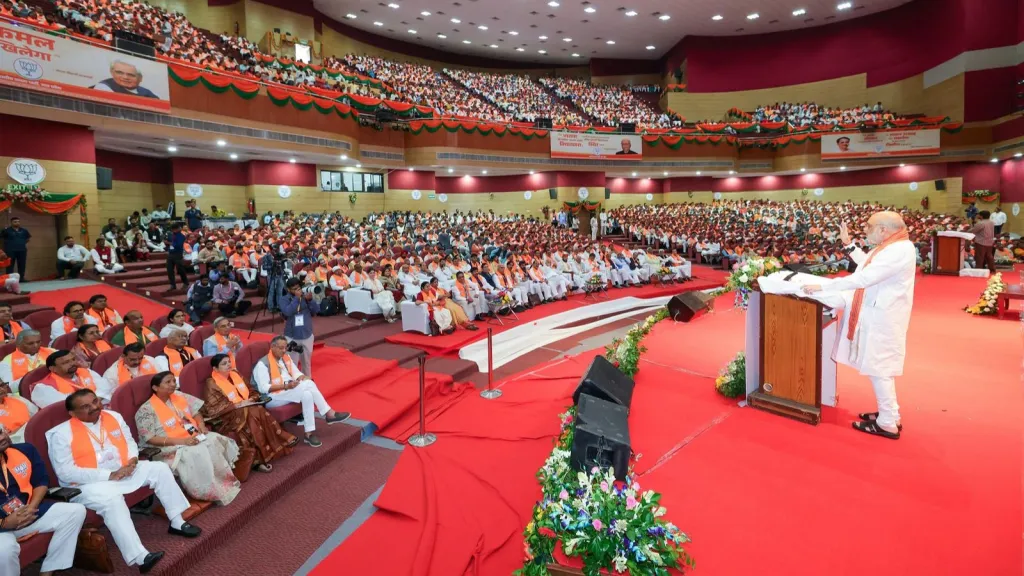
The Bharatiya Janata Party (BJP) is preparing an extensive political outreach campaign in Uttar Pradesh, with six padyatras, nearly 200 youth meetings and community feasts with farmers scheduled as part of its nationwide effort to counter the Opposition’s narrative on democracy and electoral reforms.
The programmes will be held between November 3 and 5, with senior BJP leaders, including Chief Minister Yogi Adityanath, party president Nitin Nabin, Union Ministers Shivraj Singh Chouhan and J P Nadda, and Deputy Chief Ministers Keshav Prasad Maurya and Brajesh Pathak, expected to lead the marches across different regions of the state.
The campaign comes amid growing political differences between the BJP and the INDIA bloc over the Election Commission, Chief Election Commissioner Gyanesh Kumar and the Special Intensive Revision (SIR) of electoral rolls. The Opposition has been organising protests against the poll body, while the BJP is planning public meetings and marches to present its position on the issues.
BJP to Organise Six Padyatras Across Uttar Pradesh
The BJP’s six regional units in Uttar Pradesh will organise one padyatra each as part of the campaign. The party finalised the programme during its recent state executive committee meeting in Lucknow.
The first two marches will take place on November 3 in the Awadh and Braj regions. Union Minister Shivraj Singh Chouhan will lead the padyatra in Lucknow, while BJP leader J P Nadda will lead the march in Bareilly.
On November 4, three more marches are scheduled across the state. BJP president Nitin Nabin will lead the padyatra in Gorakhpur for the Gorakhpur region. Deputy Chief Minister Keshav Prasad Maurya will lead the Kashi region’s march in Prayagraj, while Deputy Chief Minister Brajesh Pathak will head the Kanpur-Bundelkhand region’s event in Kanpur.
The sixth padyatra will be held in Ghaziabad on November 5, with Chief Minister Yogi Adityanath leading the march for West Uttar Pradesh.
Six Padyatras and Their Leaders
| Date | Location | Region | Leader |
|---|---|---|---|
| November 3 | Lucknow | Awadh | Shivraj Singh Chouhan |
| November 3 | Bareilly | Braj | J P Nadda |
| November 4 | Gorakhpur | Gorakhpur | Nitin Nabin |
| November 4 | Prayagraj | Kashi | Keshav Prasad Maurya |
| November 4 | Kanpur | Kanpur-Bundelkhand | Brajesh Pathak |
| November 5 | Ghaziabad | West Uttar Pradesh | Yogi Adityanath |
According to a senior BJP leader, the padyatras are intended to respond to what the party describes as repeated Opposition protests. The BJP has asked its regional units to mobilise at least 25,000 people for each event. Participants are expected to walk at least one kilometre alongside party leaders and workers.
A senior BJP functionary claimed that the Opposition’s recent demonstrations in Delhi had attracted relatively small crowds despite being presented prominently on social media. The functionary also claimed that the BJP expected larger participation at its Uttar Pradesh marches and said the gatherings would demonstrate public support for the party’s policies and ideology.
These statements reflect the BJP’s own assessment of the campaign and its expected turnout. The planned mobilisation will take place just months before the state’s next electoral cycle, giving the outreach programme additional political significance.
Nearly 200 Youth Meetings and Farmer Feasts Planned
Alongside the six padyatras, the BJP is planning nearly 200 Yuva Sammelans, or youth meetings, across Uttar Pradesh. The party will also organise community feasts involving farmers as part of its wider outreach programme.
The meetings and gatherings are intended to communicate the BJP’s position on the Opposition’s protests, the SIR exercise and allegations of attempts to influence the political system. Party leaders have described the Opposition’s campaign as an alleged regime-change agenda and said they want to address what they consider misconceptions about the electoral roll revision process.
The scale of the programme in Uttar Pradesh is expected to be larger than similar activities planned in other parts of the country. The BJP’s six regional units will coordinate the marches, while additional padyatras are expected to be organised at the district level later.
The campaign follows the INDIA bloc’s rally at Ramlila Maidan in Delhi, where Opposition leaders demanded the resignation of Chief Election Commissioner Gyanesh Kumar. The alliance has raised concerns about electoral processes and the functioning of the Election Commission.
BJP Prepares Pamphlet to Counter Claims About SIR
As part of its effort to counter the Opposition’s criticism, the BJP has prepared a four-page pamphlet through its publication, Kamal Jyoti. The document focuses on what the party describes as misconceptions surrounding the Special Intensive Revision of electoral rolls.
The pamphlets were distributed among members of the Uttar Pradesh BJP state executive committee on October 30. They contain the party’s explanations and arguments on several issues raised by Opposition leaders regarding the revision exercise.
One of the claims addressed in the pamphlet concerns the decision-making process within the Election Commission. The document challenges the allegation that only one person takes decisions in the poll body.
It states that orders related to the SIR exercise were issued with the consensus of all three Election Commissioners. This is the BJP’s position as presented in the pamphlet.
BJP Responds to Claim That 13 Crore Voters Were Deleted
Another issue addressed in the pamphlet is the allegation that 13 crore names have been deleted from electoral rolls. The BJP disputes this interpretation and argues that the number refers to entries identified under different categories rather than the removal of 13 crore voters.
According to the document, the entries identified during the exercise include names associated with people who were absent, had permanently shifted, had died or appeared as duplicate entries.
The pamphlet argues that identifying such entries should not be interpreted as the deletion of 13 crore names. It also accuses the Congress of misleading people about the purpose and scale of the exercise.
The document questions why the INDIA alliance would oppose the removal of duplicate and deceased voters from electoral rolls. This forms part of the BJP’s broader argument that the revision process is intended to improve the accuracy of voter records.
However, the pamphlet presents the BJP’s interpretation of the SIR exercise. The Opposition’s objections and concerns about the process remain part of the wider political dispute over electoral rolls and the Election Commission.
Party Rejects Link Between Electoral Roll Deletion and Public Benefits
The BJP pamphlet also addresses the claim that deletion of a person’s name from the electoral roll would automatically lead to the withdrawal of facilities such as ration benefits, pensions and passports.
The party lists this as another misconception and seeks to counter concerns about the possible consequences of changes to voter records.
The issue has become part of the political debate surrounding the SIR exercise, with the BJP using its pamphlet and planned public outreach programmes to explain its position to party workers and the public.
BJP Cites Previous SIR Exercises Under Congress Governments
The pamphlet also refers to the history of Special Intensive Revision exercises in India. It claims that 10 of the 12 SIR exercises were conducted during the tenure of Congress-led governments.
It further states that the Congress lost 56 Assembly elections between 2014 and 2025 before the current revision exercise. The document also points to the Congress’s victory in Keralam this year after an SIR exercise had been conducted there.
The BJP uses these examples to challenge the Opposition’s criticism of the current exercise and argue that similar electoral roll revisions have taken place under governments led by different political parties.
Uttar Pradesh Campaign Comes Amid BJP-INDIA Bloc Political Tensions
The BJP’s planned campaign comes at a time when the party and the INDIA bloc are engaged in a political confrontation over the Election Commission and the SIR process. The Samajwadi Party and Congress, which form the main Opposition alliance in Uttar Pradesh, have been actively raising these issues in Delhi and Lucknow.
The INDIA bloc’s rally at Ramlila Maidan was organised to demand the resignation of Chief Election Commissioner Gyanesh Kumar. Opposition leaders have questioned the conduct of the electoral process and raised concerns about the Election Commission’s role in protecting electoral integrity.
The BJP, meanwhile, is seeking to take its response beyond statements and press conferences through marches, youth meetings and community-level programmes. By involving senior national and state leaders, the party plans to give the campaign visibility across all six regional units of Uttar Pradesh.
The proposed district-level padyatras could extend the outreach beyond the three-day state-level programme. The youth meetings and farmer gatherings are also intended to connect the party’s arguments on electoral issues with different sections of the population.
What the BJP’s Three-Day Outreach Campaign Includes
The programme combines public marches, targeted community meetings and an information campaign focused on the SIR exercise. Its main components include:
- Six regional padyatras: Marches in Lucknow, Bareilly, Gorakhpur, Prayagraj, Kanpur and Ghaziabad from November 3 to 5.
- Senior leadership participation: National and state-level BJP leaders, including Yogi Adityanath, Nitin Nabin, J P Nadda and Union Minister Shivraj Singh Chouhan, will lead the events.
- Youth outreach: Nearly 200 Yuva Sammelans are planned across the state.
- Farmer engagement: Community feasts will be organised with farmers as part of the campaign.
- Public communication on SIR: The BJP will use its four-page pamphlet to counter claims and explain its position on electoral roll revision.
- Further district-level activity: Similar padyatras are expected to be organised at the district level after the initial programme.
The campaign represents the BJP’s planned response to the INDIA bloc’s protests and its criticism of the Election Commission. While the Opposition continues to raise questions about the SIR exercise and electoral integrity, the BJP is preparing a large-scale public outreach effort to present its counterarguments across Uttar Pradesh.
For breaking news and live news updates, like us on Facebook or follow us on Twitter and Instagram. Read more on Latest India on thefoxdaily.com.




COMMENTS 0