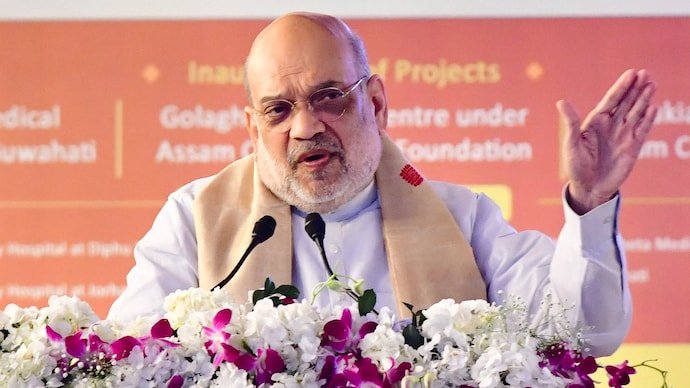
Union Home Minister Amit Shah has intensified the political battle over Vande Mataram, accusing the Congress of insulting the sacrifices of India‘s freedom fighters by maintaining its longstanding position of singing only the first two stanzas of the national song at party programmes.
Shah has linked the Congress’s 1937 decision to limit the rendition of the song to what he described as “appeasement Politics“, arguing that the move had wider political consequences before Independence. The Congress, however, has continued to defend its position, making the dispute about much more than the duration of a patriotic song.
The controversy comes during the year-long national commemoration of the 150th anniversary of Vande Mataram. The Centre has promoted wider public and official renditions of the song, while the Congress Working Committee has reaffirmed that only the first two stanzas will be sung at Congress programmes. :contentReference[oaicite:0]{index=0}
The result is a fresh political confrontation in which history, nationalism, religious sensitivities and competing interpretations of the freedom movement have become intertwined.
What Amit Shah said about Congress and Vande Mataram
Shah has argued that the Congress’s approach to Vande Mataram dates back to 1937 and was shaped by an attempt to accommodate Muslim opinion. He said the song was divided into two parts at that time and claimed the decision contributed to the political circumstances that eventually led to Partition.
“I want to remind the entire country that in 1937, for Muslim appeasement, Vande Mataram was split into two parts,” Shah said, according to the statement provided for the controversy.
He went further by connecting the episode to the development of the two-nation theory and the eventual creation of Pakistan. That is a major historical interpretation and is central to the BJP‘s present political argument: that the Congress’s handling of the song represented a compromise made for political accommodation before Independence.
Shah has also presented the Narendra Modi government’s decision to promote the complete version of Vande Mataram during its 150th-anniversary commemorations as an attempt to correct what the BJP considers a historical wrong.
That framing has made the song a political issue again, rather than leaving it solely within the realm of India’s cultural and freedom-struggle history.
Why the 1937 decision is at the centre of the dispute
The present controversy cannot be understood without looking at why Vande Mataram became contentious during the final decades of British rule.
Written by Bankim Chandra Chattopadhyay, Vande Mataram became one of the best-known symbols of the Indian freedom movement. It was associated with anti-colonial mobilisation and acquired enormous emotional significance for nationalists.
At the same time, not all of its verses were equally acceptable to all political groups. Some later portions of the composition contain religious imagery that became a source of concern for sections of India’s Muslim political leadership. That historical sensitivity is one reason the first two stanzas acquired a special place in public and political use.
The Congress’s current position is therefore rooted in a historical decision rather than a newly adopted stand. Reports on the latest controversy say the Congress Working Committee has reaffirmed the 1937 approach and resolved that only the first two stanzas should be sung at party events. :contentReference[oaicite:1]{index=1}
This distinction matters because the political argument today often treats the issue as though Congress has suddenly rejected Vande Mataram altogether. That is not the same as the party’s stated position. The dispute is principally about which portions of the song should be performed and under what circumstances.
What is the Modi government’s new Vande Mataram approach?
The BJP’s campaign around the song has coincided with a major government-backed commemoration marking 150 years of Vande Mataram.
The Centre began a year-long commemoration in November 2025. Government departments have subsequently organised mass singing programmes, cultural events and other activities around the national song. The Ministry of Defence, for example, highlighted Vande Mataram as a central theme of Republic Day celebrations in 2026. :contentReference[oaicite:2]{index=2}
The government has also moved towards using the complete six-stanza version in official contexts. A Ministry of Home Affairs guideline issued in January 2026 provided a new protocol concerning the national song, including its presentation before the national anthem when both are part of an official event. :contentReference[oaicite:3]{index=3}
All India Radio subsequently announced that it would broadcast the full six-stanza version from March 26, 2026, replacing the two-stanza version traditionally used in its morning broadcasts since Independence. The full rendition has a duration of about three minutes and 10 seconds, compared with approximately 65 seconds for the traditional two-stanza version. :contentReference[oaicite:4]{index=4}
That change gives the current political dispute a practical dimension. The debate is no longer simply about what Congress chooses to sing at its own meetings. The Centre has established a broader official framework around the complete version of the national song.
Why the full version of Vande Mataram is controversial
There is an important distinction between recognising Vande Mataram as a national symbol and agreeing that every verse should be used in every public setting.
The first two stanzas are generally regarded as the portion that became most widely accepted as a national song during the freedom movement. The later verses contain more explicit religious imagery, which historically contributed to objections from some Muslim political leaders.
This historical background helps explain why the Congress adopted its 1937 position. It also explains why the question cannot be reduced entirely to whether someone respects the freedom struggle.
The BJP’s argument is that limiting the song amounted to an unnecessary compromise and disrespected its broader historical significance. Congress’s position, by contrast, has historically treated the first two stanzas as the appropriate version for inclusive public use.
The political disagreement therefore reflects two competing interpretations of national symbolism: one emphasising the complete historical composition and another emphasising the portion that was more broadly accepted in India’s diverse political environment.
Did Congress reject Vande Mataram?
No, that is an important distinction in the current debate.
The Congress has not adopted a position of rejecting Vande Mataram altogether. Its current resolution concerns the rendition of the song at Congress programmes, where the party has reaffirmed the first-two-stanza format associated with its 1937 position. :contentReference[oaicite:5]{index=5}
The BJP, however, has framed that decision as disrespect towards the national song and the people WHO fought for India’s independence. Shah’s criticism is consequently aimed at the political reasoning behind the Congress position, rather than merely the act of singing or not singing the song.
This distinction is likely to remain important as both parties seek to shape public perception of the controversy.
Why Vande Mataram has such a powerful place in India’s history
Vande Mataram’s importance predates the Republic of India by several decades. The song became closely associated with the nationalist movement and was used as a rallying cry during the struggle against British rule.
Its historical importance is also reflected in the government’s decision to dedicate an entire year to its 150th anniversary. The official commemoration began in 2025 and has included mass singing, military band performances, youth programmes and cultural events across the country. :contentReference[oaicite:6]{index=6}
For the BJP, this history strengthens the argument that the complete song deserves greater recognition. For the Congress, the historical compromise around the first two stanzas remains relevant because the freedom movement itself was built around the difficult task of bringing together communities with different religious, cultural and political identities.
That is why the 1937 episode continues to attract political attention almost nine decades later.
Vande Mataram versus Jana Gana Mana: Why India has two major national symbols
Another reason the debate can become confusing is the different constitutional and ceremonial roles of Vande Mataram and Jana Gana Mana.
Vande Mataram is India’s National Song, while Jana Gana Mana is the National Anthem. They are not interchangeable titles or identical constitutional categories.
The Constituent Assembly ultimately adopted Jana Gana Mana as the national anthem while giving Vande Mataram an honoured national status. The distinction reflects the different historical journeys of the two compositions.
That distinction also explains why the government can establish a protocol for the national song without changing the status of the national anthem.
The political timing adds another layer to the controversy
The Vande Mataram dispute has emerged at a time when the BJP and Congress are already engaged in a broader contest over nationalism, historical memory and the political legacy of the freedom movement.
For the BJP, the issue offers an opportunity to portray Congress’s historical choices as examples of what it calls appeasement politics. Shah’s comments connect the 1937 decision to Partition, giving the controversy a much wider historical frame.
For Congress, the issue presents a different challenge. The party must defend a position established during the freedom struggle without appearing dismissive of a song that remains deeply associated with Indian nationalism.
The disagreement is therefore politically useful to both sides, but for different reasons. The BJP can emphasise patriotism and historical correction, while Congress can argue that the history of India’s national movement involved balancing competing social and religious sensitivities.
What happens next in the Vande Mataram row?
The immediate dispute is likely to remain centred on the difference between the government’s official protocol and the Congress’s internal practice.
The Centre has spent much of 2026 expanding public recognition of the complete version as part of the 150th-anniversary commemoration. Government initiatives have included mass performances and the use of Vande Mataram as a prominent theme in national events. :contentReference[oaicite:7]{index=7}
Congress, meanwhile, has reaffirmed its decision to retain the two-stanza version at its party programmes. :contentReference[oaicite:8]{index=8}
The key question is therefore not whether Vande Mataram will remain an important national symbol. Its status is firmly established. The more contentious question is how its complete text should be treated in public life and whether historical objections to some verses should continue to influence ceremonial practice.
That makes the present row bigger than a dispute over a song. It is a disagreement over how India remembers its freedom struggle, how national symbols should be used in a religiously diverse society and how political parties interpret decisions made before Independence.
The larger issue: history, nationalism and political memory
Amit Shah’s attack on Congress shows why Vande Mataram continues to carry political weight nearly 150 years after it was composed.
The BJP sees the complete song as a symbol whose historical importance should not be diluted by what it regards as past political compromises. Congress continues to defend the limited rendition associated with its 1937 position, pointing to the historical context in which that decision was made.
Both positions draw on real parts of India’s political history. The disagreement lies in how those events should be interpreted today.
For readers, the most important distinction is between the historical importance of Vande Mataram, the official status of the national song, the government’s current protocol and Congress’s separate party practice. Keeping those four issues separate makes the current controversy easier to understand.
What began as a debate over how much of a national song should be sung has now become another chapter in India’s larger argument over nationalism and the interpretation of its freedom movement. And with the 150th anniversary celebrations continuing, Vande Mataram is unlikely to disappear from the political spotlight anytime soon.
For breaking news and live news updates, like us on Facebook or follow us on Twitter and Instagram. Read more on Latest India on thefoxdaily.com.






COMMENTS 0