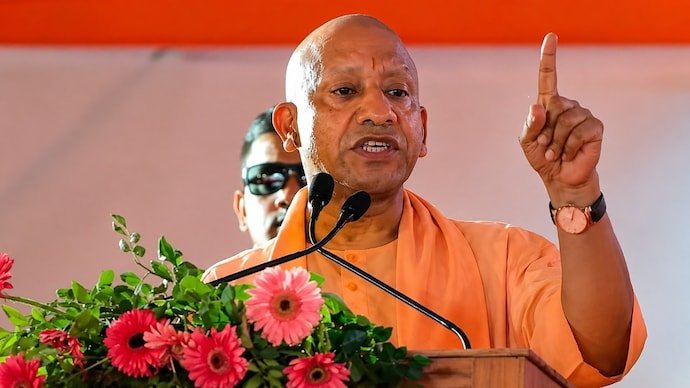
Uttar Pradesh Chief Minister Yogi Adityanath has expressed confidence that the Bharatiya Janata Party will return to power in the state in the 2027 Uttar Pradesh Assembly Election, predicting that the BJP’s “double-engine” government will win with a “grand majority.”
Speaking at the Aaj Tak Panchayat in Mathura, Adityanath presented welfare programmes, employment, investment, tourism and tighter action against examination fraud as key achievements of his government. He argued that these measures have strengthened public support for the BJP and said beneficiaries from several sections of society would back the party again.
The chief minister specifically named young people, women, farmers and Dalits among those he believes have benefited from government schemes. He also linked Uttar Pradesh’s religious and cultural identity to economic activity, pointing to rising tourist and pilgrim numbers in the Braj region and across the state.
His comments come less than a year before the next Assembly election, turning the speech into an early outline of the BJP’s campaign narrative. Adityanath is seeking to present the government’s record as a combination of welfare delivery, infrastructure and investment, law and order, employment and cultural development.
The chief minister also used the Mathura platform to attack the previous Samajwadi Party government, accusing it of failing to understand public sentiment and alleging that recruitment examinations and religious events were handled poorly during its tenure.
Yogi predicts BJP victory with a “grand majority”
Adityanath said the BJP would return to office in Uttar Pradesh with a strong mandate in 2027. He noted that he had made a similar prediction before the 2022 Assembly election and said the beneficiaries of his government’s programmes would once again support the party.
“The beneficiaries of our programmes, be it youth, women, farmers or Dalits, will vote for us in next year’s Vidhan Sabha election,” he said.
The prediction is politically significant because Uttar Pradesh is India‘s most populous state and sends the largest number of members to the Lok Sabha. Control of the state government is therefore important not only for state politics but also for the wider national political landscape.
The BJP won a majority in the 2022 Assembly election and formed the government under Adityanath for a second consecutive term. The 2027 contest will test whether the party can retain that support amid potentially changing voter priorities and competition from opposition parties.
Adityanath’s remarks suggest that the BJP intends to make the performance of its government a central part of its electoral argument rather than relying solely on ideological or cultural issues.
Welfare beneficiaries are central to the BJP’s strategy
One of the strongest themes in Adityanath’s speech was welfare delivery.
The chief minister argued that government programmes have reached multiple social groups and that beneficiaries will form an important base of support for the BJP in the next election.
This strategy reflects the growing importance of welfare delivery in electoral politics. Governments increasingly attempt to convert beneficiaries of housing, food, social-Security, infrastructure and other schemes into a broader political constituency.
For the BJP in Uttar Pradesh, the challenge will be to demonstrate that welfare programmes have translated into sustained improvements in household conditions while also addressing issues such as employment and agricultural income.
Adityanath’s emphasis on young people and women is particularly important. These are large and politically consequential voter groups, and their priorities can extend beyond traditional party loyalties.
The government’s ability to maintain support among these groups could therefore become a major factor in the 2027 contest.
Jobs are another key part of Adityanath’s argument
Employment featured prominently in the chief minister’s assessment of his government’s performance.
Adityanath claimed that his government had provided employment to 9.5 lakh young people through government recruitment. The state has separately said that more than 9.3 lakh youths have received government jobs since 2017 and recently announced plans to provide appointment letters to another one lakh young people over the following six months.
These numbers are likely to feature prominently in the BJP’s campaign because government employment remains a particularly important issue for Uttar Pradesh’s young population.
Adityanath also highlighted private-sector employment linked to investment, positioning industrial expansion as an additional source of jobs.
However, the employment debate is broader than the number of government appointments. Uttar Pradesh has a very large labour force, meaning that the quality, stability and scale of private-sector employment will also matter when voters evaluate economic performance.
The difference between obtaining a government position and finding sustainable employment in the wider economy is therefore likely to remain an important part of the state’s political debate.
Paper leaks become a major election issue
Adityanath also highlighted his government’s action against paper leaks and irregularities in recruitment examinations.
He attacked the previous Samajwadi Party government over allegations of corruption and unfair practices in recruitment and contrasted that with the BJP government’s emphasis on stricter punishment.
The chief minister said laws aimed at combating examination fraud have introduced severe penalties, including imprisonment and property confiscation for those found guilty.
He used the issue to argue that recruitment under his administration has become more transparent and merit-based.
The subject has become especially sensitive because examination leaks can affect large numbers of young job and college applicants. For students who spend years preparing for competitive examinations, the cancellation or compromise of a test can have consequences extending far beyond a single examination cycle.
Adityanath’s focus on the issue indicates that the BJP sees examination integrity as both a governance issue and an electoral issue among young voters.
Tourism and faith are being linked to the UP economy
Another major theme of the speech was tourism, particularly religious tourism.
Adityanath highlighted the Braj region, home to important sites associated with the life and traditions of Lord Krishna, as an example of how religious heritage can support economic activity.
He said approximately 11 crore devotees and tourists visited the Braj region last year. He also claimed that around 156 crore devotees visited Uttar Pradesh during 2025.
The numbers were presented as evidence of the state’s growing tourism potential and the economic importance of religious travel.
Tourism can generate activity across a wide range of sectors, including hotels, transport, restaurants, retail, handicrafts and local services. Large visitor numbers can therefore create opportunities for communities around major religious and cultural destinations.
The government’s challenge is to convert visitor numbers into sustainable economic benefits while ensuring that infrastructure, sanitation, transport and public services are able to handle high seasonal demand.
Adityanath says faith and economic growth can reinforce each other
The chief minister argued that Uttar Pradesh’s religious identity should not be separated from its economic potential.
He described the transformation as an approach in which cultural and religious assets are treated as opportunities for tourism, investment and employment rather than only as matters of faith.
This message is particularly relevant to cities such as Mathura, Ayodhya and Varanasi, where religious tourism has become an increasingly important component of development planning.
The approach also forms part of the BJP’s wider political narrative in Uttar Pradesh: cultural identity and economic development can advance simultaneously.
Critics, however, can be expected to question whether rising tourist numbers automatically translate into broad-based economic gains and whether the benefits are distributed evenly among local communities.
Why Mathura is politically significant
The choice of Mathura as the venue for Adityanath’s remarks added political and cultural significance to the speech.
Mathura and the wider Braj region occupy an important place in Hindu religious tradition and have become major destinations for pilgrims and tourists.
By highlighting tourism in the region, Adityanath connected the BJP’s cultural politics with its development message.
He also contrasted his government’s approach toward religious events with that of previous administrations, accusing the Samajwadi Party government of restricting celebrations and religious processions.
Adityanath specifically alleged that Krishna Janmashtami celebrations at police stations and jails had been prohibited before 2017. He also claimed that the previous government had stopped the Kanwar Yatra.
He said his government not only restored the yatra but allowed traditional and devotional practices, including DJs, bells and conch shells.
Such claims are part of a larger political argument in which Adityanath portrays the period since 2017 as a departure from what he describes as restrictions imposed by earlier governments.
Kanwar Yatra becomes part of the political narrative
Adityanath claimed that around five crore Kanwariyas participated in this year’s Kanwar Yatra and that the pilgrimage passed without an untoward incident.
He also said he had directed officials to ensure that Shri Krishna Janmashtami was celebrated at police stations, jails and other important public places.
The Kanwar Yatra and other religious events have become significant features of Uttar Pradesh’s political discourse. The BJP government has frequently presented arrangements for such events as evidence of improved law and order and a more accommodating approach to religious traditions.
Opposition parties, however, have often raised concerns about the way religious identity is used in political messaging and about whether government policies treat different communities equally.
The competing interpretations are likely to remain part of the 2027 election campaign.
Adityanath targets the Samajwadi Party
The chief minister used the event to sharply criticise the previous Samajwadi Party government.
He accused the former administration of failing to understand public sentiment and alleged that it had prioritised political considerations over Indian cultural heritage.
He also criticised the previous government’s record on recruitment examinations, alleging that unfair means and examination irregularities had become widespread.
Such attacks are central to the BJP’s attempt to frame the 2027 election as a choice between the governance record of the current administration and that of the earlier SP government.
The Samajwadi Party and other opposition groups are likely to challenge that narrative by focusing on issues such as unemployment, Inflation, social welfare, law and order and the experience of different communities under the current government.
As the election approaches, both sides are expected to intensify efforts to define what has changed in Uttar Pradesh since 2017.
Investment is another pillar of the BJP’s pitch
Adityanath also presented Uttar Pradesh as an increasingly investment-friendly state.
He said investors following the state’s policies are eligible for incentives and highlighted what he described as online systems for investment, skilling and employment.
The state government has pursued sector-specific policies intended to attract investment in industries ranging from manufacturing and electronics to defence, renewable energy, food processing and technology.
Investment is strategically important because the state’s large population creates an equally large need for jobs and productive economic opportunities.
However, attracting investment commitments is only one part of the process. The longer-term test is whether announced projects become operational, generate employment and create supply chains involving local businesses.
That distinction is likely to matter increasingly as voters assess the government’s economic record ahead of the 2027 election.
Can welfare and development translate into votes?
Adityanath’s speech rests on a straightforward political proposition: that people who have directly benefited from government programmes will reward the BJP at the ballot box.
That proposition is plausible but not automatic.
Voters evaluate governments on multiple factors, including household finances, employment, public services, infrastructure, law and order, caste and community dynamics, local candidates and national political trends.
Even beneficiaries of government programmes may support different parties depending on their wider political preferences.
This means the BJP will need to turn its claims about welfare, tourism and jobs into a broader argument that resonates across Uttar Pradesh’s highly diverse electorate.
The opposition, meanwhile, will seek to challenge the government’s performance figures and highlight areas where voters may feel the benefits have not been sufficient.
The 2027 election is already taking shape
Although the Assembly election is still ahead, the political contest has already begun to take shape.
Adityanath’s prediction of a “grand majority” provides an early indication of the BJP’s confidence. It also sets a high benchmark for the party: a narrow victory would not necessarily match the scale of the mandate now being predicted by the chief minister.
The BJP will enter the election with the advantage of incumbency and an established organisational network, but it will also face the normal challenges associated with seeking a third consecutive term in government.
The opposition will attempt to consolidate anti-incumbency sentiment and use economic, employment and social issues to challenge the BJP’s narrative.
The eventual contest will therefore depend on whether the BJP can maintain its coalition of voters while persuading younger and economically aspirational sections that its development agenda is delivering tangible benefits.
What voters will judge before 2027
Several issues are likely to shape the final electoral verdict in Uttar Pradesh.
Employment will remain one of the biggest. The government will need to demonstrate not only how many government jobs have been filled but also whether private investment is creating durable opportunities.
Infrastructure and investment will be another factor. Roads, expressways, airports, industrial projects and urban development can become visible symbols of economic change, but their impact will be judged by how effectively they improve daily life.
Religious tourism and cultural projects will remain prominent, particularly in cities such as Mathura, Ayodhya and Varanasi.
Law and order will also continue to be central to the BJP’s campaign. Adityanath has built much of his political identity around his government’s approach to crime and public security.
Finally, welfare delivery will remain critical, particularly among poorer households and rural voters.
Yogi’s confidence sets the tone for the BJP’s 2027 campaign
Adityanath’s Mathura speech offered an early blueprint for how the BJP could approach the next Uttar Pradesh election.
His message combines welfare, employment, investment, religious tourism, cultural identity and strict action against recruitment fraud. He argues that these policies have transformed the state and created a political constituency that will support the BJP again.
He also continues to frame the previous Samajwadi Party government as the contrasting model, accusing it of failing on recruitment, religious events and governance.
Whether those arguments produce another BJP victory with the “grand majority” Adityanath predicts will ultimately depend on voters across Uttar Pradesh.
For now, the chief minister has made his position clear well ahead of polling: he expects the BJP’s double-engine government to return to power in 2027 and believes beneficiaries of its welfare and development programmes will provide the electoral foundation for that victory.
The coming months will determine whether that confidence translates into a broader campaign advantage. The most important test will be whether voters agree that Uttar Pradesh’s gains in employment, investment, tourism, welfare and governance have been substantial enough to justify another BJP mandate.
For breaking news and live news updates, like us on Facebook or follow us on Twitter and Instagram. Read more on Latest India on thefoxdaily.com.






COMMENTS 0