
India‘s ambitious ethanol-blending programme is among the world’s largest efforts to reduce dependence on imported crude oil and lower carbon emissions. While the Policy has gained momentum domestically, Bhutan—whose petroleum products are entirely imported from India—has chosen to continue purchasing conventional petrol instead of E20 fuel.
The move is not a rejection of cleaner fuels or India itself. Rather, it reflects Bhutan’s assessment that its current storage infrastructure, climate, and terrain are not yet suitable for handling ethanol-blended petrol safely and efficiently. The decision has also reignited discussions in India about whether fuel transitions should be tailored to regional conditions rather than implemented through a one-size-fits-all approach.
What Is E20 Petrol?
E20 petrol is a blend consisting of:
- 20% ethanol (an alcohol produced from agricultural feedstocks such as sugarcane, maize, and grains)
- 80% conventional petrol
The blend is part of India’s broader strategy to diversify energy sources, reduce greenhouse gas emissions, cut oil import bills, and create additional markets for agricultural produce.
Ethanol is considered a renewable fuel because it is produced from biomass rather than fossil fuels.
Why India Is Promoting Ethanol Blending
India is one of the world’s largest importers of crude oil, making Energy Security a major national priority. Increasing Ethanol Blending offers several potential advantages.
- Reduces dependence on imported crude oil.
- Supports domestic farmers through additional demand for ethanol feedstocks.
- Helps lower tailpipe carbon emissions.
- Improves energy diversification.
- Strengthens long-term fuel security.
The ethanol blending programme forms part of India’s wider clean-energy and sustainable mobility strategy.
Why Bhutan Declined the E20 Fuel Offer
Bhutan’s decision is based primarily on practical infrastructure concerns rather than opposition to ethanol as a fuel.
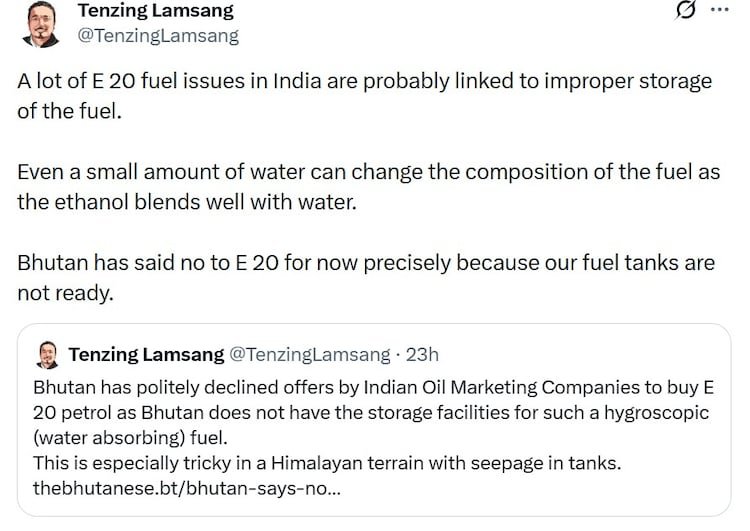
According to reports, Bhutan requested Indian oil suppliers to continue supplying conventional petrol while it remains available because several challenges remain unresolved.
1. Ageing Underground Fuel Storage Tanks
The country’s fuel storage facilities include older underground tanks that are more susceptible to water seepage.
Unlike conventional petrol, ethanol readily absorbs moisture from the surrounding environment. This characteristic makes storage conditions significantly more important.
If water enters storage tanks containing E20 fuel, the fuel quality may deteriorate more quickly than standard petrol.
2. Ethanol’s Hygroscopic Nature
The science behind Bhutan’s concern is relatively straightforward.
Ethanol molecules contain a hydroxyl (-OH) group, making them hygroscopic, meaning they naturally attract and absorb moisture from the air.
This can lead to:
- Water contamination.
- Reduced fuel quality.
- Potential phase separation under certain conditions.
- Corrosion of storage infrastructure.
- Possible long-term maintenance issues if fuel handling standards are inadequate.
Conventional petrol does not absorb water to the same extent.
3. Bhutan’s Humid Mountain Climate
Geography also plays an important role.
Many of Bhutan’s fuel depots are located in mountainous regions where:
- Humidity levels remain relatively high.
- Temperature variations encourage condensation.
- Fuel storage requires greater moisture protection.
These environmental conditions increase the importance of modern sealed storage systems when handling ethanol-blended fuels.
4. Challenging Mountain Roads
Bhutan’s road network differs considerably from that of many other countries.
Its steep gradients, winding mountain roads, and high-altitude driving conditions place greater demands on vehicles.
Authorities are concerned that any variation in fuel quality or engine performance could have greater operational consequences than in flatter regions.
How Water Affects Ethanol-Blended Fuel
One of the key technical concerns involves moisture contamination.
If excessive water enters ethanol-blended petrol:
- The fuel mixture may become unstable.
- Storage tanks may experience increased corrosion.
- Pipelines and dispensing equipment may deteriorate more quickly.
- Fuel quality can decline.
- Vehicle performance may be affected if contaminated fuel is used.
Maintaining proper storage infrastructure is therefore an essential component of successful ethanol fuel adoption.
Comparison: Conventional Petrol vs. E20 Petrol
| Feature | Conventional Petrol | E20 Petrol |
|---|---|---|
| Ethanol Content | Minimal or none | 20% |
| Moisture Absorption | Very low | Higher due to ethanol |
| Storage Requirements | Less demanding | Requires better moisture control |
| Renewable Component | Limited | Higher |
| Infrastructure Sensitivity | Lower | Higher |
Why Infrastructure Matters as Much as Fuel
Bhutan’s decision highlights an often-overlooked aspect of energy transitions: introducing a new fuel involves much more than changing what goes into a vehicle.
Successful implementation also requires:
- Modern storage tanks.
- Compatible fuel pipelines.
- Reliable distribution systems.
- Vehicle compatibility.
- Quality-control procedures.
- Training for fuel handling.
Without these supporting systems, even technically sound fuels may encounter practical implementation challenges.
India’s Ongoing Debate Over E20 Fuel
The rollout of E20 petrol has generated significant public discussion across India.
Some motorists have reported concerns relating to:
- Fuel economy.
- Older vehicle compatibility.
- Long-term maintenance.
- Availability of fuel choices.
The government has maintained that the transition is supported by technical studies, phased implementation, and increasing availability of E20-compatible vehicles. It has also stated that while fuel economy may vary slightly in some situations, the overall benefits include improved energy security and reduced dependence on imported fossil fuels.
International Perspective: Different Countries, Different Fuel Strategies
Countries around the world adopt ethanol blends according to their own infrastructure, climate, vehicle fleet, and policy priorities.
Some nations primarily use lower blends such as E5 or E10, while others have introduced higher blends in compatible vehicles. The pace of adoption often depends on factors such as fuel distribution systems, consumer readiness, and domestic ethanol production capacity.
Bhutan’s decision illustrates that successful fuel policy is not solely about environmental objectives—it also requires local operational readiness.
Expert Insight: Energy Transitions Require Systems Thinking
Energy experts frequently emphasize that fuel transitions should be viewed as ecosystem transformations rather than isolated policy changes. Vehicles, fuel stations, storage facilities, regulations, maintenance practices, and consumer Awareness all need to evolve together.
Bhutan’s cautious approach reflects this systems perspective by prioritizing infrastructure readiness before adopting a different fuel blend.
What Bhutan’s Decision Means for India
Bhutan’s position is unlikely to alter India’s long-term ethanol strategy, but it does offer valuable feedback for policymakers.
It reinforces the importance of:
- Infrastructure modernization.
- Regional flexibility.
- Fuel quality assurance.
- Consumer education.
- International coordination when exporting blended fuels.
As India continues advancing toward higher ethanol blends in the future, addressing these implementation challenges will remain essential.
Future Outlook
India is expected to continue expanding its ethanol blending programme as part of its broader clean-energy roadmap. However, future success will depend not only on increasing ethanol production but also on ensuring that fuel infrastructure, vehicle Technology, and distribution systems evolve in parallel.
For neighbouring countries like Bhutan, adoption timelines may remain different until storage facilities, transport systems, and operational conditions become fully compatible with higher ethanol blends. This underscores the reality that energy transitions often progress at different speeds based on local needs rather than universal timelines.
Conclusion
Bhutan’s decision to continue importing conventional petrol is rooted in practical engineering and infrastructure considerations rather than opposition to cleaner fuels. Concerns over ageing storage tanks, moisture contamination, mountainous terrain, and fuel handling have led the country to adopt a cautious approach while requesting continued access to conventional petrol.
More broadly, the episode highlights an important lesson for governments worldwide: successful energy transitions require more than ambitious policy goals. They demand coordinated Investment in infrastructure, technology, quality control, and regional adaptability. As India continues building one of the world’s largest biofuel programmes, Bhutan’s experience serves as a reminder that the path to cleaner energy is as much about preparedness as it is about innovation.
For breaking news and live news updates, like us on Facebook or follow us on Twitter and Instagram. Read more on Latest World on thefoxdaily.com.






COMMENTS 0