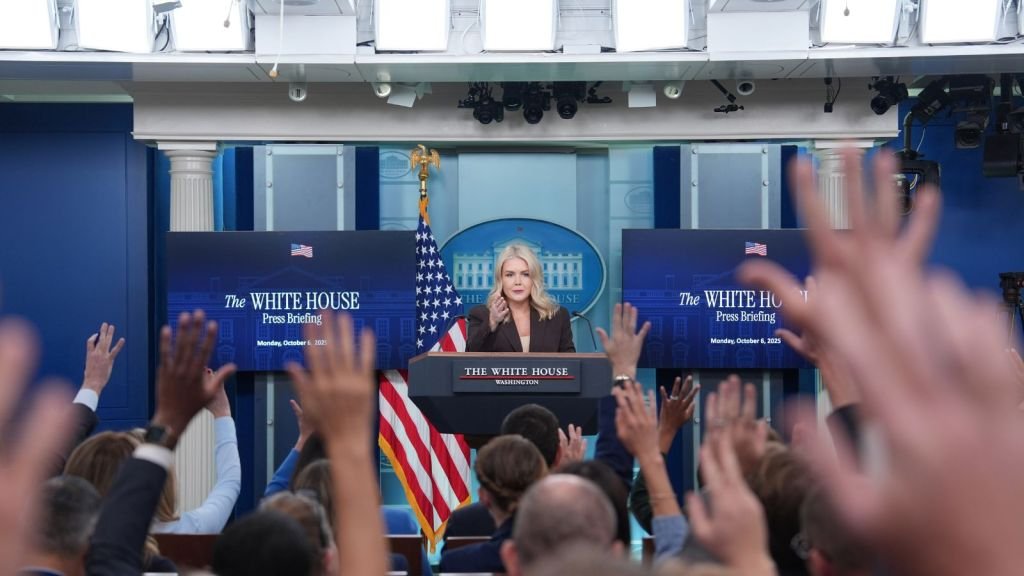
White House Press Secretary Karoline Leavitt is leaving one of the most visible communications positions in Donald Trump’s administration, with the president announcing that she will step down at the end of August to spend more time with her young family.
Leavitt’s departure comes after roughly a year and a half as the public face of the White House press operation. Trump said she would continue working with him as an outside adviser and described her as a trusted aide and a strong leader.
Although Leavitt was not the administration’s policymaker on India, her position put her at the centre of Washington’s public messaging on several issues important to New Delhi. She repeatedly addressed US tariffs on Indian goods, India’s purchases of Russian oil and the evolving trade relationship between the two countries.
She also became a prominent White House messenger during the India-Pakistan military confrontation in May 2025, when the Trump administration pushed publicly for de-escalation and later highlighted the president’s role in encouraging both sides to halt hostilities.
Her exit therefore matters beyond a change in personnel. It will remove a familiar voice from White House briefings at a time when US-India Relations remain closely tied to trade, energy, defence and regional security.
Why Karoline Leavitt is leaving the White House
Trump announced Leavitt’s departure on August 12, saying she wanted to devote more time to her children and family.
Leavitt recently returned to the White House after maternity leave following the birth of her daughter Viviana in May. She has two young children with her husband, Nicholas Riccio.
Trump said he understood and respected her decision. Rather than portraying the departure as a complete break, he indicated that Leavitt would remain politically active and become one of his outside advisers.
That distinction is important. Leaving the press secretary position does not necessarily mean that Leavitt is leaving Trump’s political orbit.
As an outside adviser, she could continue to have a political and communications role without carrying the daily responsibility of standing behind the White House podium.
Leavitt became the youngest White House press secretary
Leavitt joined Trump’s second administration in January 2025 and became the youngest person to serve as White House press secretary.
Her rise was unusually rapid. She had already become a prominent Republican communications figure during Trump’s 2024 presidential campaign before moving into the West Wing.
The press secretary job is more than a podium position. The person holding it has to explain administration policy, defend presidential decisions, respond to hostile questions, communicate during international crises and ensure that the White House’s preferred interpretation of events reaches the public.
Leavitt developed a particularly combative style during briefings, frequently challenging reporters and defending Trump’s policies. At the same time, the administration changed how it approached White House media access, including giving greater visibility to newer and digital media outlets.
That made Leavitt one of the administration’s most recognizable communicators, particularly among Trump’s supporters.
Why Leavitt mattered to India-US relations
India-US relations are managed through diplomatic, economic, defence and foreign-policy channels rather than by the White House press secretary. Leavitt was therefore not the official architect of Washington’s India policy.
Her importance was different: she was one of the administration’s most visible public messengers.
During Trump’s second term, India-US relations became closely linked with the president’s tariff agenda and Washington’s concerns about India’s continued purchases of Russian oil.
Leavitt regularly explained the administration’s position to American journalists and international audiences. Her statements were consequently watched closely in India because they offered an indication of how the White House was presenting the relationship.
One of the most important moments came in February 2026, when the United States and India announced a trade framework involving an 18 percent US reciprocal tariff rate on Indian goods and a broader effort to expand bilateral trade.
The framework also included India’s intention to purchase $500 billion of US energy products, aircraft and aircraft parts, precious metals, technology products and coking coal over five years.
Leavitt publicly presented the agreement as a major achievement for the Trump administration.
India-US trade became a major part of her White House messaging
Leavitt repeatedly highlighted the administration’s demands from India during the tariff negotiations.
One of the most politically sensitive issues was Russian oil.
India had continued purchasing Russian crude after Russia’s invasion of Ukraine, while Washington under Trump sought to use tariffs and other economic pressure to encourage countries to reduce their reliance on Russian energy.
Leavitt said in February that India had committed to stop purchasing Russian oil and increase purchases of US oil as part of the trade arrangement.
The White House subsequently described the broader agreement as an important step in strengthening economic ties between the two countries.
For India, however, the issue was never simply about tariffs.
Energy Security is central to the Indian economy, and Russian crude had become an important source of imported oil. Any US demand affecting that trade therefore carried consequences beyond the bilateral tariff relationship.
That is why Leavitt’s comments on Russian oil attracted attention in India even though the underlying policy negotiations involved senior officials and institutions across both governments.
The US later allowed limited Russian oil imports from India
The administration’s position also evolved as circumstances changed.
After the United States and Israel launched military attacks on Iran and tensions surrounding the Strait of Hormuz intensified, Leavitt said in March 2026 that the Trump administration had temporarily permitted India to resume limited Russian oil imports.
She described India as having been a good actor in the circumstances.
The episode demonstrated how quickly energy policy can change when geopolitical conditions shift.
For India, the issue illustrated the difficulty of balancing relations with Washington against domestic energy requirements and established trade relationships. For the United States, it showed that the administration’s pressure on Russian energy could be adjusted when broader strategic interests demanded flexibility.
Leavitt was one of the officials responsible for explaining those shifts publicly.
Leavitt’s role during the India-Pakistan conflict
Leavitt’s second major connection to India came through the India-Pakistan military confrontation of May 2025.
The crisis followed the April 22 terror attack near Pahalgam in Jammu and Kashmir, in which 26 people were killed. India subsequently launched Operation Sindoor, targeting terror infrastructure in Pakistan and Pakistan-administered Kashmir.
The military confrontation rapidly became a major international security concern because India and Pakistan are both nuclear-armed states.
During the early stages of the crisis, Leavitt’s messaging was cautious. She emphasized that Trump wanted the conflict to de-escalate quickly and said the United States was in active contact with both New Delhi and Islamabad.
Secretary of State Marco Rubio was also deeply involved in the US diplomatic effort.
The White House therefore presented itself as actively engaged with both sides while avoiding an early claim that Washington had imposed a settlement.
What Leavitt said after Operation Sindoor
After Indian military action under Operation Sindoor and several days of fighting, India and Pakistan agreed to halt military operations.
Trump subsequently emphasized his administration’s role, including saying that trade could be used as an incentive for the two countries to stop fighting.
Leavitt became one of the White House officials communicating that version of events during press briefings.
That created a diplomatic messaging gap with India.
New Delhi rejected the suggestion that a third country had mediated the ceasefire. Indian officials said the understanding to halt military action resulted from direct communication between the Indian and Pakistani Director Generals of Military Operations.
The distinction was significant.
For Washington, emphasizing US engagement reinforced Trump’s broader claim that his administration could use Diplomacy and economic leverage to prevent conflicts from escalating.
For India, accepting a formal mediation narrative would have conflicted with its long-standing position that India-Pakistan disputes should be handled bilaterally and that third-party mediation is not acceptable.
Leavitt was therefore not merely reporting an international event. She was communicating the Trump administration’s interpretation of America’s role in it.
Why the ceasefire messaging mattered to India
The dispute over who helped bring about the ceasefire was more than a disagreement over wording.
India’s position was that the two militaries communicated directly and reached an understanding to stop fighting. The United States, meanwhile, highlighted Trump’s diplomatic pressure and engagement with both countries.
Those two narratives can coexist to some extent: American diplomatic pressure can encourage de-escalation without Washington formally mediating an agreement.
But the distinction matters because India has historically resisted outside involvement in India-Pakistan disputes.
Leavitt’s role was to defend and explain the White House position, making her a prominent figure in an episode that was being closely followed in New Delhi.
Leavitt was a messenger, not the architect of India policy
It is important not to overstate Leavitt’s role in US-India relations.
She did not negotiate India’s tariff arrangements, determine US energy policy or conduct the military diplomacy between India and Pakistan. Those responsibilities belonged to the president, cabinet officials, diplomats and other government agencies.
Her influence came from communication.
As press secretary, she could frame how the White House wanted the public to understand a policy, explain Trump’s position and respond to criticism in real time.
That made her particularly important during moments when Washington and New Delhi interpreted the same event differently.
For Indian audiences, her briefings often provided an early indication of the administration’s public position on trade, tariffs, Russian oil and regional security.
What her departure could mean for Trump’s India messaging
The immediate impact of Leavitt’s departure will depend largely on whom Trump chooses as her successor and how that person handles India-related issues.
The press secretary is one of the most visible White House officials, but the substance of US-India policy will continue to be shaped by the president and the administration’s foreign-policy, trade and economic teams.
The biggest change may therefore be in presentation rather than policy.
A new press secretary could adopt a different tone on tariffs, energy purchases, trade negotiations or South Asian security. Even when the underlying policy remains unchanged, differences in language can affect how governments and markets interpret Washington’s intentions.
For India, that will be worth watching as the two countries continue working through their trade relationship and wider strategic partnership.
Leavitt’s future role could keep her close to Trump
Trump’s decision to keep Leavitt as an outside adviser means her political career is unlikely to end with her departure from the podium.
Her continued relationship with Trump could allow her to remain involved in Republican politics and the administration’s broader political messaging.
That could become especially relevant as the United States approaches the 2026 midterm elections.
Trump has already described Leavitt as someone he trusts and as a future outside adviser. Her experience inside the West Wing gives her an understanding of the administration’s communication strategy that few younger Republican figures possess.
She could therefore remain an influential voice even without the official title of press secretary.
A significant change for the White House communications team
Leavitt’s departure closes one of the more distinctive chapters of Trump’s second administration.
She entered the White House as the youngest person ever to hold the press secretary job and became a central defender of Trump’s policies during a period marked by trade disputes, military crises and major shifts in US foreign policy.
For India, her legacy is particularly visible in three areas: the administration’s messaging on tariffs and trade, Washington’s pressure over Russian oil purchases and the White House narrative surrounding the India-Pakistan conflict and Operation Sindoor.
Her replacement will inherit all three issues.
The next press secretary will have to explain an increasingly complicated US-India relationship in which economic cooperation and strategic partnership coexist with disagreements over trade, energy and foreign policy.
For New Delhi, the important question will not simply be who replaces Leavitt at the White House podium. It will be whether the administration’s broader approach to India changes with the new voice representing it.
What happens next
Leavitt is expected to leave the press secretary position at the end of August 2026. Trump has indicated that she will remain connected to his political operation as an outside adviser.
The White House will then face the task of selecting a successor who can manage daily briefings while communicating an administration dealing with several sensitive international relationships.
For India, the transition comes at a consequential moment. The two countries are working through a major trade framework, energy questions involving Russian oil remain sensitive, and the strategic relationship continues to intersect with developments across South Asia.
Leavitt’s departure is therefore unlikely to fundamentally alter India-US policy on its own. But it will change one of the most recognizable voices explaining that policy to the world.
Her time as press secretary showed how influential public messaging can become in International Relations. On India, she was not the person making the decisions, but she was often among the people explaining those decisions when the stakes were highest.
That communication role will now pass to someone else, while Leavitt moves from the White House podium to an advisory position that could keep her close to Trump and Republican politics.
For breaking news and live news updates, like us on Facebook or follow us on Twitter and Instagram. Read more on Latest World on thefoxdaily.com.




COMMENTS 0