The most consequential question in any India–Pakistan crisis is not simply how many Nuclear Weapons either country possesses. It is what happens if a conventional conflict reaches a point where one side believes its survival is at risk.
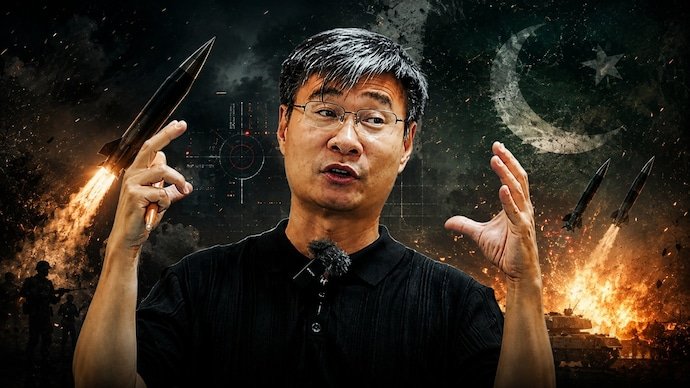
That question has returned to the spotlight after Chinese-born geopolitical commentator Jiang Xueqin argued that, if nuclear weapons were ever used in a future conflict, Pakistan could be the country most likely to use one first.
Jiang made the prediction during an appearance on YouTuber Raj Shamani’s podcast, where he was asked to assess the possibility of nuclear weapons being used in a future conflict. His answer was striking, but his wider argument was more cautious than the headline prediction suggests.
Jiang explicitly said he did not believe nuclear weapons would be used during his lifetime, pointing to what he described as a universal taboo surrounding their use. Only after making that qualification did he identify India and Pakistan as the pair most likely to become involved in a nuclear first-use scenario, with Pakistan his preferred answer.
His reasoning is built around a basic feature of South Asian nuclear strategy: India has a declared No First Use posture, while Pakistan has deliberately retained the option of using nuclear weapons first under certain circumstances.
That does not mean Pakistan is preparing to launch a nuclear weapon, nor does it mean a nuclear conflict is considered inevitable. It means the structure of deterrence between the two countries creates a particular escalation risk that analysts have studied for decades.
What exactly is Jiang predicting?
Jiang’s prediction should first be understood as a hypothetical judgment rather than an intelligence assessment or official forecast.
He did not say that Pakistan is planning a nuclear strike against India. Nor did he say that a nuclear war is likely in the near future. His argument was about which country might be more likely to cross the nuclear threshold if an extreme India-Pakistan conflict ever developed.
In the podcast discussion, Jiang described Pakistan as vulnerable and argued that its nuclear weapons serve a fundamentally different strategic purpose from India’s larger conventional military capability.
His central calculation was that India may be able to pursue conventional military options without immediately resorting to nuclear weapons, whereas Pakistan’s strategy has historically relied on nuclear weapons to deter a much larger conventional military adversary.
That is the logic behind his conclusion that Pakistan could face greater pressure to use nuclear weapons first.
But there is an important distinction between having a first-use option and actually deciding to use nuclear weapons. Pakistan’s nuclear posture is intended primarily to deter threats and prevent a catastrophic conventional defeat. A first-use doctrine is therefore better understood as a threat designed to influence an adversary’s calculations than as a declaration that nuclear weapons will automatically be used during a crisis.
Why India and Pakistan are different from most nuclear rivals
The India-Pakistan nuclear relationship is unusual because the two countries have repeatedly experienced military crises while sharing a relatively short and contested border.
Both countries conducted nuclear tests in 1998 and have subsequently developed nuclear-capable delivery systems. Their arsenals are designed primarily around deterrence, but their doctrines are not identical.
India has publicly maintained a No First Use policy, meaning it has declared that it will not be the first to use nuclear weapons. India’s stated doctrine has, however, included qualifications concerning a nuclear, chemical or biological attack.
Pakistan has not adopted a comparable No First Use pledge. Instead, its nuclear strategy has deliberately preserved ambiguity about the circumstances under which nuclear weapons might be employed.
This difference is central to Jiang’s argument.
If India maintains a conventional military advantage but is constrained by its declared nuclear posture, Pakistan can potentially use the threat of nuclear escalation to deter large-scale conventional action. The nuclear arsenal therefore acts as an equaliser of sorts.
Pakistan’s strategy has long been discussed in terms of full-spectrum deterrence, with nuclear capabilities intended to deter different levels of military pressure from India.
Why Pakistan keeps the first-use option open
Pakistan’s decision not to adopt No First Use has a straightforward strategic explanation: its conventional military strength is smaller than India’s in several important respects.
If Pakistan promised never to use nuclear weapons first, it could theoretically leave itself more vulnerable to a major conventional offensive. By maintaining ambiguity, Islamabad seeks to create uncertainty over where the nuclear threshold lies.
The logic is that India should have to consider the possibility of nuclear escalation before launching or sustaining a major conventional operation.
This strategy is not unique to Pakistan’s history of strategic thinking. Nuclear-armed states have often used uncertainty about escalation to strengthen deterrence. The danger, however, is that ambiguity can also create miscalculation.
During a severe crisis, political leaders and military commanders may disagree about whether an adversary is approaching a threshold that requires nuclear signalling or action. A doctrine designed to prevent war can therefore become dangerous if both sides misunderstand each other’s intentions.
India’s No First Use policy changes the calculation
India’s declared No First Use posture is an important reason why analysts often describe the nuclear balance between the two countries as asymmetric.
India has stated that nuclear weapons are intended primarily for deterrence and that it will not initiate nuclear use. This does not mean India has renounced nuclear retaliation. Its doctrine is based on maintaining a credible retaliatory capability.
That distinction is crucial.
A No First Use policy does not mean that a country would remain passive after suffering a nuclear attack. Instead, it establishes a declared threshold for initiating nuclear use.
Pakistan’s posture is different because it leaves open the possibility of first use under circumstances that Islamabad considers sufficiently threatening.
Jiang’s prediction therefore rests less on the size of the two countries’ arsenals than on the different conditions under which their doctrines contemplate nuclear employment.
How large are India’s and Pakistan’s nuclear arsenals?
The numerical balance is closer than the conventional military balance, although estimates vary because neither country provides complete public information about its arsenal.
The Stockholm International Peace Research Institute’s 2026 assessment estimates that India had approximately 190 nuclear warheads and Pakistan approximately 170 as of January 2026. SIPRI also notes that nuclear stockpile estimates contain uncertainty because of limited transparency.
The numbers matter less than the basic strategic reality: both countries possess enough nuclear capability to inflict catastrophic damage on the other.
That means the difference between 190 and 170 warheads does not provide a meaningful measure of WHO would “win” a nuclear exchange. There is no conventional sense in which nuclear war between India and Pakistan could produce a normal military victory.
The purpose of the arsenals is deterrence. Their value comes largely from the threat of unacceptable retaliation rather than from battlefield utility.
The real danger is the escalation ladder
The most serious risk identified by Jiang’s argument is not that Pakistan would suddenly decide to launch a nuclear weapon during peacetime.
The danger lies in escalation.
Imagine a conventional conflict beginning after a major terrorist attack or another serious security incident. India could respond with conventional military action. Pakistan could attempt to deter further escalation by moving nuclear-capable forces, issuing warnings or altering its nuclear signalling.
India could interpret those moves as coercion rather than preparation for actual nuclear use. Pakistan, meanwhile, could interpret continued Indian military action as evidence that its deterrent is failing.
Each side could then take additional steps to strengthen its position.
That is how a crisis can become more dangerous without either government initially wanting nuclear war.
The problem is sometimes described as the stability-instability paradox: nuclear weapons may discourage full-scale war because the consequences are catastrophic, while the perceived protection provided by nuclear deterrence can encourage lower-level military confrontations below the nuclear threshold.
Pakistan’s nuclear rhetoric has repeatedly shaped crises
Pakistan’s leaders and military officials have repeatedly referred to nuclear weapons as part of the country’s survival strategy.
After the 1999 Kargil conflict and during subsequent India-Pakistan crises, Pakistani officials repeatedly emphasised that nuclear weapons were intended to prevent India from exploiting its conventional military superiority.
The pattern became especially visible during the 2019 crisis following the Pulwama terrorist attack and India’s Balakot air strikes. Pakistani Prime Minister Imran Khan warned that continued escalation between two nuclear-armed states could have catastrophic consequences.
Such statements can serve two purposes simultaneously. They can warn the international community about the consequences of escalation while also reminding India that military action carries nuclear risks.
In May 2025, during the India-Pakistan military confrontation that followed the Pahalgam terrorist attack, Pakistani officials again referred to nuclear weapons in the context of an existential threat.
Pakistan’s Defence Minister Khawaja Asif said nuclear weapons could be used if the country faced a direct threat to its existence, although he subsequently described nuclear use as a distant possibility rather than an immediate option. Other Pakistani officials stressed that Islamabad had no intention of deploying nuclear weapons.
These statements illustrate the difference between nuclear signalling and actual nuclear preparation. Governments can invoke nuclear deterrence precisely to prevent a situation from reaching the point where nuclear weapons would actually be used.
Why Asim Munir’s 2025 remarks drew attention
Jiang’s prediction also gains context from remarks reportedly made by Pakistan’s army chief, Field Marshal Asim Munir, at a private dinner in Tampa, Florida, in August 2025.
According to reporting by ThePrint, Munir told attendees that Pakistan was a nuclear nation and that if the country believed it was going down, it would “take half the world down with us.” The remarks were subsequently reported by several Indian Media organisations and described as nuclear sabre-rattling.
The reported comments were controversial, although the circumstances and precise wording have been disputed in some accounts. They nevertheless demonstrated how nuclear rhetoric can become part of political and military signalling during periods of tension.
For analysts studying Pakistan’s nuclear posture, such statements are relevant because they reinforce the country’s long-standing emphasis on nuclear weapons as an ultimate deterrent against existential threats.
But does Pakistan’s doctrine make first use inevitable?
No.
This is where Jiang’s argument needs to be treated carefully.
Pakistan’s retention of a first-use option does not mean its leadership would automatically choose nuclear weapons if conventional forces were under pressure. Nuclear use would carry extraordinary consequences for Pakistan itself, including the possibility of devastating retaliation.
Pakistan also has an established nuclear command-and-control structure. Arms-control analysts have generally described the country’s nuclear posture as designed around deterrence rather than an intention to launch an unprovoked nuclear attack.
The strategic purpose of maintaining ambiguity is precisely to make an adversary uncertain about the consequences of crossing certain thresholds.
In other words, the existence of a first-use doctrine can be intended to prevent the circumstances that would require first use.
Why calling Pakistan “weak” is an incomplete explanation
Jiang’s description of Pakistan as weak, poor, corrupt and divided is one of the more controversial parts of his reasoning.
Economic or political difficulties do not automatically translate into weak nuclear command and control. A state can have serious domestic challenges while maintaining sophisticated military institutions and strict procedures for controlling nuclear weapons.
Pakistan possesses a large military establishment, a developed missile programme and a dedicated strategic command structure. Its nuclear forces are not simply weapons sitting outside an organised security system.
That means the strongest version of Jiang’s argument is not that Pakistan is inherently too unstable to control nuclear weapons. A more defensible interpretation is that greater strategic vulnerability can increase the pressure to rely on nuclear deterrence.
That is a very different proposition.
Jiang himself is not a nuclear strategist
Another important point is Jiang’s professional background.
He is widely known online as “Professor Jiang”, but in a 2026 interview with journalist Mehdi Hasan, Jiang acknowledged that he is not actually a professor. He described the title as something associated with his online identity and said he had worked as a teacher.
His geopolitical commentary uses concepts including game theory, historical patterns and systems thinking to make predictions about future events. That can provide an interesting framework for discussing International Relations, but it should not be confused with a formal nuclear-risk assessment produced by a government, military institution or specialist arms-control organisation.
His prediction is therefore best understood as commentary and scenario analysis, not as evidence that Pakistan intends to use nuclear weapons first.
The most important factor is not who fires first
The more useful question raised by Jiang’s prediction is why a nuclear crisis could emerge in South Asia despite both countries understanding the catastrophic consequences.
India and Pakistan have already experienced several military confrontations since becoming nuclear powers. The fact that those crises did not cross the nuclear threshold is important evidence that deterrence and crisis-management mechanisms can work.
At the same time, every crisis carries its own circumstances.
A terrorist attack causing mass casualties, a major conventional strike, a misidentified military movement or a political leadership crisis could create pressure for rapid decisions. The shorter the decision-making time, the greater the risk that leaders act on incomplete information.
This is why nuclear stability depends not only on the number of warheads but also on communication channels, command-and-control systems, political restraint and the ability of both sides to understand the other’s red lines.
What could make a future crisis more dangerous?
Several factors could increase nuclear risk without making nuclear war inevitable.
- A major terrorist attack: A mass-casualty attack could generate intense domestic pressure for military retaliation.
- Rapid conventional escalation: Large-scale strikes could create pressure on Pakistan to demonstrate that its nuclear deterrent remains credible.
- Ambiguous nuclear signalling: Statements or military movements could be interpreted differently by the two sides.
- Short decision times: The faster a crisis develops, the less opportunity leaders have to verify information and communicate.
- Domestic political pressure: Leaders may face strong incentives to appear uncompromising during a national-security crisis.
None of these factors means nuclear weapons will be used. They explain why nuclear planners and arms-control experts focus so heavily on preventing miscalculation.
So, why does Jiang think Pakistan could use nuclear weapons first?
At its core, Jiang’s argument is about asymmetric deterrence.
India has a larger conventional military and has publicly maintained a No First Use nuclear posture. Pakistan has a smaller conventional military relative to India and has deliberately preserved the option of first use.
Jiang therefore sees Pakistan as potentially facing a situation in which its leadership could regard nuclear weapons as the ultimate insurance against a conventional defeat.
That does not establish that Pakistan would actually cross the nuclear threshold. It identifies a strategic vulnerability in the deterrence relationship: the country that feels most threatened may also be the country with the greater incentive to threaten nuclear escalation.
There is an important irony here. Pakistan’s nuclear arsenal was developed in large part to prevent precisely the kind of existential conflict that Jiang describes. The deterrent is supposed to make a catastrophic war impossible by making the costs of attacking Pakistan unacceptable.
But deterrence only works if both sides understand the signals being sent and believe the other side will act rationally under extreme pressure.
What happens next?
There is no evidence in Jiang’s prediction that a nuclear confrontation between India and Pakistan is imminent. His own comments explicitly argue the opposite, placing the probability of nuclear use in his lifetime at effectively zero.
The significance of his prediction lies elsewhere. It highlights the uncomfortable logic of a nuclear relationship in which one country maintains No First Use while the other retains strategic ambiguity.
The India-Pakistan nuclear balance has survived multiple crises, which is an important fact that should not be overlooked. Yet survival of previous crises does not guarantee that every future crisis will unfold in the same way.
The safest conclusion is therefore neither that Pakistan will use nuclear weapons first nor that such a scenario can never happen. The evidence supports a narrower point: Pakistan’s nuclear doctrine leaves open a first-use option, while its strategic reliance on nuclear weapons to offset India’s conventional advantage makes escalation management especially important.
Jiang’s prediction is provocative because it puts that possibility into plain language. But the real lesson is less sensational. Nuclear danger in South Asia is not determined by a single leader’s statement, the number of warheads or one commentator’s forecast. It is shaped by doctrine, military posture, crisis communication and the decisions made when conventional conflict begins moving toward an unpredictable threshold.
For India and Pakistan, that threshold remains the most dangerous line neither side can afford to misunderstand.
For breaking news and live news updates, like us on Facebook or follow us on Twitter and Instagram. Read more on Latest India on thefoxdaily.com.






COMMENTS 0