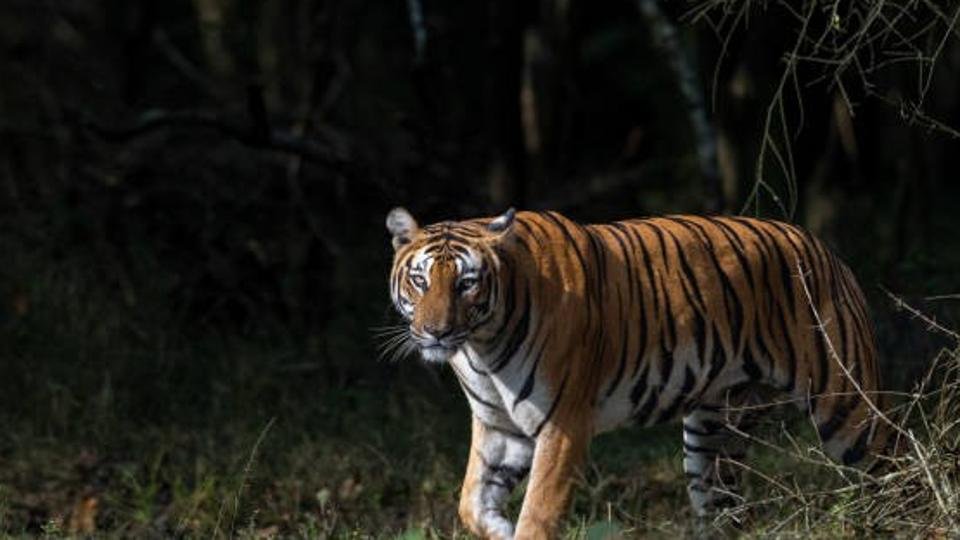
A three-year-old tigress relocated to West Bengal’s Buxa Tiger Reserve (BTR) from Bihar’s Valmiki Tiger Reserve has been tranquilised in Assam and is being transported back to Buxa. The operation was carried out on Tuesday after the animal travelled several kilometres into Assam in search of its own territory.
Forest department officials from West Bengal and Assam had been monitoring the tigress’s movements since she left Buxa on October 23. Her journey across the state border was recorded by trail cameras, prompting wildlife authorities to track her movements and assess the situation before deciding to bring her back.
Tigress tranquilised near Raimona National Park
The tigress was tranquilised near Rajendrapur village, outside Assam’s Raimona National Park, at around 5 pm on Tuesday. A Buxa Tiger Reserve officer confirmed the development at approximately 8 pm, saying the animal was being transported back to the reserve.
Officials had tracked the tigress after she entered Assam and crossed the Sankosh river. She subsequently travelled around 25–30 kilometres into Raimona National Park, apparently exploring the area in search of a territory of her own.
After locating her near Rajendrapur village, forest officials decided to tranquilise the animal and bring her back to Buxa. The operation involved coordination between the forest departments of West Bengal and Assam, along with the National Tiger Conservation Authority (NTCA).
How the tigress travelled from Bihar to Bengal and Assam
The tigress was originally brought to Buxa Tiger Reserve from Bihar’s Valmiki Tiger Reserve on October 2. The relocation was part of an effort to reintroduce tigers into Buxa, which had not recorded a resident tiger population until her arrival.
However, the animal left Buxa on October 23 and moved towards Assam. Trail cameras helped forest officials identify her movements and follow her route after she crossed into the neighbouring state.
After crossing the Sankosh river, she moved deeper into Raimona National Park. Her journey suggested that she was exploring the surrounding landscape to find a suitable area to establish her own territory.
Rather than immediately intervening, officials from both states and the NTCA closely monitored her movements. They allowed the tigress time to follow her natural instincts before ultimately deciding to capture and transport her back to Buxa.
Why the tigress was relocated to Buxa Tiger Reserve
The tigress’s relocation from Valmiki Tiger Reserve was significant for Buxa, a protected forest area in northern West Bengal. Although tigers had historically been found in the region, the reserve did not have a single tiger until her arrival in October.
The animal was transported from Bihar to West Bengal through a coordinated operation involving road and air travel. She was taken to Hasimara Air Force Base before being flown in an Indian Air Force C-130J Super Hercules aircraft. She was subsequently released in Buxa during National Wildlife Week.
The relocation was intended to support the return of tigers to the reserve. Her subsequent movement into Assam, however, presented forest officials with the challenge of managing a large carnivore moving across state boundaries.
Forest departments and NTCA monitored her movements
The forest departments of West Bengal and Assam worked alongside the National Tiger Conservation Authority to monitor the tigress after she left Buxa. Trail cameras and tracking efforts helped officials follow her journey and identify her location in Assam.
The decision to allow her to move naturally before intervening indicates that officials initially chose to monitor her behaviour rather than immediately capture her. Once she had travelled deep into Raimona National Park, authorities eventually decided to tranquilise her and return her to the reserve from which she had been relocated.
Such operations require coordination between wildlife authorities, particularly when an animal crosses administrative boundaries and moves through different protected forest areas.
Chief wildlife warden to decide when she will be released
Although the tigress is being brought back to Buxa, her immediate release into the reserve has not been scheduled. Forest officials said West Bengal’s chief wildlife warden will decide when she can be released again.
The decision will determine the next stage of the relocation effort following her movement into Assam. Officials have not announced a specific date or provided further details about the conditions under which the tigress will be released.
For now, the focus remains on safely transporting the animal back to Buxa and ensuring that the next steps are decided by the state’s wildlife authorities.
What happens next?
The tigress’s return marks another important stage in the effort to establish a tiger population in Buxa Tiger Reserve. Her movement into Assam demonstrated how a relocated animal can travel beyond the intended release area while exploring its surroundings.
Her next release will depend on the decision of the chief wildlife warden. Forest officials will also remain responsible for monitoring her movements after she returns to Buxa, as authorities continue their efforts to manage the relocation and support the reserve’s tiger population.
For breaking news and live news updates, like us on Facebook or follow us on Twitter and Instagram. Read more on Latest India on thefoxdaily.com.





COMMENTS 0