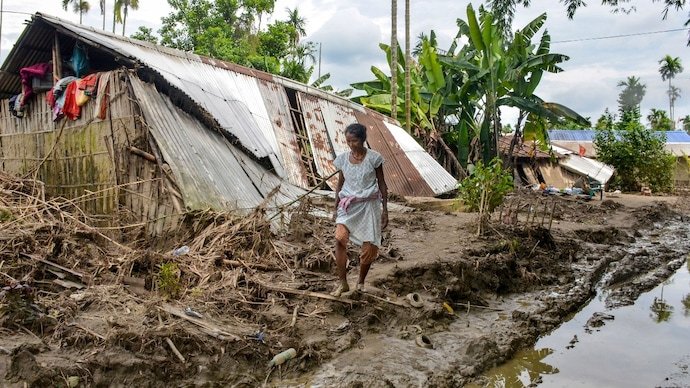
Assam‘s flood crisis continued to affect more than 1.55 lakh people on Saturday, even as floodwaters receded from some areas and the number of affected districts fell from 15 to 13. The death toll from this year’s Floods rose to 98 after one more person died in Charaideo district.
The state government is now shifting greater attention from immediate relief to assessing the scale of damage and planning permanent rehabilitation. A detailed door-to-door survey is scheduled to begin on August 9 across four of the worst-affected districts, with the government aiming to determine the financial requirement for rehabilitation by September 10.
More than 1.55 lakh people still affected by Assam floods
According to officials, 1,55,849 people remained affected by flooding across 13 districts on Saturday. Although the figure is still substantial, it represents a decline from more than 1.68 lakh people across 15 districts reported a day earlier.
The latest figures show that the flood situation remains serious in parts of eastern Assam, where several districts continue to report large numbers of affected residents.
Golaghat is currently the worst-affected district, with 58,750 people facing the impact of the floods. Sivasagar follows with 48,286 affected people, while Jorhat has 25,259 residents affected.
The other affected districts are Nagaon, Hojai, Sonitpur, Dhemaji, Darrang, Biswanath, Kamrup (Metropolitan), Lakhimpur, Udalguri and Charaideo.
The reduction in the overall number of affected people does not mean the crisis has ended. Thousands of residents remain displaced or dependent on government relief, while agricultural land and livestock have suffered significant losses.
Flood-related death toll rises to 98
The latest death was reported from the Mahmora revenue circle in Charaideo district. With the additional fatality, the flood-related death toll in Assam this year has reached 98.
The rising death toll underlines the human cost of the prolonged flooding. Flood emergencies can affect communities in multiple ways, from direct threats to life to the destruction of homes, crops, livestock and local Infrastructure.
For families already displaced by the water, the consequences can continue even after flood levels fall. Damaged homes may require rebuilding, farmland may need restoration and livestock losses can remove an important source of household income.
55 relief camps operating across the state
The state administration has established 55 Relief Camps for people displaced by the floods. More than 10,000 people are currently staying in these camps, according to officials.
Another 18 relief distribution centres are also operating to provide assistance to affected communities.
Relief camps play an important role during periods when residents cannot safely return home. However, the number of people requiring assistance is only one part of the challenge. Authorities also have to assess whether damaged houses, agricultural fields, roads and other local assets can be restored quickly enough for families to resume normal activities.
The government’s decision to begin a detailed damage assessment is therefore an important transition from Emergency Response to recovery planning.
Four eastern Assam districts to get detailed damage survey
Chief Minister Himanta Biswa Sarma has announced a door-to-door assessment in Jorhat, Sivasagar, Golaghat and Charaideo between August 9 and August 30.
These four districts have been selected for a detailed assessment because of the scale of the damage and the continuing impact of the floods in eastern Assam.
The survey is intended to establish the losses suffered by individual households rather than relying only on broad district-level estimates. Sarma said no affected household would be left out of the exercise.
The government also plans to verify the initial assessment with affected families. This verification process could help identify discrepancies and ensure that households affected by the flooding are included when rehabilitation assistance is calculated.
Government wants rehabilitation funds released faster
The damage assessment has a larger purpose than simply documenting losses. The state government wants to use the findings to calculate the funds required for permanent rehabilitation.
Sarma said the government expects to have an estimate of the required funds by September 10. Once that estimate is available, financial assistance for permanent rehabilitation can begin, subject to applicable government norms.
This timetable is significant because emergency relief and permanent rehabilitation address different problems. Relief provides immediate support while people are displaced or unable to meet basic needs. Rehabilitation is intended to help affected households recover from the longer-term damage caused by the disaster.
The government’s assurance that the maximum relief permissible under existing norms will be provided also places importance on the accuracy of the household-level survey.
Floods have damaged more than 10,700 hectares of crops
Agriculture is among the sectors bearing a major share of the flood’s economic impact. Officials said 10,748.64 hectares of crop area have been submerged.
Crop damage can have consequences that extend beyond the immediate period of flooding. Farmers WHO lose standing crops may face income losses while also having to spend money preparing land and purchasing inputs for the next cultivation cycle.
The impact is particularly important in rural areas where agricultural activity supports not only farmers but also agricultural labourers, traders and local businesses connected to the farm economy.
Flood recovery therefore cannot be measured only by how quickly water levels decline. The ability of affected households to return to agricultural activity will be an important part of the recovery process.
More than 47,000 animals affected
The floods have also affected Assam’s livestock population. More than 47,000 animals have been impacted, according to officials.
For many rural households, livestock represents both an economic asset and a source of Food or income. The loss or displacement of animals can therefore create an additional financial burden after a flood.
The livestock figures also demonstrate why flood rehabilitation needs to extend beyond housing assistance. Families may require support to restore the economic assets that allow them to rebuild their livelihoods.
Why the shift from relief to rehabilitation matters
The latest government response reflects two different stages of disaster management taking place at the same time.
The first is immediate relief. This includes sheltering displaced people in camps and providing essential assistance through relief distribution centres.
The second is recovery. That requires identifying damaged homes, agricultural losses and other household-level impacts, calculating the financial requirement and delivering assistance for rebuilding.
Assam’s latest figures show why both stages remain necessary. Although the number of affected people has fallen from the previous day’s level, more than 1.55 lakh people are still affected. At the same time, the government is already preparing for the longer recovery period.
What the latest flood figures tell us
The decline from more than 1.68 lakh affected people across 15 districts to 1,55,849 across 13 districts is a sign that the geographical spread of the flooding has reduced compared with the previous day.
But the figures also show that the remaining impact is concentrated heavily in a few districts. Golaghat, Sivasagar and Jorhat together account for a large share of the people currently affected.
This concentration could allow authorities to direct recovery resources toward areas facing the greatest immediate need. It also explains why the government has prioritised Jorhat, Sivasagar, Golaghat and Charaideo for the detailed assessment.
For residents, however, the critical measure will not simply be the number of districts classified as affected. What matters is whether families can safely return home, restore their livelihoods and receive assistance for losses that cannot be addressed through temporary relief alone.
What happens next in Assam’s flood response?
The next major phase begins on August 9, when teams are scheduled to start the door-to-door damage assessment in the four selected districts. The exercise is due to continue until August 30.
The government will then work toward establishing the total financial requirement for rehabilitation, with September 10 identified as the target for completing the estimate.
The effectiveness of this process will depend on whether the assessment captures the full range of losses experienced by affected households. Verification with families is intended to strengthen the process by allowing initial findings to be checked against residents’ accounts of the damage.
At the same time, relief operations will remain necessary for people who cannot yet return home. The 55 relief camps and 18 distribution centres will continue to be important as authorities manage the immediate consequences of the flooding.
Assam faces a long recovery after the waters recede
The latest flood figures suggest that the immediate situation has improved in some parts of Assam, but the state’s recovery challenge remains substantial. Ninety-eight people have died in the floods this year, more than 1.55 lakh people remain affected and thousands are still relying on relief arrangements.
The damage to 10,748.64 hectares of crop land and the impact on more than 47,000 animals add another layer to the recovery effort. For affected families, the end of flooding will be only the beginning of the process of rebuilding homes, restoring farms and recovering household incomes.
The government’s planned assessment in Jorhat, Sivasagar, Golaghat and Charaideo is therefore a key next step. If the exercise accurately identifies household-level losses and leads to timely financial assistance, it could help move the worst-affected communities from emergency relief toward permanent recovery.
For now, the priority remains clear: keep supporting those still affected, complete a credible assessment of losses and ensure that rehabilitation reaches every eligible household. The falling number of affected districts is encouraging, but with more than 1.55 lakh people still facing the consequences of the floods, Assam’s response is far from over.
For breaking news and live news updates, like us on Facebook or follow us on Twitter and Instagram. Read more on Latest India on thefoxdaily.com.






COMMENTS 0