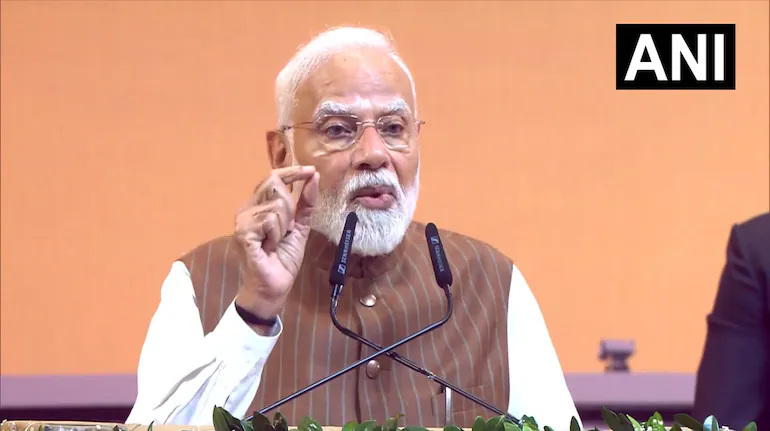
Prime Minister Narendra Modi has cited a World Bank poverty assessment to claim that around 50 crore people have moved out of poverty in India over the past 12 to 13 years, presenting the reported decline as evidence of the country’s changing economic trajectory. Addressing the platinum jubilee celebrations of IIT Kharagpur in West Bengal on Saturday, November 21, 2026, he contrasted his government’s approach with that of previous administrations, arguing that earlier efforts to eliminate poverty often remained limited to political promises and official paperwork.
Modi said India had demonstrated its ability to unlock its potential by changing its approach, expanding opportunities and overcoming what he described as limitations in thinking. He attributed the reported progress to policies and initiatives aimed at empowering poorer sections of society, while also highlighting the country’s growing technological ambitions.
The Prime Minister’s claim refers to a major finding in the World Bank’s October 2026 India Poverty and Equity Brief. The assessment estimates that approximately 496 million people moved above the World Bank’s lower-middle-income poverty threshold between 2011 and 2023. The figure is close to the 50 crore number cited by Modi, although the poverty measure and the period covered are important when interpreting the achievement.
What the World Bank Report Actually Says About Poverty in India
The World Bank’s October 2026 India Poverty and Equity Brief provides the statistical basis for the figure highlighted by Modi. It estimates that the proportion of India’s population living below the lower-middle-income poverty line of $4.20 per person per day, measured using 2021 purchasing power parity (PPP), declined from 57.7% in 2011 to 16.1% in 2023.
In absolute terms, the reduction represents approximately 496 million people moving above that poverty threshold over the 12-year period. This is the figure that Modi rounded to 50 crore in his remarks.
The report also records a substantial decline in extreme poverty. Using the international extreme-poverty threshold of $3 per person per day, the World Bank estimated that India’s extreme-poverty rate fell from 27.1% in 2011 to 2.6% in 2023. Around 35 million people remained below this extreme-poverty threshold.
These figures describe two different measures of poverty. The 496 million estimate refers to people moving above the lower-middle-income poverty line, while the decline in extreme poverty is measured against the lower $3-a-day threshold. Treating the entire 50 crore figure as a count of people escaping extreme poverty would therefore overlook an important distinction in the World Bank’s assessment.
The report’s findings nevertheless point to a major improvement in measured living standards over the period. They also provide a more detailed picture than a single headline figure, showing how poverty has changed across different income thresholds and population groups.
Modi Criticises Earlier Poverty-Reduction Efforts
While discussing the poverty figures, Modi contrasted the reported progress of recent years with the approach adopted by earlier governments. He referred to the slogan “Garibi Hatao”, which became closely associated with India’s political debate over poverty during the 1970s.
At a separate address to industry leaders at the Federation of Indian Chambers of Commerce and Industry’s centenary convention on November 19, the Prime Minister argued that earlier governments had shortcomings in both policy and intent. He said that Poverty Reduction had remained an unfulfilled objective despite the political prominence given to the issue.
Modi used the comparison to argue that policy implementation and government commitment were essential to achieving measurable results. He maintained that the reduction recorded by the World Bank reflected the impact of a different approach to economic development and welfare delivery.
His remarks form part of a broader political argument over how India’s poverty levels have changed and which policies contributed to that progress. The World Bank’s estimates provide evidence of the reduction in measured poverty, while questions about the relative contribution of individual government programmes, economic growth, employment and other factors require a wider assessment.
The Prime Minister also said that the achievement should be understood as evidence of India’s collective capacity to improve living conditions when opportunities are expanded and long-standing limitations are challenged.
Welfare Schemes and Access to Basic Services in Focus
Over the past decade, the government has expanded several welfare programmes aimed at improving access to housing, banking, healthcare, food security, sanitation and financial assistance. These initiatives have formed a central part of its argument that reducing poverty requires more than increasing household incomes alone.
Programmes such as Pradhan Mantri Jan Dhan Yojana have sought to bring more people into the formal banking system, while the Pradhan Mantri Awas Yojana has focused on providing housing support to eligible households. Other initiatives have targeted healthcare coverage, access to cooking fuel, sanitation facilities, drinking water and subsidised food.
These interventions can influence household living standards by reducing the amount families need to spend on essential services. Access to subsidised food, for example, can help protect household consumption, while improved housing and sanitation can address vulnerabilities that income measurements alone may not fully capture.
Direct benefit transfers and financial inclusion have also been presented by the government as ways to improve the delivery of welfare assistance and reduce gaps between beneficiaries and public support systems.
However, the existence of a welfare programme does not automatically establish how much it contributed to the overall decline in poverty. Assessing its impact requires examining coverage, implementation, the quality of services delivered and the extent to which benefits reach the intended households.
IIT Kharagpur Event Highlights India’s Technology Ambitions
Modi made his remarks during the platinum jubilee celebrations of IIT Kharagpur, which marked 75 years since the establishment of India’s first Indian Institute of Technology. Founded in 1951, the institution has played an important role in the country’s development of technical education, scientific research and engineering talent.
The Prime Minister used the occasion to encourage students to challenge what he described as limiting beliefs. He argued that individuals and nations often restrict their ambitions by accepting existing boundaries rather than exploring their full potential.
According to Modi, India’s progress over recent years demonstrates what can be achieved when the country changes its outlook and pursues opportunities that were previously considered difficult or beyond its capabilities.
He connected this argument with India’s expanding technological ambitions, particularly in the semiconductor industry. The Prime Minister recalled that the launch of the India Semiconductor Mission had attracted criticism from those who believed the country had entered the sector too late.
Modi said that India had since made progress in establishing semiconductor manufacturing capabilities and was moving towards a stronger position in the global technology supply chain. He presented the development as another example of the country challenging assumptions about what it could achieve.
Semiconductor Mission and India’s Push for Technological Self-Reliance
India’s semiconductor ambitions are part of a wider effort to reduce dependence on imported technology components and build domestic manufacturing capacity. Semiconductors are essential to a range of industries, including smartphones, automobiles, telecommunications equipment, computers, defence systems and industrial electronics.
The India Semiconductor Mission was introduced to encourage investment in semiconductor fabrication, display manufacturing and related supply-chain activities. The government has used financial incentives and policy support to attract companies into a sector that requires significant capital, specialised infrastructure, skilled workers and long-term technological investment.
Building a domestic semiconductor industry is a complex process. Manufacturing advanced chips requires reliable electricity and water supplies, specialised equipment, technical expertise and access to global suppliers. Establishing factories is only one part of the challenge; companies must also develop the workforce, research capabilities and supporting industries needed to sustain production.
Modi’s reference to the mission at IIT Kharagpur connected the country’s technology strategy with his wider message about changing India’s ambitions. The Prime Minister suggested that entering a sector late should not prevent the country from pursuing opportunities where it believes it can build long-term capabilities.
Why the Poverty Figures Matter for India’s Development Debate
The World Bank’s estimates are significant because poverty reduction is one of the key indicators used to assess whether economic growth is improving people’s living conditions. A falling poverty rate can indicate that more households have gained access to resources and consumption levels above a defined minimum threshold.
However, the number of people moving above a poverty line does not tell the entire story of economic security. Households that have crossed a poverty threshold may still face unstable employment, limited savings, high healthcare costs or vulnerability to inflation and economic shocks.
The distinction between extreme poverty and the broader lower-middle-income poverty line is particularly important for understanding India’s progress. Although the extreme-poverty rate fell sharply, the World Bank’s estimate that approximately 232 million people remained below the $4.20-a-day threshold in 2023 shows that a substantial section of the population continued to face economic hardship.
Future progress will therefore depend not only on helping households move above poverty thresholds but also on creating conditions that allow them to remain economically secure. Stable employment, better wages, access to quality education and healthcare, improved infrastructure and opportunities for small businesses will remain important parts of that effort.
The quality of economic growth also matters. If new opportunities are concentrated in a limited number of regions or sectors, the benefits may not reach all communities at the same pace. Rural households, informal workers and people with limited access to education or financial services can face different challenges from those experienced by urban and formally employed populations.
From Poverty Reduction to Long-Term Economic Opportunity
Modi’s message at IIT Kharagpur placed poverty reduction within a larger vision of India’s economic transformation. By citing the World Bank’s findings, he sought to demonstrate that the country had made substantial progress in improving living standards and could continue expanding its capabilities through policy changes and greater ambition.
The Prime Minister’s criticism of previous governments also brought the political debate over poverty back into focus. His argument was that promises alone were insufficient and that progress should be measured through outcomes that affect people’s lives.
The World Bank’s October assessment provides a statistical basis for the central claim that poverty declined significantly between 2011 and 2023. At the same time, its different poverty thresholds show why the headline figure needs context and why the remaining challenges should not be overlooked.
For India, the next stage of development will involve sustaining the gains already recorded while improving access to productive employment, education, healthcare and economic opportunities. The reduction in poverty represents an important change in the country’s development indicators, but ensuring that more households achieve lasting financial security remains a continuing challenge.
At the platinum jubilee celebrations, Modi urged students to think beyond existing limitations and contribute to India’s future. His remarks linked the reported poverty reduction with the country’s technological ambitions, presenting both as examples of what sustained effort and changing expectations could make possible.
For breaking news and live news updates, like us on Facebook or follow us on Twitter and Instagram. Read more on Latest India on thefoxdaily.com.






COMMENTS 0