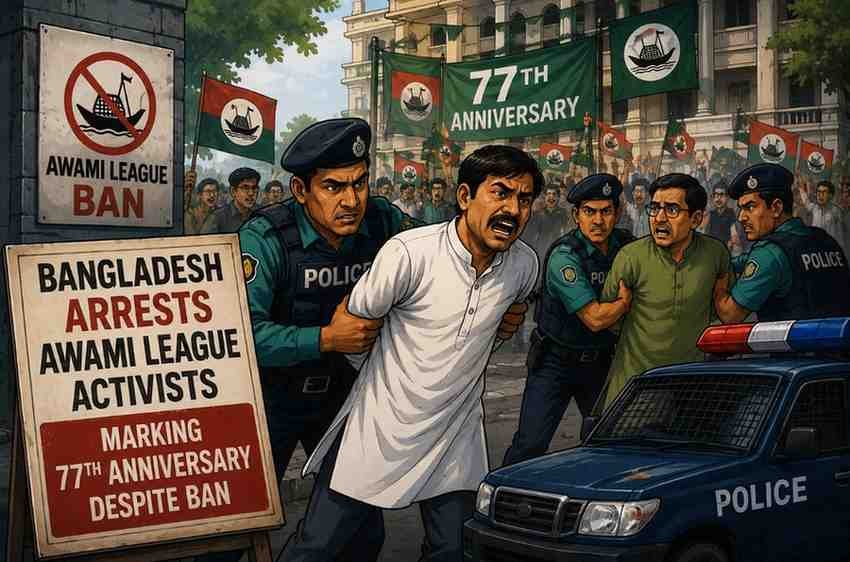
Bangladesh witnessed heightened political tension as authorities arrested dozens of activists linked to the banned Awami League during attempts to commemorate the party’s 77th founding anniversary. The crackdown unfolded under a nationwide security operation involving police, army personnel and Border Guard Bangladesh (BGB), reflecting the continuing political instability that has gripped the country since former Prime Minister Sheikh Hasina was removed from power in 2024.
The anniversary of Bangladesh’s oldest political party, once the dominant force in the country’s politics and the organization that led the 1971 Liberation War, became a test of the government’s determination to prevent any public resurgence of the Awami League. At the same time, it exposed the enduring support the party continues to enjoy among sections of the population despite its formal dissolution.
A Historic Party Facing an Unprecedented Ban
The Awami League was founded on June 23, 1949, during the era when Bangladesh was still East Pakistan. Over the decades, it became one of South Asia’s most influential political movements, spearheading Bangladesh’s struggle for independence in 1971 and later shaping much of the nation’s political landscape.
For many Bangladeshis, the party’s History is inseparable from the country’s own story of independence and state-building. However, the political environment changed dramatically following the mass Protests and unrest of 2024 that ultimately led to Sheikh Hasina’s ouster.
After the change in government, authorities moved to disband the Awami League, arguing that the organization’s activities had become incompatible with the country’s political transition. The decision fundamentally altered Bangladesh’s political structure and left millions of former supporters without formal political representation.
Why the Anniversary Became a Flashpoint
Political anniversaries often carry symbolic significance, but this year’s observance became particularly sensitive because it represented the first major attempt by Awami League supporters to publicly demonstrate their presence since the ban.
Party-linked Social Media accounts encouraged supporters to mark the occasion through:
- Digital discussion forums
- Online campaigns
- Poster drives
- Flag-hoisting events
- Street processions
- Public gatherings
Authorities viewed these plans as potential challenges to public order and responded with extensive preventive measures.
Security Forces Move to Prevent Public Mobilisation
The government launched a large-scale security operation ahead of the anniversary. Police, military personnel and Border Guard Bangladesh units were deployed across Dhaka and several strategically important districts.
The security deployment reflected official concerns that anniversary-related events could evolve into larger political demonstrations.
| Security Measure | Purpose |
|---|---|
| Army Deployment | Support civil administration and maintain order |
| Border Guard Bangladesh Deployment | Strengthen security in sensitive districts |
| Police Operations | Prevent rallies and unauthorized gatherings |
| Nationwide Alert | Monitor potential unrest linked to anniversary events |
Authorities stated that the deployments were precautionary measures intended to maintain stability and prevent any escalation of tensions.
Arrests Across Multiple Districts
Police reported arresting dozens of individuals allegedly connected to the banned organization. Security officials said the arrests targeted those attempting to organize or participate in processions and gatherings that violated restrictions.
While authorities described the actions as necessary law-enforcement measures, supporters of the former ruling party portrayed them as efforts to suppress political expression.
Videos circulated online appeared to show small groups carrying party flags and chanting slogans in several locations despite the restrictions.
The contrasting narratives underscore the polarized political climate currently prevailing in Bangladesh.
Sheikh Hasina Remains a Central Figure
Even while living outside Bangladesh, Sheikh Hasina continues to occupy a central place in the country’s political discourse.
Ahead of the anniversary, messages attributed to Hasina appeared on social media platforms used by Awami League supporters. These statements emphasized resilience and suggested that the movement intended to remain politically relevant despite the ban.
Her continued influence demonstrates the challenge facing authorities attempting to neutralize one of the country’s most established political networks.
For supporters, Hasina remains the symbol of the Awami League’s legacy. For opponents, she represents a political era they argue must remain in the past.
The Role of Social Media in a Restricted Political Environment
The anniversary highlighted how digital platforms have become increasingly important in Bangladesh’s political landscape.
With traditional avenues of political activity restricted, supporters relied heavily on social media to organize events, share videos and communicate messages.
Political movements around the world increasingly use digital tools when physical mobilization becomes difficult, and Bangladesh appears to be following a similar pattern.
This creates new challenges for governments seeking to regulate political activity while maintaining freedom of expression and public order.
Political Tensions Were Already Rising
The anniversary did not occur in isolation.
Political tensions had already intensified following reports of the deaths of two Awami League activists in separate incidents. These events generated local protests and further heightened emotions among supporters.
The government responded by strengthening security arrangements in several districts, particularly areas historically associated with strong Awami League support.
As a result, the anniversary became both a symbolic commemoration and a focal point for broader political grievances.
What the Crackdown Reveals About Bangladesh’s Political Landscape
The events surrounding the anniversary reveal several important realities about contemporary Bangladesh.
First, the Awami League’s organizational structure may have been dismantled, but its political influence has not disappeared entirely.
Second, the government remains concerned about the possibility of large-scale political mobilization linked to former ruling-party networks.
Third, political polarization remains one of the defining characteristics of Bangladesh’s post-2024 environment.
These factors suggest that political stability will continue to depend on how effectively authorities manage competing narratives about the country’s future.
The Economic and Governance Impact of Political Uncertainty
Political uncertainty often extends beyond politics itself.
Investors, businesses and international partners typically watch domestic political developments closely because prolonged instability can affect economic performance.
Key concerns include:
- Investor confidence
- Foreign direct investment flows
- Tourism growth
- Trade relationships
- Infrastructure development timelines
- Public-sector decision-making
Bangladesh has emerged as one of South Asia’s fastest-growing economies over the past decade. Maintaining that trajectory may require political stability alongside economic reforms.
How Bangladesh’s Situation Compares Globally
The banning of major political parties is relatively rare but not unprecedented in global politics.
History shows that when long-established political movements are removed from formal politics, outcomes vary widely depending on public support, institutional strength and the broader political environment.
Some banned movements gradually fade from influence. Others re-emerge through new political organizations, coalitions or grassroots networks.
The long-term trajectory of the Awami League’s political base remains uncertain, making Bangladesh an important case study in political transition and party realignment.
The Challenge of Balancing Security and Political Participation
One of the most difficult tasks facing any government during periods of political transition is balancing security concerns with democratic participation.
Authorities argue that restrictions are necessary to preserve public order and prevent unrest. Critics counter that excessive restrictions can deepen political divisions and reduce opportunities for peaceful political engagement.
Finding the right balance will likely remain one of the most significant Governance challenges facing Bangladesh in the coming years.
What Happens Next?
The immediate anniversary-related tensions may subside, but the underlying political questions remain unresolved.
Observers will be closely watching several developments:
- The government’s approach toward former Awami League supporters
- Future political mobilization efforts
- The role of digital activism
- Security policies in politically sensitive regions
- The broader evolution of Bangladesh’s political system
How these issues are managed could significantly influence the country’s political trajectory over the next several years.
Conclusion
The 77th anniversary of the Awami League became far more than a historical commemoration. It evolved into a powerful reminder of Bangladesh’s ongoing political transformation and the unresolved tensions that continue to shape the country after Sheikh Hasina’s removal from power.
Despite arrests, security deployments and restrictions, the anniversary demonstrated that the political legacy of the Awami League remains a significant factor in Bangladesh’s public life. At the same time, the government’s firm response highlighted its determination to prevent any organized resurgence of the banned party.
As Bangladesh moves forward, the challenge will be managing political differences while maintaining stability, economic growth and public confidence. The events surrounding this anniversary suggest that the debate over the country’s political future is far from settled.
For breaking news and live news updates, like us on Facebook or follow us on Twitter and Instagram. Read more on Latest World on thefoxdaily.com.





COMMENTS 0