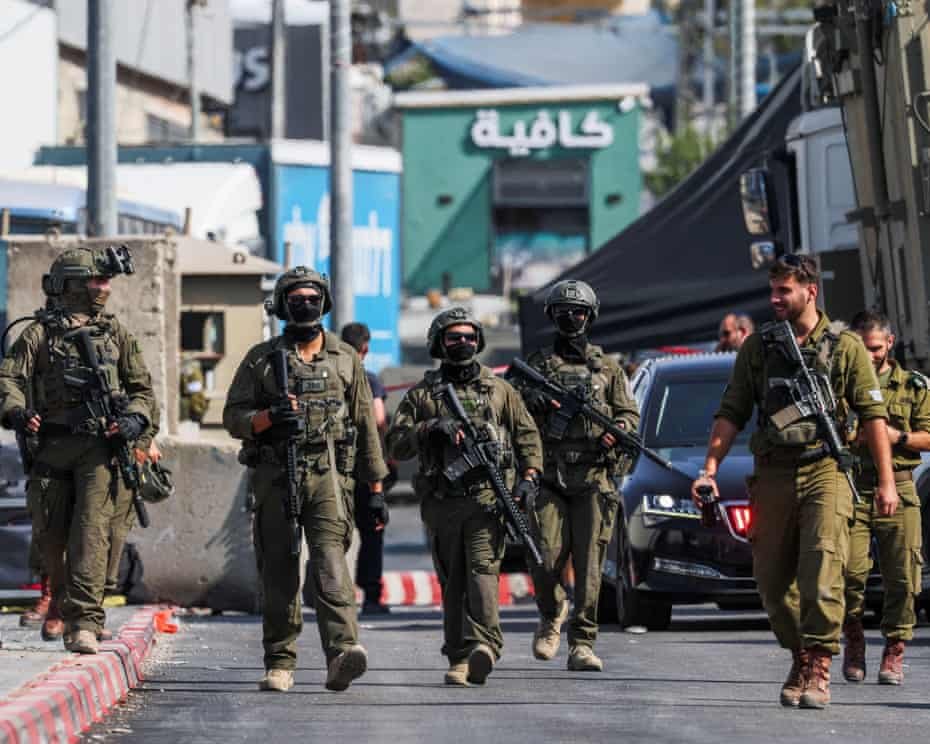
Israeli Prime Minister Benjamin Netanyahu has ordered the military to prepare for a “very extensive” operation in the occupied West Bank after two Israeli soldiers and two Palestinians were killed in an exchange of fire near a checkpoint outside Hebron. The announcement came after the Israeli military said it had thwarted an alleged attack by two armed Palestinians, prompting plans for tighter restrictions, house-to-house searches and the demolition of homes associated with the attackers.
Netanyahu said Israeli forces would enter the neighbourhood where the attackers lived, evacuate residents, seize weapons and destroy what he described as terrorist infrastructure. His government also instructed security forces to cordon off Hebron and prepare for a full closure of the West Bank.
The developments come amid escalating violence in the occupied territory, increased restrictions on Palestinian movement, growing settler attacks and heightened political tensions ahead of an election scheduled for Tuesday. Human rights advocates have warned that the latest incident could be used to justify further restrictions and military action against Palestinians.
What Happened Near Hebron? Two Israeli Soldiers and Two Palestinians Killed
The violence began near a temporary Israeli military checkpoint outside Hebron, where Israeli forces said two armed Palestinians opened fire on soldiers after failing to reach a nearby highway.
According to the Israel Defense Forces (IDF), the military believes the two men had intended to reach the highway to attack civilians. The alleged intended target was not reached, and the confrontation instead developed into a gunfight at the checkpoint.
A preliminary military investigation found that the exchange of fire lasted more than 20 minutes. Five Israelis were wounded, two of whom later died from their injuries. The two Palestinian men involved in the shooting were also killed, according to the report.
An Agence France-Presse (AFP) photographer who was travelling to another assignment witnessed the gun battle. The photographer saw two Palestinian men, armed with a handgun and an automatic rifle, exchanging fire with Israeli forces.
The Israeli military described the incident as an attempted “terror attack”. The available report does not independently establish the attackers’ intended target beyond the account attributed to the IDF.
Netanyahu Orders Major Military Operation in the Occupied West Bank
Following the shooting, Netanyahu convened an emergency meeting with his security cabinet and senior officials from Israel’s military and security agencies. His office subsequently said security forces had been instructed to immediately cordon off Hebron and prepare for a full closure of the West Bank starting Friday.
Netanyahu later visited Hebron and announced plans for a large-scale operation targeting the neighbourhood where the attackers lived. He said the military would evacuate residents, conduct searches from house to house, seize weapons and destroy infrastructure it considered connected to terrorism.
According to a statement from his office, Netanyahu said:
“We will evacuate the residents, we will go from house to house, we will also seize the weapons there, and all the terrorist infrastructure will be dealt with and destroyed.”
The planned operation could involve substantial disruption for Palestinians living in the targeted neighbourhood. Evacuations, house searches, demolitions and movement restrictions can affect residents who are not directly involved in an armed confrontation.
The report does not specify the exact geographical scope of the proposed operation, how many people might be ordered to leave their homes or how long the restrictions would remain in place.
Israel Plans West Bank Closure and Additional Movement Restrictions
Netanyahu’s office said security forces would prepare for a full closure of the West Bank following the Hebron shooting. The proposed measures come amid increasingly frequent restrictions on Palestinian movement throughout the occupied territory.
According to the report, Friday’s lockdown marked the fourth time in the preceding month that Israel had imposed restrictions across the West Bank.
These measures involve shutting gates and checkpoints that connect Palestinian villages to major roads. The report said the roads would remain open to Israeli drivers, including settlers, who could continue travelling through the area.
How Closures Affect Palestinian Communities
Checkpoints and road closures can make it harder for Palestinians to travel between communities and reach essential destinations. Restrictions may disrupt access to workplaces, schools, medical services, family members and commercial areas.
When movement restrictions are imposed across multiple locations, their effects can extend beyond the immediate area where an attack occurred. Residents may face longer journeys, uncertainty over which routes remain open and difficulties carrying out ordinary activities.
The reported differences in road access between Palestinian communities and Israeli drivers, including settlers, also highlight the unequal mobility conditions described in the source material.
The latest closure plans form part of a wider security response, but the report does not provide a complete list of checkpoints affected or a detailed timetable for the restrictions.
Netanyahu Accuses Hamas of Planning a Major Attack
Following the shooting, Netanyahu said Hamas was “planning a major attack aimed at murdering innocent civilians”. His remarks came during an emergency security meeting after the deaths of the two Israeli soldiers.
The report does not provide further evidence supporting this specific allegation or establish whether the two Palestinians involved in the Hebron shooting were acting under direct orders from Hamas.
Netanyahu’s announcement nevertheless signals that the Israeli government intends to respond to the incident with expanded military measures. The planned operation is expected to focus on the attackers’ neighbourhood and what Israeli authorities describe as terrorist infrastructure.
The distinction between the government’s allegations and independently established facts remains important. The report attributes the claim about a planned attack to Netanyahu and the Israeli military rather than presenting it as an independently verified finding.
Far-Right Finance Minister Calls for a Campaign Similar to Gaza
Bezalel Smotrich, Israel’s far-right finance minister, who also holds a position within the defence ministry, called for a military campaign in the West Bank on a scale similar to Israel’s operations in Gaza.
Smotrich argued that a comprehensive campaign was necessary to dismantle the Palestinian Authority, collect weapons and eliminate people he described as terrorists. He compared the proposed approach with Israeli military operations in Gaza and Lebanon.
“There is no other option but a comprehensive military campaign to dismantle the Palestinian Authority, collect weapons and eliminate terrorists. Exactly like in Gaza and Lebanon.”
Smotrich also said that the proposal should be among the first measures demanded and implemented by the next government.
His comments go beyond the immediate security operation announced after the Hebron shooting. While Netanyahu outlined plans for evacuations, searches, weapons seizures and demolitions in the attackers’ neighbourhood, Smotrich advocated a broader campaign directed at the Palestinian Authority as well.
The statements illustrate calls within Israel’s government for a more extensive military response in the occupied West Bank. The report does not establish whether Netanyahu has adopted Smotrich’s full proposal to dismantle the Palestinian Authority.
Operation Iron Wall and the Displacement of Palestinians
Netanyahu said the planned operation would follow a model previously used by Israeli forces in refugee camps in the northern West Bank.
One relevant precedent is Operation Iron Wall, a large-scale military operation launched in January 2025. According to the United Nations human rights office, the operation forcibly displaced tens of thousands of people from several refugee camps.
The reference to that operation provides context for concerns about the possible consequences of a new campaign involving evacuations, house-to-house searches and demolitions.
Concerns About Evacuations and Home Demolitions
Netanyahu said residents would be evacuated from the attackers’ neighbourhood and that the military would search homes and destroy what it considered terrorist infrastructure.
Such measures can have significant consequences for families, particularly when residents are displaced from their homes or when properties are demolished. The scale of the impact would depend on the number of homes affected, the duration of evacuations and the conditions under which residents are permitted to return.
The UN rights office’s account of displacement during Operation Iron Wall offers a precedent for understanding why the announcement has raised concerns. However, the number of people affected by the newly announced operation has not been established in the supplied report.
The planned campaign should therefore be distinguished from Operation Iron Wall itself. Netanyahu referred to the earlier operation as a model, but the report does not establish that the new operation will follow exactly the same course or produce the same outcome.
Human Rights Groups Warn Against Using the Attack to Justify Broader Measures
Human rights groups have warned that Netanyahu and his government could use the deaths of the Israeli soldiers to justify tougher measures against Palestinians and strengthen their security credentials before the election.
Yariv Oppenheimer, the former director of Peace Now, described the situation facing Palestinians in the West Bank as increasingly difficult. Speaking to Al Jazeera, he referred to Israeli military incursions into Palestinian cities and attacks by settlers.
Oppenheimer also warned that the latest incident could be followed by house demolitions, curfews, additional troop deployments and arrests. He raised concerns that settlers might use the attack as an opportunity to target Palestinians in retaliation.
These comments represent Oppenheimer’s assessment of the likely consequences of the announcement, rather than confirmation that every predicted measure or retaliatory attack will occur.
The broader concern is that a security response to a specific shooting could expand to affect communities well beyond the individuals accused of carrying it out. The extent of any future displacement, arrests or property destruction will depend on how the announced operation is implemented.
Settler Violence and Home Demolitions Intensify Tensions
The proposed operation comes against a backdrop of increasing Israeli settler activity, home demolitions and displacement in the occupied West Bank.
According to the report, Israeli settlers have increasingly taken over Palestinian properties, while authorities have stepped up the demolition of homes that lack building permits. These measures have displaced families and intensified tensions across the territory.
The campaign has intensified since the Gaza war began in October 2023, amid accelerating land seizures and settlement expansion across the occupied West Bank.
More than 1,100 Palestinians have been killed in the territory by Israeli forces or settlers, according to the report. It also notes a surge in settler violence during the annual olive harvest.
The reported killings and displacement provide important context for the concerns raised by human rights advocates. They also show that the latest shooting occurred within a wider pattern of violence and restrictions affecting Palestinian communities.
Attacks on Palestinian Villages During the Olive Harvest
The report described a series of recent attacks by Israeli settlers on Palestinian communities.
On the Friday before the Hebron incident, settlers attacked Palestinian villages, burning cars and trees and injuring a Washington Post photographer, according to the supplied account.
The following day, settlers attacked European diplomats, a French mayor and Palestinian olive pickers. Three people were injured, and a diplomatic vehicle was damaged.
The incidents have added to concerns about the safety of Palestinians and those documenting or observing events in the occupied West Bank.
The annual olive harvest is an important period for Palestinian agricultural communities. Attacks that injure harvesters or damage trees and vehicles can affect both personal safety and the ability of residents to carry out agricultural work.
The report does not provide further details about investigations into these incidents or whether arrests were made in connection with the reported attacks.
AFP Photographer Faces Conspiracy Claims After Documenting the Shooting
The Hebron shooting also triggered a separate controversy involving the AFP photographer who witnessed and documented the exchange of fire.
According to the report, prominent Israelis, including a candidate for the far-right Amcha Yisrael party, shared conspiracy theories accusing the photographer of having links to the gunmen. The report described these accusations as groundless.
The claims prompted a response from the Foreign Press Association (FPA), which said it was deeply alarmed by allegations that the photographer had been tipped off about the incident.
“He is a longtime professional who was on his way to another assignment and courageously documented what he saw in keeping with his professional duties,” the FPA said.
The association described the claims as “dangerous and defamatory”, defending the photographer’s account that he had been travelling to another assignment when he witnessed the shooting.
The controversy highlights the risks faced by journalists covering violence in the occupied West Bank, where their reporting may be challenged by allegations about their motives or connections.
The supplied report does not provide evidence supporting the claims against the photographer. The FPA, meanwhile, defended his professional conduct and said he was documenting an event he encountered while travelling to another assignment.
Photographer Heidi Levine Injured in Earlier Settler Attack
The dispute over the AFP photographer came a week after another journalist, Heidi Levine, was severely injured while documenting attacks on Palestinians attempting to harvest olives in the occupied West Bank.
The incident adds to concerns about the safety of journalists and photographers working in areas affected by settler violence and military operations.
The report also said Israel had denied entry to several European journalists and an academic, although it did not provide further details about the individuals affected or the reasons given for the decisions.
Together, the incidents raise questions about the conditions under which journalists can report on developments in the occupied territory. Independent documentation can be particularly important during periods of violence, when competing accounts of events may emerge.
West Bank Operation Comes Ahead of Israel’s Election
The planned military operation comes at a politically sensitive moment. Israeli voters are scheduled to go to the polls on Tuesday in an election that will help determine whether Netanyahu secures another term as prime minister.
The vote takes place three years after the Hamas-led attacks on Israel that triggered the war in Gaza, according to the report.
Security and the government’s handling of violence remain central to the political context surrounding the announcement. Netanyahu’s response to the Hebron shooting includes plans for a large-scale military operation, additional restrictions and action against the attackers’ neighbourhood.
Human rights advocates have argued that the government may use the incident to justify tougher measures and reinforce its security credentials ahead of the vote. That interpretation remains an assessment attributed to critics rather than an established explanation of the government’s motives.
Smotrich’s call for a campaign similar to operations in Gaza and Lebanon also introduces a wider political demand for a more extensive military response in the West Bank.
The report does not establish how the latest events will affect voting behaviour or the eventual election outcome. It does, however, place the proposed operation within a period of heightened political tension and continued violence.
What Happens Next in Hebron and the Occupied West Bank?
Netanyahu has ordered security forces to prepare for a major operation, including the evacuation of residents, house-to-house searches, weapons seizures and the destruction of infrastructure the military considers connected to terrorism.
His office has also instructed security forces to cordon off Hebron and prepare for a full closure of the West Bank. These measures could impose additional restrictions on movement in Palestinian communities, although the report does not specify the full scope or duration of the planned closure.
Several questions remain unresolved:
- Scope of the operation: The precise area to be targeted and the number of residents who could be evacuated have not been specified.
- Home demolitions: Netanyahu has announced plans to demolish homes and destroy infrastructure, but the number of properties affected remains unknown.
- Movement restrictions: The report does not provide a detailed timetable for the proposed West Bank closure or identify every checkpoint that will be affected.
- Risk of further violence: Human rights advocates have warned of possible retaliation by settlers, but the extent of any subsequent violence remains uncertain.
- Political consequences: The announcement comes ahead of Tuesday’s election, but the report does not establish its likely effect on the result.
The implementation of the announced measures will determine their immediate impact on residents and the wider security situation. The response also comes amid existing concerns over displacement, settlement expansion, settler violence and restrictions on Palestinian movement.
Frequently Asked Questions
Why has Netanyahu ordered a major operation in the West Bank?
Netanyahu ordered the military to prepare for a “very extensive” operation after two Israeli soldiers and two Palestinians were killed in an exchange of fire near a checkpoint outside Hebron. The Israeli military said the two Palestinian men had carried out an attempted attack and believed they had intended to target civilians near a highway.
How many people were killed in the Hebron shooting?
Four people were reported killed: two Israeli soldiers and two Palestinians. The preliminary Israeli military investigation said five Israelis were wounded, including the two soldiers who later died.
What measures has Netanyahu announced?
Netanyahu said Israeli forces would evacuate residents from the attackers’ neighbourhood, search homes, seize weapons and destroy infrastructure they considered connected to terrorism. His office also said security forces would cordon off Hebron and prepare for a full closure of the West Bank.
What is Operation Iron Wall?
Operation Iron Wall was a large-scale Israeli military operation launched in January 2025. According to the UN rights office, it forcibly displaced tens of thousands of people from several refugee camps in the northern West Bank. Netanyahu referred to the operation as a model for the newly announced campaign.
Why are human rights groups concerned about the planned operation?
Human rights advocates have warned that the operation could lead to further restrictions, home demolitions, curfews, arrests and displacement. They have also raised concerns that the attack could be used to justify broader measures against Palestinians and that settlers might target Palestinians in retaliation.
When is Israel’s election?
According to the report, Israeli voters are scheduled to go to the polls on Tuesday. The election will help determine whether Netanyahu secures another term as prime minister.
What happened to the AFP photographer who witnessed the shooting?
The photographer documented the exchange of fire after encountering it while travelling to another assignment. The Foreign Press Association condemned conspiracy claims accusing the photographer of links to the gunmen, describing the allegations as dangerous and defamatory.
Conclusion
Netanyahu has ordered preparations for a major military operation in the occupied West Bank after an exchange of fire near Hebron left two Israeli soldiers and two Palestinians dead. The announced response includes plans for evacuations, house-to-house searches, weapons seizures, home demolitions and wider movement restrictions.
The decision comes amid increasing settler violence, property demolitions, displacement and political tensions ahead of Israel’s election. Smotrich has called for a broader campaign similar to military operations in Gaza and Lebanon, while human rights advocates have warned that further measures could deepen the difficulties facing Palestinian communities.
The precise scale and duration of the planned operation remain unclear. Its implementation will be closely connected to the security situation around Hebron and the wider West Bank, where restrictions on movement, concerns about displacement and attacks on civilians and journalists have already intensified tensions.
For breaking news and live news updates, like us on Facebook or follow us on Twitter and Instagram. Read more on Latest World on thefoxdaily.com.



COMMENTS 0